Airline fuel hedging: why the 2027 cliff everyone fears could end up raising fares for good
Jet fuel doubled, but most European airlines had bought theirs in advance, so fares barely moved; the unhedged airlines cut flights instead, and when the hedges run out next April every airline pays the same price and fares reset for everyone.
The fuel that did not fall with oil
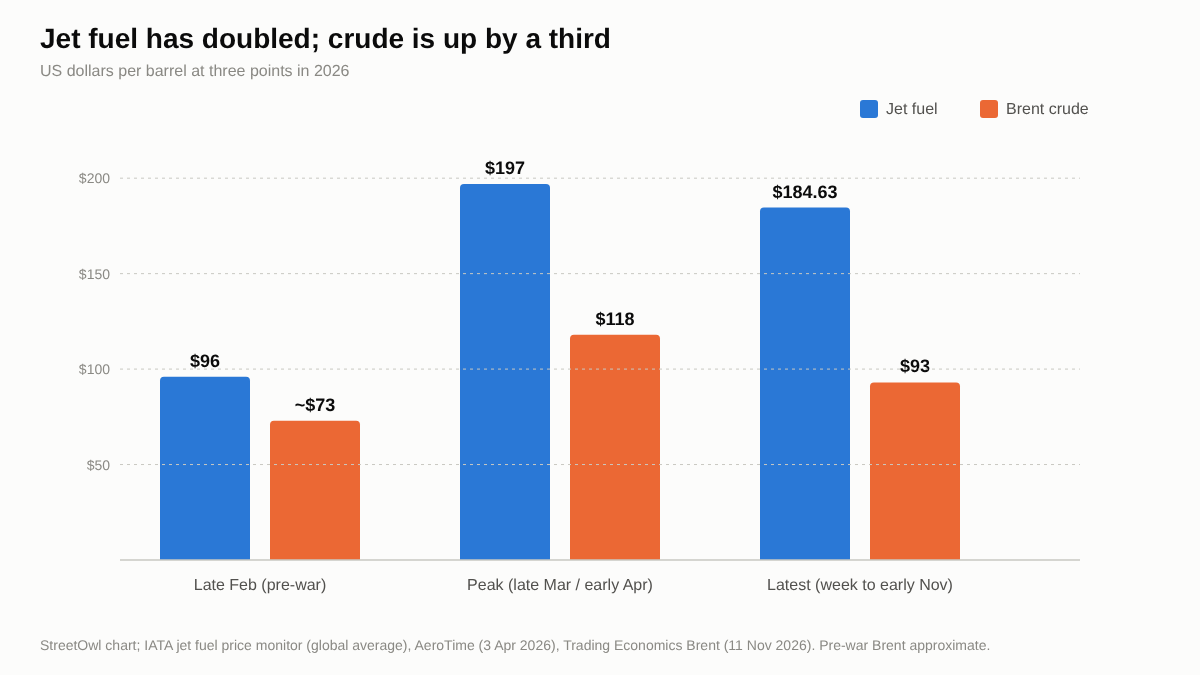
Brent crude has fallen to about $93 a barrel on hopes of a settlement in the Gulf, but jet fuel has not followed. The global average jet fuel price was $184.63 a barrel in the week to early November, according to IATA, down 6.7 per cent on the week but still double its level before the war began on 28 February. Crude is up by roughly a third since then; kerosene has doubled, because the Gulf refineries that supplied much of Europe's aviation fuel sit behind the closed Strait of Hormuz. Fuel is normally 20 to 35 per cent of an airline's costs, which makes this the largest input shock the industry has faced since 2008.
What has decided who pays is hedging: buying fuel months ahead at a fixed price. Going into 2026 the large European carriers had bought 60 to 93 per cent of this year's fuel at pre-war prices, in one case as low as $67 a barrel for the year to March 2027. The weakest had bought almost none: one Scandinavian airline started the year with nothing hedged, a Baltic one with 6 per cent, and the big American carriers abandoned hedging years ago.
Why fares did not rise in 2026
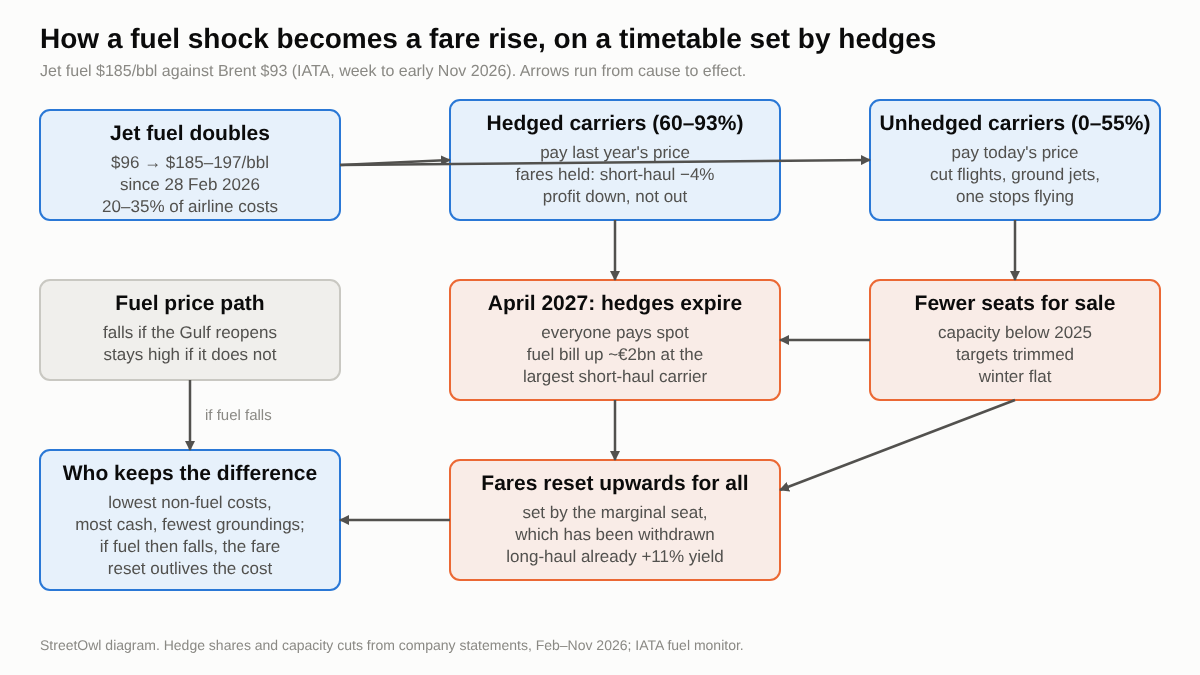
A hedge does not remove the shock; it turns it into a timetable. Through 2026 the hedged airlines paid last year's price and the unhedged paid this year's. Because most European seats were flown on cheap fuel, fares did not need to rise: the largest short-haul carrier's average fare actually fell 4 per cent in the six months to September, while its profit fell 15 per cent on a 15 per cent rise in its fuel bill. The unhedged did what the unhedged always do: one large American carrier took 5 per cent of its flights out, a US discount airline stopped flying on 2 May, the Scandinavian carrier cancelled around a thousand flights in April, and the biggest short-haul airline trimmed its passenger target from 216 million to 214 million. The largest British long-haul group now expects its full-year capacity to be below 2025.
From April 2027 the hedges roll off together. The largest short-haul carrier has only a quarter of next year's fuel covered, at $95 a barrel, and says its fuel bill rises by about €2 billion, so short-haul fares will rise 'materially' but not enough to cover it.
What happens when everyone pays the same price
Fares are set by the marginal seat, the last one an airline is prepared to sell, and the marginal seats are the ones being withdrawn by carriers that cannot pay the spot price. When every airline pays the same spot price, the fare resets for all of them, and the carriers with the lowest non-fuel costs, the most cash and the fewest grounded aircraft keep the difference. Long-haul has already got there: on the North Atlantic, revenue per seat rose 11 per cent in the third quarter even as operating profit fell. If the kerosene price then keeps falling with Brent, the fare reset outlives the cost that caused it.
For passengers the sequence runs the other way. The cheap fares of 2026 were paid for by hedges bought in 2025; the fares of summer 2027 will be set by whatever fuel costs next spring, and by how many seats are left after the weakest airlines have shrunk. Package-holiday customers booking now for next summer are, in effect, being sold a hedge by the airline, which is why several leisure carriers have promised no fuel surcharges on anything already on sale.
Sources
- IATA, Jet Fuel Price Monitor, week to early November 2026
- AeroTime, Airlines face a fuel hedging reckoning as Iran conflict reshapes flying costs, 3 Apr 2026
- ABC Money, Ryanair says fares will rise but not enough to cover fuel hit, 4 Nov 2026
- Yahoo Finance UK / Reuters, IAG revenue rises 5% but fuel costs squeeze quarterly profit, 6 Nov 2026
- Jet2 plc, No Fuel Surcharges guarantee for Winter 2026/27 and beyond, 23 Oct 2026
- Jet2 plc, AGM trading statement, 3 Sep 2026
- Wikipedia, 2026 Iran war fuel crisis, Nov 2026
- Trading Economics, Brent crude news, 9–11 Nov 2026
- Financial Times, European carriers' 2026 fuel hedging (as cited by AeroTime), Mar 2026
This piece was drafted by AI from the public sources named, then read and approved by Michael Rossi before it went up. It describes how one thing moves another; it names no investment and is not financial advice.
← Back to StreetOwl