A fund at 80p in the pound is an invitation to buy the whole fund
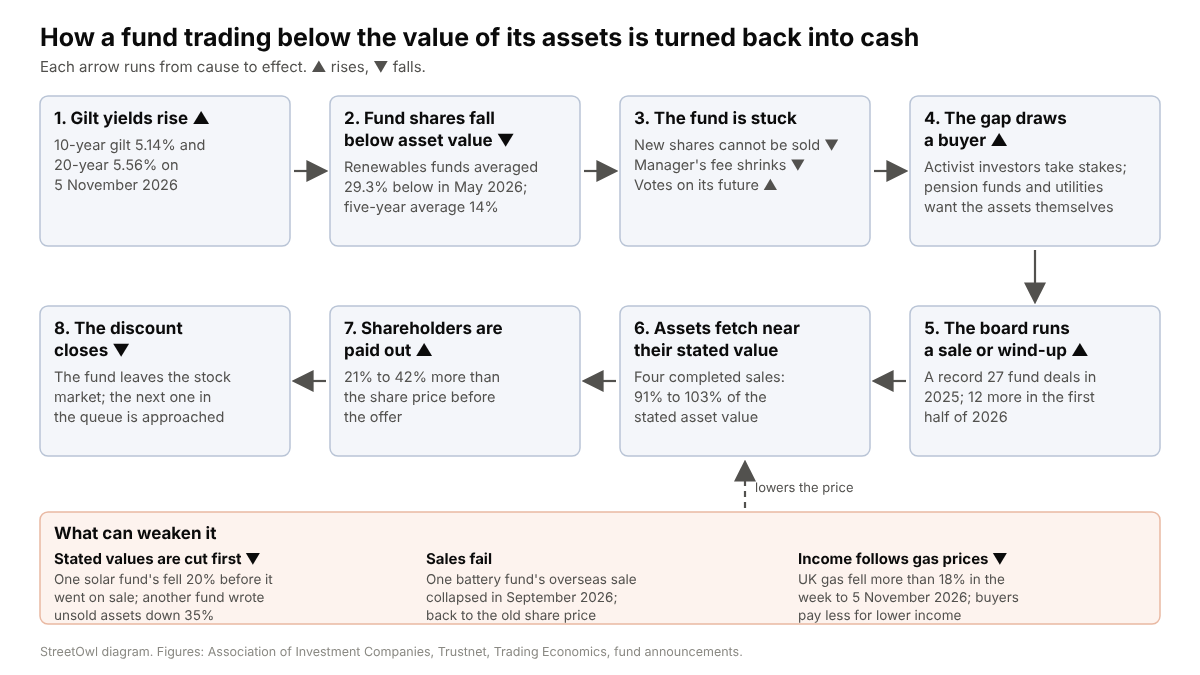
Gilt yields rise, so income investors pay less for the funds that own wind farms, solar parks and batteries, so the shares fall below the value of the assets, so someone who can buy the whole fund does, and the gap is closed by a sale.
Why the shares fall below the assets
An investment trust is a company on the London stock market whose only business is owning things: in this case wind farms, solar parks and grid batteries. Twice a year or more it publishes what those assets are worth, the net asset value, worked out from the cash they are expected to earn. The shares are a separate matter. They trade at whatever investors will pay.
People buy these funds for income, so they compare the dividend with what a government bond pays. On 5 November 2026 a 10-year gilt yielded 5.14 per cent and a 20-year gilt 5.56 per cent, about 0.7 of a point more than a year earlier. When a safe bond pays that much, buyers want a bigger yield from a wind farm, and the only way the share can offer one is to fall. At the end of May 2026 the shares of renewable energy funds stood on average 29.3 per cent below their asset values, against a five-year average of 14 per cent. In February the gap had been 34.2 per cent.
What a discount does to a fund
A fund whose shares trade below its assets is stuck. It cannot sell new shares to buy more wind farms, because selling at 75p something worth a pound takes money from the existing owners. Its manager's fee shrinks where, as at one of the largest wind funds, the fee is charged on the lower of the share value and the asset value. And its own rule book begins to fire: that fund must ask shareholders whether it should carry on in any year its shares average more than 10 per cent below asset value. It has held the vote two years running; in May 2026 97 per cent backed carrying on.
Boards respond by buying back shares. Investment trusts bought back a record £10.22 billion of their own shares in 2025, and a further £4.10 billion in the first half of 2026. That helps, but it does not remove the reason for the gap.
Who closes the gap
The gap is an opening for anyone able to buy the whole fund. A pension manager or a power company does not care what the shares fetch on a Tuesday. It wants the assets, and paying 95p for a pound of wind farm is a good deal for it and a better one for shareholders than the 75p the market offers. Activist investors make the introduction: they buy a few per cent of the shares, write to the board and ask for a sale.
The newest case took four months. On 30 June 2026 an activist holding about 7 per cent of a fund that owns 1,072 megawatts of batteries in Great Britain asked its board to prepare a sale. On 15 September the board answered that a sale would not be in shareholders' best interests. On 2 November it announced a formal sale process for all of its shares. The fund's stated asset value was 131.3p a share at 30 June; the shares were about 95p before the announcement and about 105.5p on 5 November.
What sales have fetched
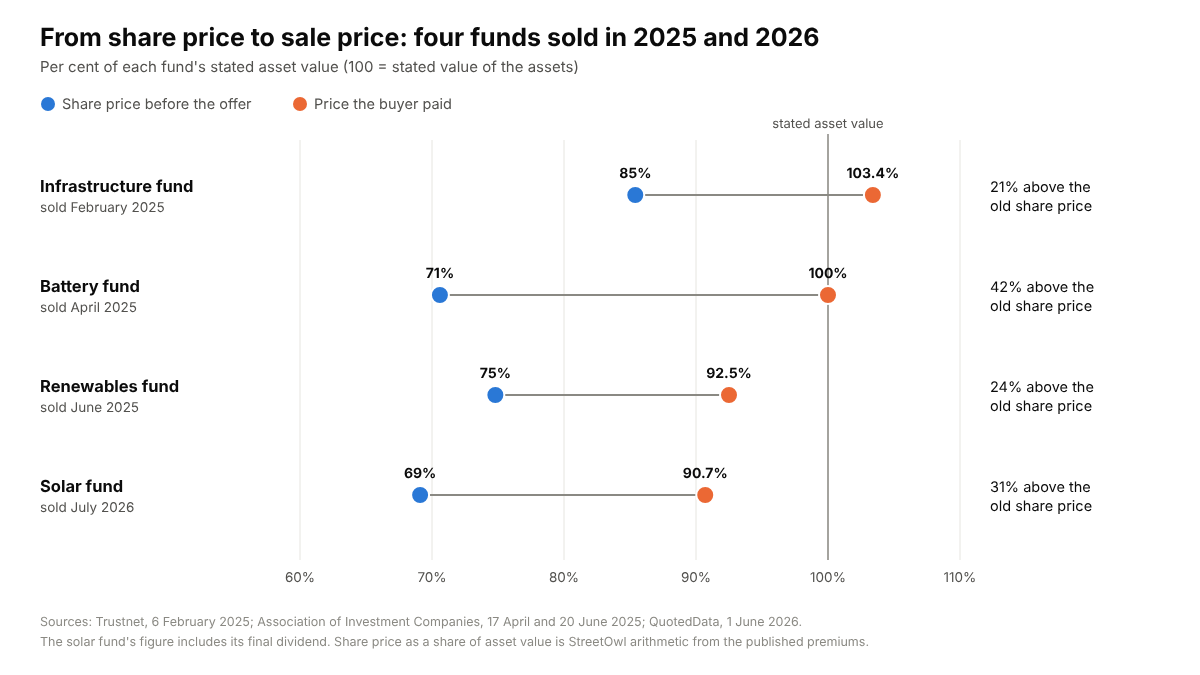
Four completed sales give the range. An infrastructure fund went to a Canadian pension manager in February 2025 at 103 per cent of its asset value, 21 per cent above the share price. A battery fund was sold in April 2025, after two bidders competed, at 100 per cent of asset value, 42 per cent above the share price. A renewables fund accepted 92.5 per cent in June 2025, 24 per cent above the share price. A solar fund's sale to a power company was completed on 31 July 2026 at about 91 per cent including its last dividend, 31 per cent above the share price.
It has become routine. 2025 saw a record 27 investment trusts merged, taken over or wound up; the first half of 2026 added 12.
What can go wrong, and who it matters to
Asset values are estimates, and they tend to be cut before a sale rather than after. One solar fund's fell by a fifth, from 95.1p to 76.1p a share, before it put itself up for sale in July 2026, and it has cut its dividend. Another fund, being wound up, wrote its unsold assets down by 35 per cent in April 2026. Sales also fail: a battery fund's sale of a German project collapsed in September 2026, and a solar fund paused the sale of its Australian parks because the bids could not be relied on. The battery fund now for sale counts 14.33p of its 131.3p from revaluing projects still being built, and its income per megawatt fell to £63,200 in the first half of 2026 from £75,100 a year earlier.
Batteries and wind farms earn more when gas is dear, and wholesale gas in Britain fell more than 18 per cent in the week to 5 November 2026 on hopes of an end to the war with Iran. A buyer pays less for lower income. The gap can also close without a sale: one wind fund's shares went from about 29 per cent below asset value in February 2026 to about 10 per cent below in early November, as gilt yields eased to a two-month low, the fund completed a £200 million share buyback and power prices rose.
It matters to more people than it sounds. These funds sit in many ISAs and self-invested pensions. When one is sold, its holders are paid in cash at a price well above the old share price, and the wind farm carries on turning for a new owner. What is lost is the listed fund itself: one fewer way for a small saver to own a piece of the country's power system.
Sources
- Trading Economics, UK government bond yields, 5 November 2026
- Trustnet, investment trust sector discounts against their own history, 22 June 2026
- Association of Investment Companies (Citywire), renewables funds in 2026, 11 February 2026
- Association of Investment Companies, investment trust review of the first half of 2026, July 2026
- IFA Magazine, investment trust review of 2025, January 2026
- London Stock Exchange regulatory news, a wind fund's annual meeting result and continuation rule, 20 May 2026
- Financial Conduct Authority National Storage Mechanism, a wind fund's half-year report, 30 July 2026
- QuotedData, a battery fund puts itself up for sale, 2 November 2026
- Financial Conduct Authority National Storage Mechanism, a battery fund's half-year results, 2 September 2026
- Trustnet, Canadian investor to acquire an infrastructure fund, 6 February 2025
- Association of Investment Companies (Citywire), battery fund bidding contest, 17 April 2025, and renewables fund offer, 20 June 2025
- QuotedData, solar fund accepts an offer, 1 June 2026; fund write-downs and sale processes, April to September 2026
- Trading Economics, UK natural gas, 5 November 2026
This piece was researched with AI from the public sources named and written up and checked by Michael Rossi before it went up. It describes how one thing moves another; it names no investment and is not financial advice.
← Back to StreetOwl