
Your monthly tech subscriptions add up to a real annual bill
Recurring charges feel trivial month to month, but stacked up they form a genuine annual outlay. And if they sit on a credit card, the interest compounds the cost well beyond the sticker price.
The monthly number that hides the annual one
A phone plan, cloud storage, a software licence and a streaming service each look like small, forgettable amounts when they hit the account once a month. Your brain anchors on that immediate figure rather than the larger sum it represents over the year. Recurring monthly charges are psychologically underweighted compared to their annual total, making a small subscription seem far less significant than the cumulative yearly cost. This flexibility only holds if you genuinely value the option to leave, and the calculation assumes you keep the service for a full twelve months rather than cancelling early.
Multiply a typical tech stack by twelve and the 'small' monthly outlay becomes a substantial annual commitment. For this article, the assumed annual tech bill is £600. This figure hides in plain sight because the monthly instalment slides past without demanding much attention. Yet, when you view the total as the real price you are deciding to pay, the scale of the commitment becomes clear. It is no longer a trivial daily expense, but a significant yearly outlay that requires deliberate budgeting.
Subscription traps and free trials that roll into recurring card payments you did not knowingly agree to are a recognised pattern. This means the list of charges can grow without the holder noticing, further distorting the true cost. The key reframe is to stop looking at the monthly number in isolation. By treating the annual total as the primary metric, you gain a clearer perspective on your spending habits. This shift helps you decide which services truly add value to your life, rather than just accepting them because the monthly deduction feels insignificant.
What the credit card adds to the picture
The representative APR on credit card purchases in October 2026 is 24.88%. For context, the average APR on a personal loan is 7.11%, meaning the card rate is several times higher. If you carry a balance, the interest you accrue dwarfs the interest you would earn leaving that same amount in an instant-access account at 2.08%. This asymmetry is the point: the cost of just paying by card and carrying the balance is not marginal when the rate is many times the savings rate.
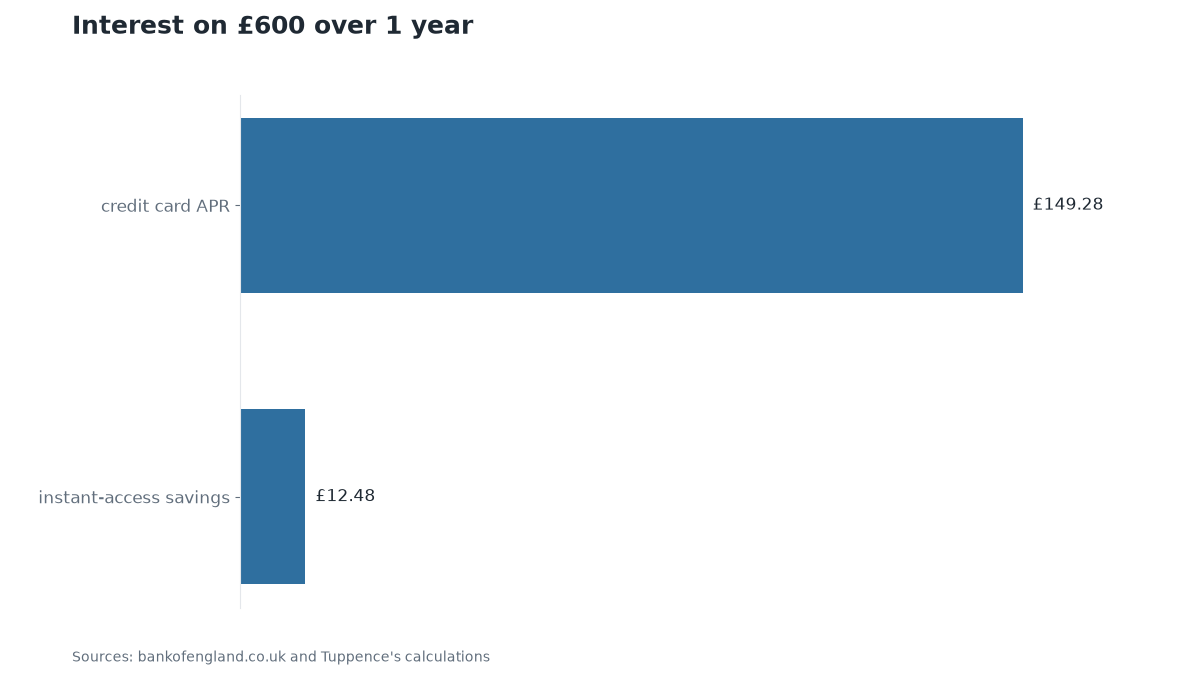
Consider the assumed annual tech bill of £600. If this sits on a credit card for one year at the 24.88% rate, the interest cost is £149.28 before tax. In contrast, keeping that £600 in a savings account at 2.08% yields only £12.48 before tax over the same period. The difference is £136.80. This gap illustrates why the net effect of paying a known bill in full is positive, provided you have the cash available. While rates change over time and the gap may shift, the current disparity makes carrying a balance a significantly more expensive option than using funds from a savings account.
The small price of paying cash
Paying a known annual bill from your current account means that money is not sitting in a savings account earning interest. For a household using the assumed amount to cover these subscriptions, the opportunity cost is modest. The instant-access savings account average rate is 2.08%, so the interest you forgo over a year is relatively small.
Set against the 24.88% representative APR on credit card purchases, this forgone savings interest is a tiny fraction of what you would pay in interest if you carried the balance. The practical takeaway is that the cost of paying cash is the interest you do not earn, while the saving is the interest you do not pay. In this pairing, the saving is far greater than the cost.
This does not mean savings are worthless, but it suggests that paying a known bill in full is usually the lower-cost option. This depends on whether you have the cash available and whether your card charges interest on the amount you carry. If you do not have the cash, you may need to borrow, which changes the calculation entirely.
What to do with your subscriptions
List every recurring tech charge from your recent statements and multiply each monthly figure by 12. This reveals the true annual outlay, helping you see the full cost clearly. Next, check which payments hit a credit card. Move these to a current account or a dedicated savings pot with a direct debit set up. This ensures no balance is carried forward, preventing interest from accumulating on your fees.
Set a calendar reminder to re-review this list half-yearly. Cancel any service you have not actively used recently and note any price rises. This regular habit helps catch forgotten subscriptions and unused services before they accumulate into a significant annual outlay. It also allows you to spot fee increases, giving you the chance to switch providers.
This approach helps most anyone paying multiple tech subscriptions on a credit card, or who has not reviewed their recurring charges recently. The benefit depends on your individual balance and whether your card charges interest. By keeping these payments off interest-bearing accounts, you avoid the compounding cost that turns small monthly bills into a much larger financial burden.
- annual tech bill: £600
- years: 1 years
- List every recurring charge on your recent bank or card statements and multiply each monthly amount by twelve to get the annual total
- Check which subscriptions are charged to a credit card and move them to a current account or set up a direct debit from a savings pot so no balance is carried
- Cancel any service you have not actively used recently
- Set a calendar reminder to re-review the full list half-yearly and note any price increases
- If a subscription is genuinely necessary, write the annual cost into your budget so it is a deliberate choice rather than an automatic one
Sources
- Scam avoidance database: Subscription traps and free trials, 2026-09-25 (StreetOwl scam avoidance database, via StreetOwl)
- What borrowing costs: Credit card, representative APR on purchases, Oct 2026 (Bank of England IUMCCTL, via StreetOwl)
- What borrowing costs: Personal loan of £10,000, APR, Oct 2026 (Bank of England IUMHPTL, via StreetOwl)
- What savings pay: Instant-access savings account (including introductory bonuses), Oct 2026 (Bank of England IUMB6VJ, via StreetOwl)
This digest was drafted by StreetOwl’s own model from published figures and the sources listed, then read and approved by Michael Rossi on 14 November 2026 before it went up. It is general information, not financial advice: your circumstances are yours, and for a decision that matters, MoneyHelper (free, government-backed) or a regulated adviser is the place to go. General information, not personal financial advice. Figures checked on the dates shown.
← Back to StreetOwl