
Why your pound stretches further in Thailand than Portugal
The euro exchange rate looks decent, but local prices tell a different story. StreetOwl's value score shows where your money really stretches on the ground.
What the value score actually measures
StreetOwl’s value score blends exchange rates with local price levels, because a favourable rate can be offset by high local costs. Thailand scores 86, rated Great value, while the Euro zone scores 68, rated Good value. This gap shows a real difference in what your money buys. The Thai baht exchange rate is 2.1% better than a year ago, though that is worse than in 70% of months since 1999. The euro is 2.8% better than a year ago, worse than in 57% of months since 1999. Remember that the exchange rate alone does not determine your holiday’s real cost. Local prices can offset a favourable rate, and a weak local currency does not make sure cheap holidays if the economy is tourism-driven.
What £100 really buys: Thailand vs the Euro zone
A basket costing £100 in the UK is about £32 in Thailand, but roughly £72 in typical Euro-zone destinations like Portugal or Spain. Even in Bulgaria, the cheapest Euro-zone country, the cost is about £50, still significantly higher than the Thai price.
The Euro’s 'Good' score reflects that local prices have risen despite the exchange rate being 2.8 per cent better than a year ago. In Thailand, the pound buys 6.2 per cent more in real terms, which drives the 'Great value' rating. While the Thai rate is 2.1 per cent better than last year, the key difference is the actual purchasing power you get on the ground.
Other great-value destinations to consider
Indonesia scores 92, with a £100 basket costing about £30. India follows with a score of 91, where the same basket is just £22. The Philippines also performs well, scoring 90 and costing about £34. These destinations all outperform Thailand on the score and cost less per basket.
Malaysia shares the same 68 score as the Euro zone, yet the local cost is £37 per £100, compared to £72 in typical Euro destinations. This shows that identical scores can mask very different price levels. Japan scores 73, rated Great value, but the local cost is £70 per £100, similar to a typical Euro destination. This illustrates that the score reflects both exchange rates and prices.
A lower value score does not mean a worse holiday. It reflects relative cost, not quality, safety, or experience. What you want from your trip matters as much as the price. Factors like travel time, visa requirements, and language barriers are not captured in the score, and infrastructure and healthcare standards differ between destinations.
Where your pound works hardest
Iceland offers poor value, scoring just 14. A basket costing £100 in the UK reaches about £147 there. Israel is similarly expensive, scoring 7 and costing about £127. Switzerland sits in the middle with a score of 45, where your money stretches to about £132. Norway scores 36, meaning £100 buys goods worth about £111 locally. Australia is also pricey, with a score of 27 and a local cost of about £109. Even Sweden, which earns a high score of 74, still costs about £92 for that £100 basket.
This gap highlights why Thailand remains a top choice. A week of daily spending in Iceland can cost nearly 4.4 times more on the ground than the same week in Thailand. That is before you have paid for flights. The difference is stark when you compare the local price levels. Your pound works much harder in these expensive destinations, reducing your purchasing power significantly. It is worth checking the value score before you book. This ensures your budget goes further. The exchange rate alone does not tell the whole story. Local prices are the key factor.
Worked example: seven days of ground spending
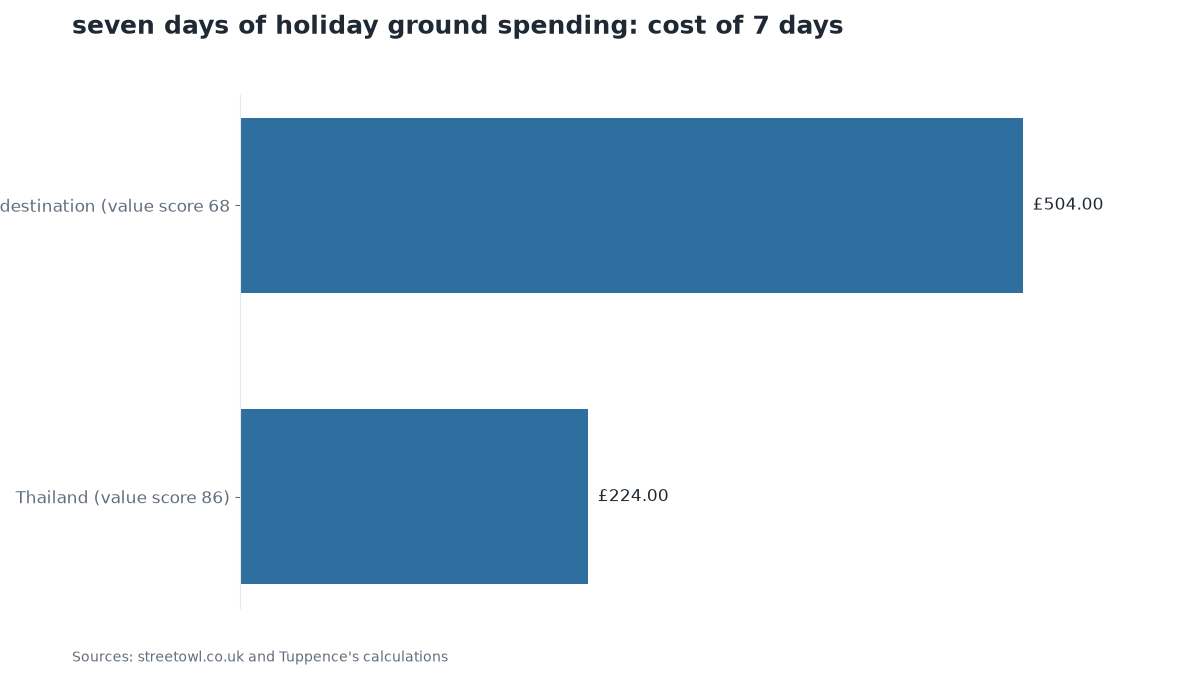
For a 7-day holiday, the ground-cost gap is clear. Thailand’s value score is 86, where £100 of UK spending costs about £32. A typical Euro destination has a lower score, with the same basket costing more. Over 7 days, this amounts to £224 in Thailand versus £504 in the Euro zone. The difference is £280, meaning the Euro destination is 125% more expensive for local costs.
This comparison covers ground spending only, such as food and transport, excluding accommodation and flights. Total trip cost includes airfare, and a long-haul flight to Southeast Asia can cost significantly more than a short-haul European flight. This means the ground-cost saving may be partly offset by airfare. Flight prices also vary by airline, season, and how far ahead you book, so you should factor these variables into your total budget before deciding where your pound works hardest.
What to do before you book
Check StreetOwl’s holiday value score and the £100 costs figure for your chosen destination, not just the headline exchange rate. Work out your likely total ground spend over the trip, including food, transport, and activities, then apply the local cost ratio to estimate your real on-the-ground budget. Add your flight cost separately and compare the all-in total across two or three destinations rather than looking at the ticket price alone. Recheck the score closer to your travel date, as exchange rates and the score can shift month to month. The figures here are as of 7 October 2026.
- holiday days: 7 days
- Look up the holiday value score and the '£100 costs' figure for your destination on StreetOwl's holiday-money page
- Note your expected total ground spend over the trip, then apply the local cost ratio to estimate your real budget
- Get flight quotes for two or three candidate destinations and add them to your ground-cost estimate
- Compare the all-in total, not the ticket price alone, before you commit
- Recheck the score and exchange rate a few weeks before you travel, as both can shift
Sources
This digest was drafted by StreetOwl’s own model from published figures and the sources listed, then read and approved by Michael Rossi on 8 October 2026 before it went up. It is general information, not financial advice: your circumstances are yours, and for a decision that matters, MoneyHelper (free, government-backed) or a regulated adviser is the place to go. General information, not personal financial advice. Figures checked on the dates shown.
← Back to StreetOwl