
Why your 85% LTV mortgage might cost you the 95% rate
A small arrangement fee or a lower revaluation can push you across a bracket boundary. Here's what the rate gap actually costs, and how to check before you commit.
How LTV brackets set your rate
Lenders price two-year fixed mortgages in discrete loan-to-value bands, not a smooth curve. Your rate depends on which band your balance falls into, and boundaries vary by lender. A small increase in your loan-to-value can push you into a higher bracket with a noticeably higher rate, though your exact price also depends on your credit profile.
In September 2026, advertised market averages were 5.01% at 60% loan-to-value, 5.13% at 75%, 5.26% at 85%, 5.37% at 90%, and 5.7% at 95%. These are weighted market averages, not individual offers. Every band has risen over the past year, with increases between 0.18 points and 0.98 points compared to September 2025. Because the gap between bands widens near the top, your position in a bracket matters as much as the headline rate.
The fee that quietly moves you up a band
At remortgage time, arrangement fees, a lower valuation, or your remaining balance can nudge your effective LTV up enough to cross a band boundary. This is a subtle trap because the shift is often small, yet it changes your pricing bracket. If you sit just below a boundary, fees plus a slightly lower valuation can add a couple of points, landing you in the next band up.
This is not a one-off cost. It is a higher rate applied to your entire balance for the whole fixed term. The impact depends heavily on how close you are to the boundary. Someone well below the line is less at risk, as the buffer absorbs these adjustments. However, if you are sitting right on the line, even minor changes in valuation or fees can push you over. The result is a permanent increase in your monthly payments until you remortgage again, making it crucial to check your position before committing.
The top-band gap is the one that hurts most
Lenders price the extra risk of a thin equity buffer more steeply, making the step into the highest band the largest. In September 2026, the advertised averages show this pattern. The moves between the lower bands are modest, with increases of just a few hundredths of a point. From 60% to 75% loan-to-value, the rate rises slightly. The jump from 75% to 85% is similarly small, and the step from 85% to 90% remains minor. However, crossing from 90% to 95% sees a much sharper rise. This wider gap reflects the higher risk lenders associate with having very little equity.
This disparity is evident across different terms. For a five-year fixed mortgage, the average rate at 75% loan-to-value is 4.98%. At 95% loan-to-value, the rate climbs to 5.54%. That is a total gap of 0.56 points between these two brackets. While your individual offer will differ based on your specific circumstances, the pattern of a larger penalty at the top end is consistent. These are market-wide advertised averages, so check your exact quote carefully to see if you are paying that premium for the highest band.
Worked example: what the bracket jump costs on a typical mortgage
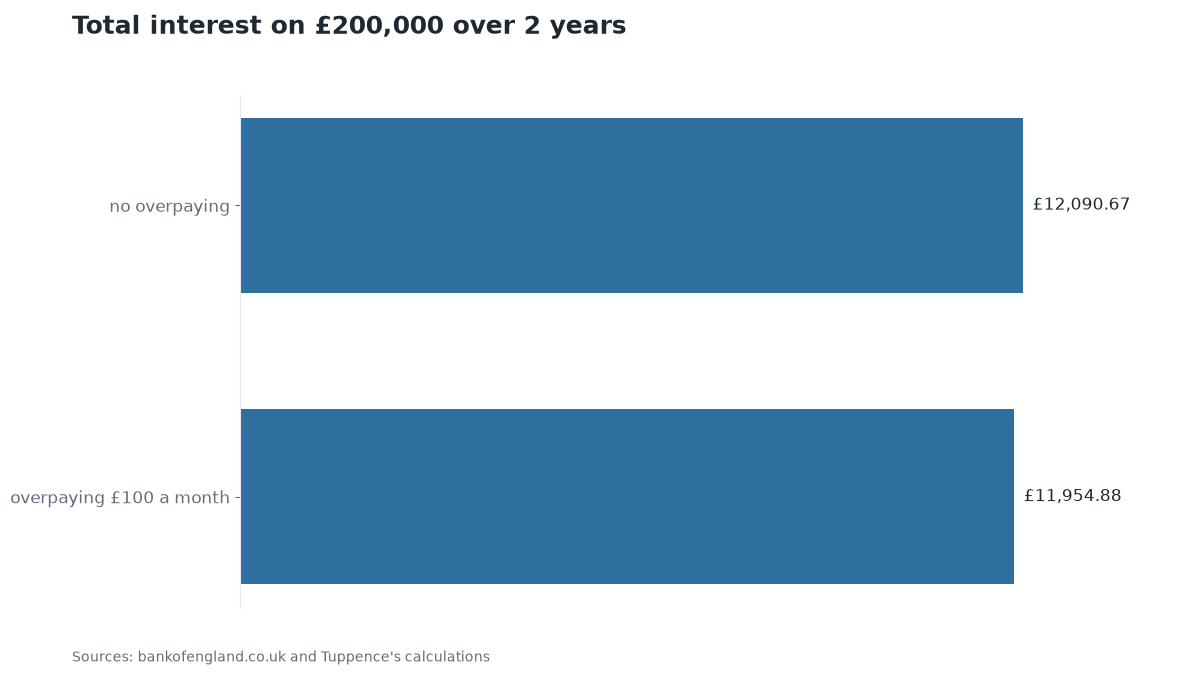
Take a hypothetical household with a £200,000 balance over a 2-year term. If you pay £100 a month in overpayments, the total interest drops to £11,954.88. That is £135.79 less than the £12,090.67 paid without overpayments, though the loan is cleared 0 months sooner. This extra interest is added to any arrangement or legal fees already paid over the full two-year term. If you fall onto the standard variable rate of 6.58% instead of remortgaging, the cost is even higher, which is why getting the bracket right matters.
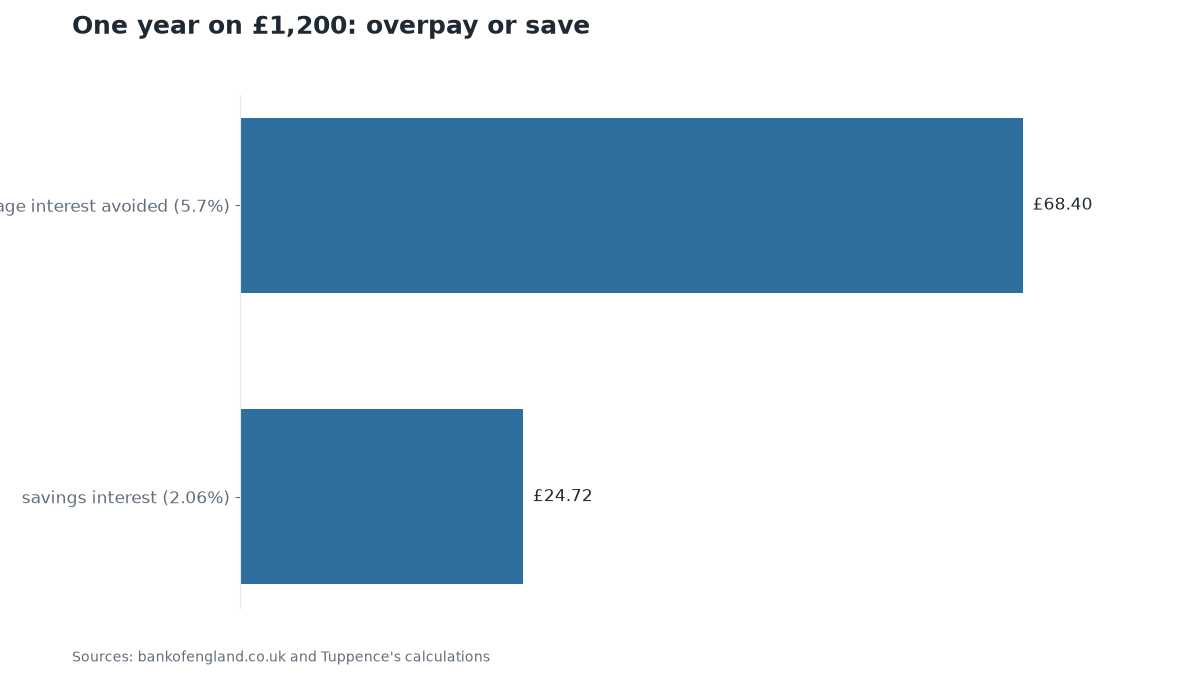
Consider the alternative: parking a year’s overpayments of £1,200 in a 2.06% instant-access account earns £24.72. Applying that sum to the mortgage at 5.7% avoids £68.40 in interest. The rates are 3.64 percentage points apart, meaning overpaying comes out £43.68 ahead before any tax.
What to do before you remortgage
Check your current balance against the property value to see which loan-to-value boundary is closest. You are not just comparing rates; you are positioning your effective LTV. Add up every fee the new deal will charge, including arrangement, valuation, and legal costs. Subtract these from your equity to find your true post-fee loan-to-value. This adjusted figure determines your band, not the balance alone.
Ask your broker for the rate at the adjacent band to see the exact step you would cross. If you are close to a boundary, consider overpaying a small lump sum before the switch to stay in the lower band. Alternatively, ask whether the lender will waive the valuation fee. This can keep your effective loan-to-value down without extra cash outlay.
If your property has changed since your last valuation, request a fresh one before committing. A lower revaluation can push you up a band unexpectedly. Ensuring the figure the lender uses is accurate protects you from a rate jump you did not anticipate. These checks are low-effort but can prevent a costly bracket shift.
- mortgage balance: £200,000
- remaining term: 2 years
- monthly overpayment: £100 a month
- Work out your true LTV by dividing your remaining balance (plus any fees the new deal charges) by the current property value, and note which band boundary you are closest to
- Ask your broker or lender for the advertised rate at both your current band and the next one up, so you can see the exact percentage-point step you would cross
- If you are close to a boundary, ask whether a small overpayment before the switch would keep you in the lower band, or whether the lender will waive the revaluation fee
- Request a fresh valuation before you sign, especially if the property has changed since your last one, so the figure the lender uses is not lower than you expect
- Compare the total two-year interest cost at the higher bracket rate against the lower one, so you are choosing on the real number rather than the headline rate
Sources
- What mortgages cost (advertised averages): 2-year fixed mortgage, 60% loan-to-value, Sep 2026 (Bank of England IUMZICQ, via StreetOwl)
- What mortgages cost (advertised averages): 2-year fixed mortgage, 75% loan-to-value, Sep 2026 (Bank of England IUMBV34, via StreetOwl)
- What mortgages cost (advertised averages): 2-year fixed mortgage, 85% loan-to-value, Sep 2026 (Bank of England IUMZICR, via StreetOwl)
- What mortgages cost (advertised averages): 2-year fixed mortgage, 90% loan-to-value, Sep 2026 (Bank of England IUMB482, via StreetOwl)
- What mortgages cost (advertised averages): 2-year fixed mortgage, 95% loan-to-value, Sep 2026 (Bank of England IUM2WTL, via StreetOwl)
- What mortgages cost (advertised averages): 5-year fixed mortgage, 75% loan-to-value, Sep 2026 (Bank of England IUMBV42, via StreetOwl)
- What mortgages cost (advertised averages): 5-year fixed mortgage, 95% loan-to-value, Sep 2026 (Bank of England IUM5WTL, via StreetOwl)
- What mortgages cost (advertised averages): Standard variable rate (the revert-to rate a fixed deal falls onto), Sep 2026 (Bank of England IUMTLMV, via StreetOwl)
- What savings pay: Instant-access savings account (including introductory bonuses), Sep 2026 (Bank of England IUMB6VJ, via StreetOwl)
- What savings pay: 2-year fixed-rate cash ISA, Sep 2026 (Bank of England IUMZID2, via StreetOwl)
- What savings pay: 1-year fixed-rate savings bond, Sep 2026 (Bank of England IUMWTFA, via StreetOwl)
- 2-year fixed mortgage, 85% loan-to-value (StreetOwl)
This digest was drafted by StreetOwl’s own model from published figures and the sources listed, then read and approved by Michael Rossi on 13 October 2026 before it went up. It is general information, not financial advice: your circumstances are yours, and for a decision that matters, MoneyHelper (free, government-backed) or a regulated adviser is the place to go. General information, not personal financial advice. Figures checked on the dates shown.
← Back to StreetOwl