Why a personal loan can beat your credit card on a big purchase
Spreading a purchase over months? The card in your wallet may cost you far more than a fixed-term loan. Here is the maths and what to check first.
The spread you are not seeing
The gap between your borrowing options is wider than it looks. The representative APR on credit card purchases is 24.71%, while the average personal loan APR is 11.52%. This makes the card rate more than double the loan rate. These are Bank of England advertised averages weighted by volume, not specific offers you will receive. The scale of borrowing is significant, with UK consumer credit growing at 9.8% a year and total credit-card balances reaching £84,091 million. Millions of people carry this kind of debt.
It is easy to assume the card is cheaper because it is already in your wallet. The first month may be interest-free, creating a false sense of security. However, the moment your balance rolls into the next statement, the card APR applies to the whole amount. You are paying for the entire period the money is borrowed, not just the time you held the item. This silent shift from a free month to a high-cost loan is the spread you are not seeing. Do not let the convenience of the plastic mask the true cost of carrying the balance forward.
When the credit card actually works for you
There is one scenario where the card genuinely costs you nothing. If you pay the full statement balance by the due date, no interest is charged at all. In this specific window, the advertised APR never applies to your transaction. This is the only time you can use the card for a purchase without incurring a fee, provided you clear the debt within that period.
If you would otherwise dip into an arranged overdraft, the credit card is the cheaper option. The average arranged overdraft rate is 34.52%, which exceeds the card purchase rate. Using the card in this instance avoids that higher cost, making it a sensible bridge for immediate cash needs when you plan to settle the balance quickly.
However, caution is required regarding transaction types. While standard purchases benefit from the grace period, cash advances and balance transfers are typically charged interest from the day of the transaction. There is no waiting period for these actions, so costs start accumulating immediately. Check your terms to ensure you are not accidentally moving funds in a way that bypasses the interest-free window.
The personal loan: a cheaper way to spread a purchase
A personal loan often presents a more affordable route for spreading a large purchase. The average APR for a £5,000 loan is 11.52%, while for a larger £10,000 loan, it drops to 6.98%. Both are well below the card rate mentioned earlier. These figures are market averages, not specific offers you will receive, but they illustrate that larger loans often carry lower rates.
The repayment structure matters as much as the rate. A personal loan provides a fixed monthly payment over a set term, so the total interest is known upfront. A credit card balance is revolving; if you make only the minimum payment, the balance persists and interest compounds on a larger base every month. Therefore, a fixed-term loan at a lower rate usually costs less in total interest than carrying the same amount on a revolving card, as the balance shrinks on a set schedule rather than persisting under minimum payments.
Before committing, check for arrangement or broker fees, as these can narrow the saving. Confirm there are no early-repayment charges, especially if you may want to clear the loan ahead of schedule. Finally, ensure the fixed monthly payment fits your budget for the entire term before the first payment is due.
Worked example: overpay the card or keep the cash earning
Suppose you have a £5,000 balance at the 24.71% representative APR. You can overpay £100 monthly or keep that cash in a 3-year fixed bond earning 4.56%. This is a genuine trade-off: overpaying clears debt faster but locks up cash that could earn interest. The right choice depends on your upcoming bills.
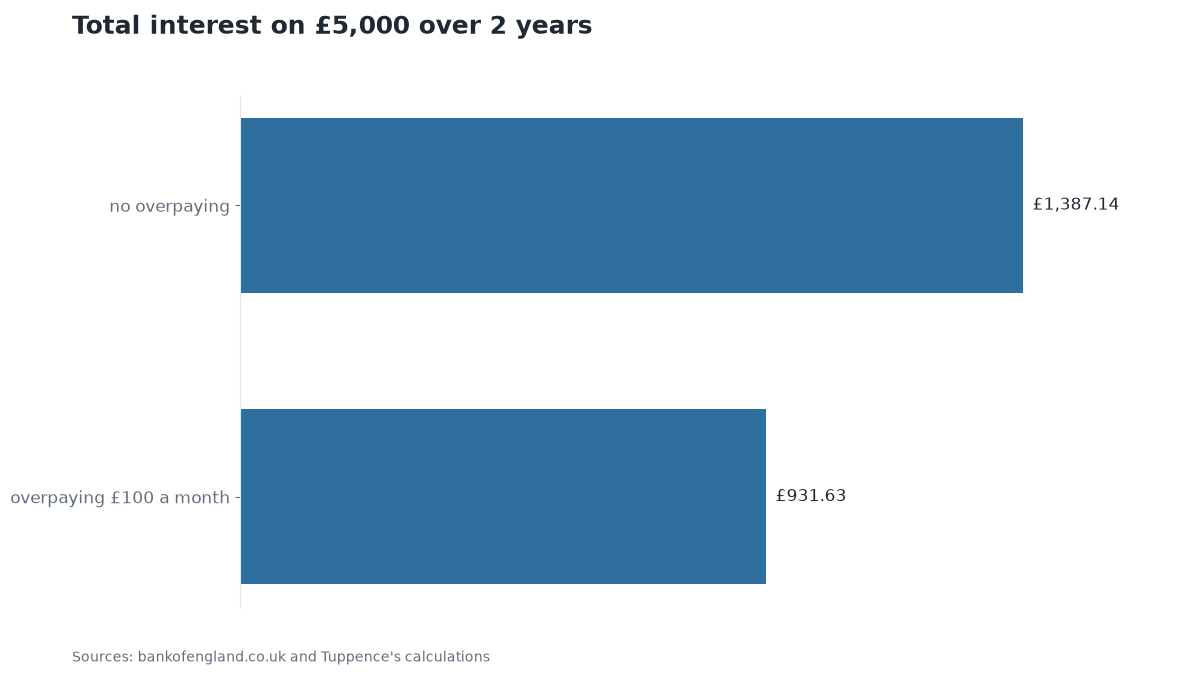
You do not need to calculate this yourself. The standard repayment is £266.13 a month, with total interest of £1,387.14. Overpaying £100 monthly reduces total interest to £931.63, saving £455.51 and clearing the loan 7 months sooner.
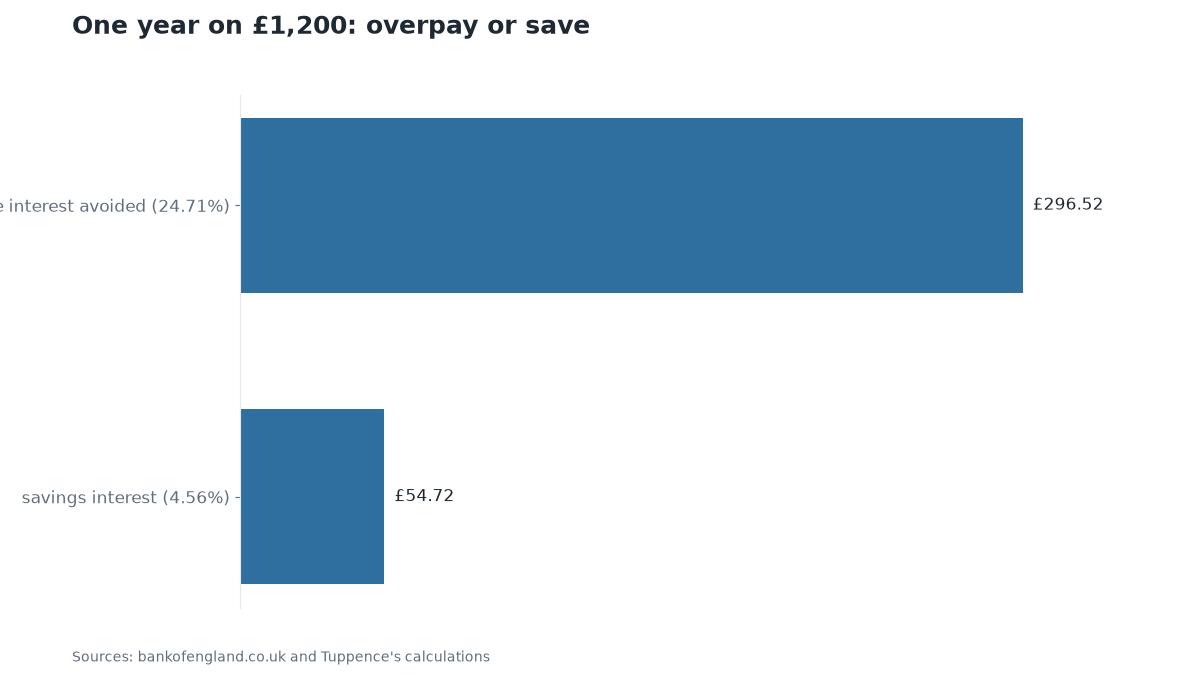
Consider the cash you would have kept. On £1,200 for one year, you avoid £296.52 in interest costs but only earn £54.72 in savings, before tax. The rates are 20.15 percentage points apart. Overpaying comes out £241.80 ahead.
What to do before you swipe
First, decide if you will pay the full balance by the due date. If yes, the card is fine. If not, get a personal-loan quote for the exact amount and term, comparing total interest against the card’s minimum-payment schedule. Before signing, check the loan’s arrangement fee and any early-repayment charge.
Next, consider moving spare cash from an instant-access account earning 2.06% into a higher-rate product, such as a 3-year fixed bond at 4.56%. Holding cash in a higher-rate account can reduce the net cost of debt, as the interest earned offsets some of the interest paid. Note that fixed-term accounts lock money away for the bond period and may charge an early-withdrawal penalty. This approach helps most if you are making a one-off purchase of roughly £5,000 to £10,000 and plan to spread payments over three months or more, rather than relying on the credit card’s minimum-payment route.
- card balance: £5,000
- repayment period: 2 years
- monthly overpayment: £100 a month
- Decide whether you can pay the full card balance by the statement due date; if you can, the card costs you nothing and you can skip the rest
- If you need to spread the payment, get a personal-loan quote for the exact amount and term and write down the total interest and any arrangement fee
- Compare the loan's total cost against the credit card's minimum-payment schedule over the same number of months before you commit
- Check the loan agreement for early-repayment charges and confirm the fixed monthly payment fits your budget for the full term
- Move any spare cash out of an instant-access account and into a higher-rate account so the interest you earn offsets some of the interest you pay
Sources
- What borrowing costs: Credit card, representative APR on purchases, Sep 2026 (Bank of England IUMCCTL, via StreetOwl)
- What borrowing costs: Personal loan of £5,000, APR, Sep 2026 (Bank of England IUMBX67, via StreetOwl)
- What borrowing costs: Personal loan of £10,000, APR, Sep 2026 (Bank of England IUMHPTL, via StreetOwl)
- What borrowing costs: Arranged overdraft, interest rate, Sep 2026 (Bank of England IUMODTL, via StreetOwl)
- What savings pay: Instant-access savings account (including introductory bonuses), Sep 2026 (Bank of England IUMB6VJ, via StreetOwl)
- What savings pay: 3-year fixed-rate savings bond, Sep 2026 (Bank of England IUMB6RI, via StreetOwl)
- Borrowing and saving, as it happened: Consumer credit, annual growth rate, Sep 2026 (Bank of England LPMB4TC, via StreetOwl)
- Borrowing and saving, as it happened: Credit card balances outstanding, Sep 2026 (Bank of England LPMVZRE, via StreetOwl)
- 2-year fixed mortgage, 60% loan-to-value (StreetOwl)
- 2-year fixed mortgage, 75% loan-to-value (StreetOwl)
- 2-year fixed mortgage, 85% loan-to-value (StreetOwl)
This digest was drafted by StreetOwl’s own model from published figures and the sources listed, then read and approved by Michael Rossi on 6 November 2026 before it went up. It is general information, not financial advice: your circumstances are yours, and for a decision that matters, MoneyHelper (free, government-backed) or a regulated adviser is the place to go. General information, not personal financial advice. Figures checked on the dates shown.
← Back to StreetOwl