Why a half-tank top-up quietly costs you more than a full tank
The small, frequent fuel stop looks convenient, but the detour to the forecourt burns petrol you never use. A full tank at the median pump price usually works out cheaper per mile.
The hidden cost of a quick top-up
A quick top-up feels like a minor convenience, but it often means driving out of your way to reach the pump. That detour burns fuel that does not count toward the miles you plan to travel later. You are effectively paying for a short trip just to buy petrol for a longer one, which raises your true cost per useful mile compared with filling a full tank at the same location.
The national median E10 petrol price stood at 174.9p a litre on 5 October 2026. This figure represents the median of 8,079 forecourts, meaning half are cheaper and half are dearer. While this price point gives you a useful benchmark, your local station may be different. The key issue is not the pump price itself, but the extra distance you drive to get there.
Every time you choose a partial fill, you add another layer of wasted kilometres. The more frequently you stop for a few litres, the more dead mileage accumulates over a week. This hidden cost is small in isolation but adds up quickly. If your forecourt is not on your normal route, that extra driving becomes a significant drag on your fuel economy, making the convenient top-up less efficient than a single, full-tank visit.
Worked example: what a partial fill costs against a full tank
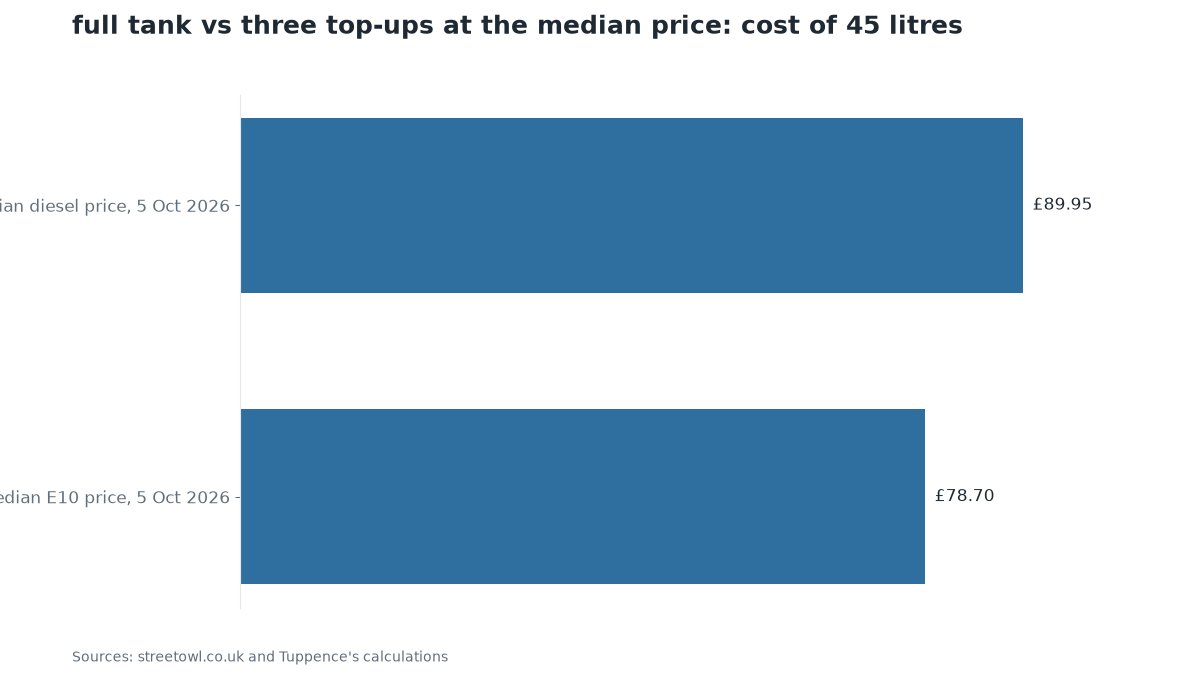
Let us work through a specific example. For a household using a 45 litre tank and a car that uses 6.0 litres per 100 km, the maths is clear. Buying a full tank of 45 litres at the national median E10 price of 174.9p a litre costs £78.70. This assumes the forecourt is 3 km away, creating a 6 km round trip.
Compare this with buying the same 45 litres in three separate top-ups. Each visit requires a 3 km one-way detour, creating 18 km of dead mileage in total. That extra driving burns fuel which does not cover the distance you intended to travel. You are paying for fuel you never use for your intended journey, adding a small but real cost to your total bill.
Diesel drivers face a steeper penalty. At the national median diesel price of 199.9p a litre, the same 45 litres costs £89.95. The difference between the two fuel types is £11.25, meaning diesel costs 14.29% more than petrol. This higher per-litre price makes the dead mileage from frequent top-ups even more significant.
When a top-up still makes sense
If a forecourt is on your normal route, the dead mileage is zero or near zero. In that scenario, the top-up penalty disappears, and you pay only for the litres you buy. This makes a quick stop financially neutral compared with filling a full tank at the same location.
You should also consider your vehicle’s capacity and immediate budget. For a car with a small tank, filling to the brim might feel excessive if you are only driving short distances this week. A top-up allows you to manage cash flow more tightly. Remember that the national median is just a benchmark. Your local forecourt may be cheaper or dearer than the national average, so a top-up at a nearby cheap pump can be a smart move regardless of tank size.
Diesel drivers face a different calculation. The national median diesel price is 199.9p a litre. Because this is higher than the petrol median, the cost of any unnecessary detour is more expensive per litre. If you drive a diesel car, avoid top-ups that require a detour. The higher fuel price means the wasted mileage costs you more in absolute terms than it would for a petrol driver, making direct-route top-ups even more critical for saving money.
How to fill your tank without wasting money
Choose a forecourt on your regular commute or errand route so the detour is minimal. Before pulling in, compare local prices with the national median figure mentioned earlier. While this serves as a useful benchmark, your local station may be cheaper or dearer, so verifying the specific price protects your budget.
If you need to top up partway through the week, do it once rather than several times. Multiple short stops multiply the dead mileage, burning fuel that does not cover your intended journey. Consolidating these visits reduces the unnecessary detours and the extra fuel wasted on getting to the pump.
Fill your tank when you are already at the forecourt for another reason. This ensures the top-up costs only the litres you buy, with no extra driving required. Finally, check your car's actual fuel consumption using the fuel computer or owner's manual. The cost of dead mileage scales with how thirsty your vehicle is, so knowing your precise consumption helps you understand exactly how much extra fuel a detour burns.
- fuel bought in each scenario: 45 litres
- fuel tank size: 45 litres
- fuel consumption: 6 litres per 100 km
- one-way distance to forecourt: 3 kilometres
- Look at your car's fuel gauge and note how many litres you usually buy on a top-up
- Work out the one-way distance to the forecourt you use and multiply by two for the round trip
- Multiply that round-trip distance by your car's litres-per-100-km figure to find the dead mileage in litres
- Multiply the dead-mileage litres by the current median price of 174.9p per litre to see the extra cost per top-up
- Do the same calculation for a full-tank fill and compare the two totals
- If the top-up is more expensive, plan your fill so the forecourt is on your normal route
Sources
This digest was drafted by StreetOwl’s own model from published figures and the sources listed, then read and approved by Michael Rossi on 6 October 2026 before it went up. It is general information, not financial advice: your circumstances are yours, and for a decision that matters, MoneyHelper (free, government-backed) or a regulated adviser is the place to go. General information, not personal financial advice. Figures checked on the dates shown.
← Back to StreetOwl