Where to keep your savings as rates fall
Instant-access rates are below inflation while fixed bonds and ISAs pay more. Here is the gap and how to close it.
The quiet shift in your savings pot
Bank Rate stands at 3.75%, a quarter of a point lower than a year ago. This has pulled the average instant-access savings rate down from 2.27% to 2.07% over that same period. With CPI inflation at 3.1%, the average instant-access account pays less than prices are rising, so your money is losing a little purchasing power every month.
At the other end, the average one-year fixed bond is 4.04%, the two-year bond 4.24%, and the two-year fixed cash ISA 4.41%, each up on the year. These are Bank of England market averages weighted by volume, not quotes from any single provider, so your actual rate will vary. Yet the spread between the two ends is clear, highlighting the gap between keeping cash accessible and locking it away for a better return.
Why the gap matters more than it looks
Variable and instant-access rates track the Bank of England’s official rate, so if the Monetary Policy Committee cuts further, your do-nothing pot will drift down with it. A fixed deal stays at the rate you locked in, protecting you if rates fall, though you forgo gains if they rise. Consider how long you genuinely will not need the money before committing.
The premium for locking in cash is larger now than twelve months ago. The two-year fixed-rate cash ISA has risen 0.59 points since August 2025. Meanwhile, average real pay growth is just 0.6% after inflation. A savings pot earning below that threshold works against you, eroding purchasing power over time.
You have a natural deadline to act. The current ISA allowance of £20,000 runs until 5 April 2027. This gives you a clear window to sort out where longer-term cash is parked before the tax year closes, ensuring you are not left holding a low-rate product as the market moves.
Worked example: £10,000 over two years
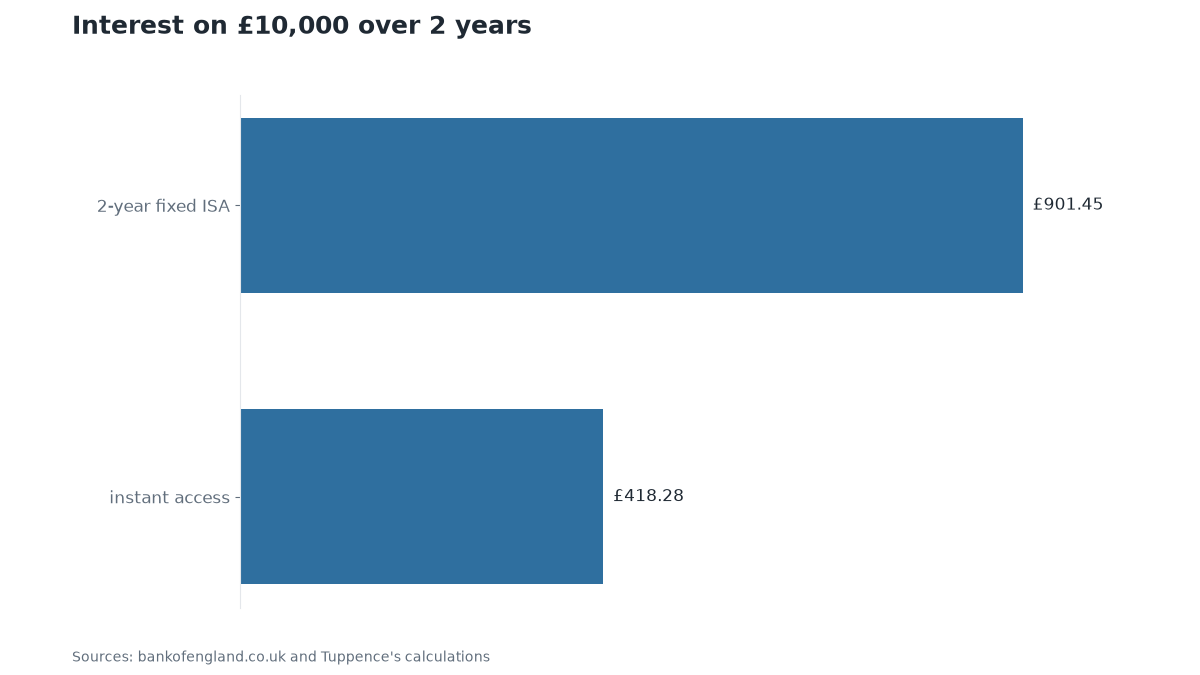
Assume you have £10,000 you will not need for at least two years and you are choosing between the average instant-access rate and the average two-year fixed cash ISA rate. The software calculates the interest each option earns over the two-year period and the difference between them, so you can see the concrete pounds at stake rather than an abstract percentage gap. The example uses market averages and is illustrative; your individual rate will differ, and the ISA option also means the interest is tax-free.
Walking through the numbers, £10,000 for 2 years at 2.07% (instant access) earns £418.28 before tax, with interest added yearly. In contrast, £10,000 for 2 years at 4.41% (2-year fixed ISA) earns £901.45 before tax, with interest added yearly. The 2-year fixed ISA earns £483.17 more than instant access over 2 years. This breakdown helps you visualise the real-world impact of the rate spread on your specific savings pot.
What to do
Log in to your bank to note the exact interest rate and access terms on your current account, as the headline ‘up to’ figure is not your actual rate. Determine how much cash you will need in the next twelve months for bills, holidays, or repairs, and keep that in an instant-access account.
Move the longer-term remainder into a one- or two-year fixed bond or fixed-rate cash ISA while current rates are available. Check the early-withdrawal penalty before committing. If you have unused ISA allowance, use it before 5 April 2027 so the interest is tax-free, as the allowance resets each tax year and does not roll over.
Set a calendar reminder for a month before your fixed deal matures. This helps you re-shop the rate rather than drifting back onto your bank's standard variable rate, which averages 6.58%.
Who this helps most, and what to watch
This matters most if you have several thousand pounds in an instant-access balance you will not touch for one to three years. A fixed deal means you cannot get the money out early without a penalty, so do not lock in cash you might need for a deposit, a car repair, or a family event. Money you cannot access when you need it is less useful than money you can, even if it earns a little less.
If you carry a personal loan at the 12.08% average APR or a credit-card balance at 24.71%, paying that off first may make more sense than chasing the fixed ISA rate mentioned earlier, because the debt costs you far more than the savings earn you. Check for early repayment charges and keep an emergency fund first. All rates cited are Bank of England market averages, not quotes from any one provider. This is general information, not personal financial advice; your circumstances, tax position, and access needs will shape the right answer.
- savings pot: £10,000
- years: 2 years
- Log in to your bank and note the exact interest rate and access terms on your current savings or current account
- Work out how much cash you will need in the next twelve months and keep that in instant access
- Move the longer-term remainder into a one- or two-year fixed bond or fixed-rate cash ISA
- Use any remaining ISA allowance before 5 April 2027 so the interest is tax-free
- Set a reminder for a month before your fixed deal matures so you can re-shop the rate
Sources
- What savings pay: Instant-access savings account (including introductory bonuses), Aug 2026 (Bank of England IUMB6VJ, via StreetOwl)
- What savings pay: Instant-access savings account (excluding introductory bonuses), Aug 2026 (Bank of England IUMB6VK, via StreetOwl)
- What savings pay: 1-year fixed-rate savings bond, Aug 2026 (Bank of England IUMWTFA, via StreetOwl)
- What savings pay: 2-year fixed-rate savings bond, Aug 2026 (Bank of England IUMB6RH, via StreetOwl)
- What savings pay: 3-year fixed-rate savings bond, Aug 2026 (Bank of England IUMB6RI, via StreetOwl)
- What savings pay: Variable-rate cash ISA (including introductory bonuses), Aug 2026 (Bank of England IUMB6VL, via StreetOwl)
- What savings pay: 1-year fixed-rate cash ISA, Aug 2026 (Bank of England IUMB6VN, via StreetOwl)
- What savings pay: 2-year fixed-rate cash ISA, Aug 2026 (Bank of England IUMZID2, via StreetOwl)
- Bank Rate: Bank Rate (the Bank of England's official interest rate), 2026-09-28 (Bank of England IUDBEDR, via StreetOwl)
- Prices: CPI inflation, twelve-month rate, Aug 2026 (ONS D7G7, via StreetOwl)
- Prices: CPIH inflation, twelve-month rate, Aug 2026 (ONS L55O, via StreetOwl)
- Pay and jobs: Regular pay growth, annual, after inflation, Jul 2026 (ONS A2FA, via StreetOwl)
- What savings pay: Annual ISA allowance, 2026-04-06 to 2027-04-05 (GOV.UK, via StreetOwl)
- What mortgages cost (advertised averages): Standard variable rate (the revert-to rate a fixed deal falls onto), Aug 2026 (Bank of England IUMTLMV, via StreetOwl)
- What borrowing costs: Personal loan of £5,000, APR, Aug 2026 (Bank of England IUMBX67, via StreetOwl)
- What borrowing costs: Credit card, representative APR on purchases, Aug 2026 (Bank of England IUMCCTL, via StreetOwl)
This digest was drafted by StreetOwl’s own model from published figures and the sources listed, then read and approved by Michael Rossi on 30 September 2026 before it went up. It is general information, not financial advice: your circumstances are yours, and for a decision that matters, MoneyHelper (free, government-backed) or a regulated adviser is the place to go. General information, not personal financial advice. Figures checked on the dates shown.
← Back to StreetOwl