
Three allowances to check before April: pension, tax-free pay and ISA room
Your State Pension, personal allowance and ISA limit are all fixed for 2026-2027. A quick check now can stop you leaving money on the table.
Your State Pension this year
If you reached State Pension age from 6 April 2016 and have 35 qualifying years of contributions, the full new State Pension pays £241.30 a week. This rate is in force for the period from 6 April 2026 until 5 April 2027. It is a fixed figure for that year, so you do not need to worry about mid-year adjustments changing your weekly amount.
If you are still building up your record, this is the rate you are working toward. Your personal statement will show how many qualifying years you have accumulated so far, helping you understand how much of the full amount you are likely to receive when you reach State Pension age. Checking this now gives you a clear picture of your future income without any guesswork.
The amount is set for the entire year, providing stability in your planning. You can rely on this specific weekly payment for the duration of the current period, knowing it will not fluctuate due to economic changes or other adjustments during the year. This certainty allows you to budget with confidence, whether you are relying on it as your main income or supplementing other savings.
The income you can earn before tax kicks in
The income tax personal allowance remains £12,570 a year for the period running from 6 April 2026 until 5 April 2027. This figure has been frozen since 2021, meaning the threshold has not moved for five years while pay and prices have generally risen. Because the limit stays static, the freeze can push more people into paying tax over time, even if their real spending power has not changed much. This effect depends on your specific income levels and any other personal allowances or deductions you might have.
All taxable income counts against this allowance. This includes your State Pension, part-time work, rental income, and taxable pension income from a private pot. If your total taxable income for the year stays under £12,570, you owe no income tax on it. It is worth checking where you stand now. If you are close to the limit, every pound of additional taxable income matters. You may need to review your sources of income to see if you can shift some earnings into tax-free categories or adjust your timing. A quick calculation now can help you avoid an unexpected tax bill later in the year.
Your ISA room: up to £20,000 a year
Your annual ISA allowance is £20,000 a year, covering all ISA types combined within a single tax year. This limit is in force from 6 April 2026 until 5 April 2027. Money you hold inside an ISA wrapper is shielded from income tax and capital gains tax on any interest or dividends it earns. This means your savings can grow without those specific charges reducing the total, which is particularly useful if you are saving for long-term goals or keeping funds accessible for later use.
If you have not yet used your full £20,000 allocation this year, you still have time to make a top-up contribution before the deadline on 5 April 2027. Unused room generally cannot be carried forward to the next year, so checking your statement now ensures you do not leave potential tax-free capacity unused. For those who have retired and no longer need to invest aggressively, a cash ISA offers a straightforward place to park savings. Since the income generated is tax-free, it can be a sensible option for funds you may draw on later, provided you do not need immediate access to the entire amount and the tax advantage suits your marginal tax rate.
Why the frozen allowance is catching more people
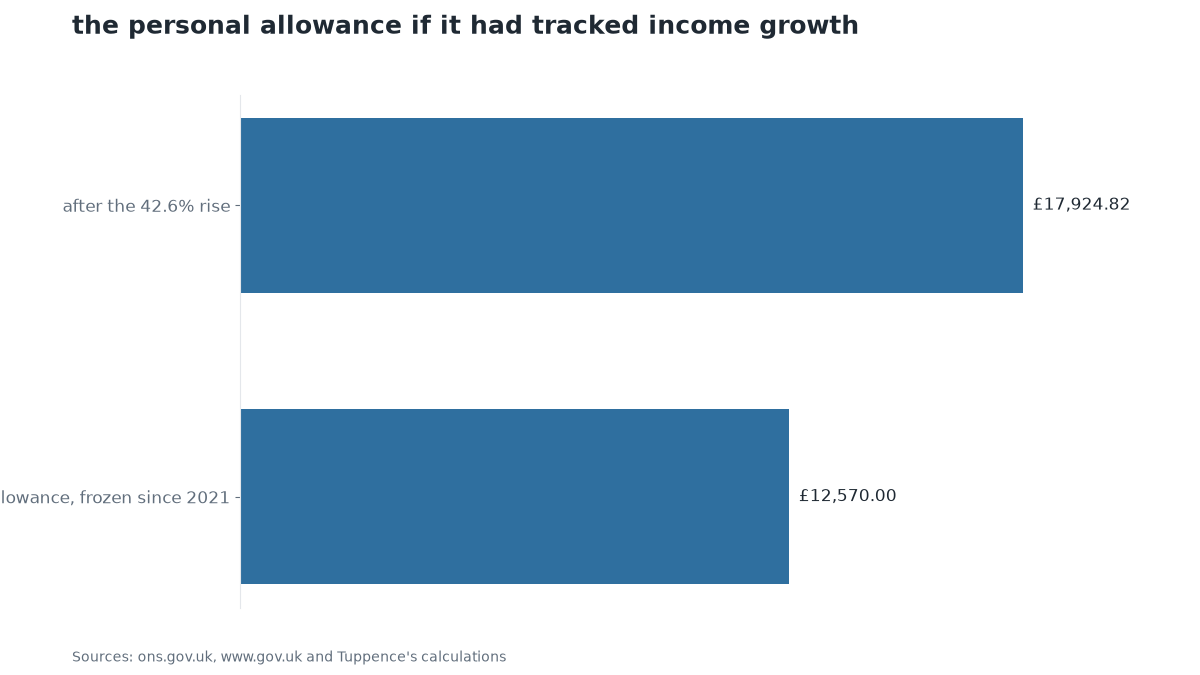
The personal allowance has stayed at £12,570 since 2021, while nominal household disposable income per head rose by 42.6% between 2015 and 2025. This mismatch means more households now pay tax on income that was previously tax-free. If the allowance had tracked that income growth, it would be £17,924.82 instead of £12,570. The difference is £5,354.82, representing the value of the freeze.
This matters most for couples where one partner draws a full State Pension and the other does part-time work or has a small private pension. If the working partner’s income pushes them over the threshold, they pay tax on that extra income. However, if the pensioner is not using their own allowance, their unused personal allowance can sometimes be transferred to the working partner. This effectively doubles the couple’s tax-free threshold. The rules depend on both partners’ ages and income levels in the tax year, but checking whether this transfer applies could save you money you did not know you were losing.
- Check your State Pension statement on GOV.UK to confirm you are receiving the full £241.30 a week and to see how many qualifying years you have.
- Add up every source of taxable income for the year - State Pension, part-time pay, rental, taxable private pension - and compare the total with the £12,570 personal allowance to see whether you are in tax.
- Log in to your ISA provider's online account and check how much of your £20,000 allowance you have already used this tax year; if there is room left, you can still contribute before 5 April 2027.
- If you hold savings in a standard bank account and have unused ISA room, consider moving some into a cash ISA so future interest is tax-free.
- Set a diary reminder for early April 2027 to recheck all three figures, because the allowances and the State Pension rate can change at the start of each tax year.
Sources
- Pensions: Full new State Pension, 2026-04-06 to 2027-04-05 (GOV.UK, via StreetOwl)
- Tax: Income tax personal allowance, 2026-04-06 to 2027-04-05 (GOV.UK, via StreetOwl)
- What savings pay: Annual ISA allowance, 2026-04-06 to 2027-04-05 (GOV.UK, via StreetOwl)
- Inflation & interest rates & you: Households: Gross disposable income per head: Current price £: Seasonally adjusted, change 2015 to 2025, 2015 to 2025 (Office for National Statistics, via StreetOwl)
This digest was drafted by StreetOwl’s own model from published figures and the sources listed, then read and approved by Michael Rossi on 10 October 2026 before it went up. It is general information, not financial advice: your circumstances are yours, and for a decision that matters, MoneyHelper (free, government-backed) or a regulated adviser is the place to go. General information, not personal financial advice. Figures checked on the dates shown.
← Back to StreetOwl