
The quiet cost of staying put: why your bills outpace your pay rise
Food prices are up 45% since 2016, mortgage rates have climbed since last autumn, and your savings earn less than inflation. Here is what the gap means for your budget.
The gap between your pay and your prices
Current measures suggest prices are still rising. The Consumer Price Index stands at 3.5% for the twelve months to September 2026, while the Retail Price Index is slightly higher at 3.9%. This indicates that the average basket of goods and services continues to get more expensive every year, keeping pressure on your monthly budget.
The squeeze is often sharper for essentials than the headline number suggests. Between 2016 and 2025, the cost of food and non-alcoholic beverages rose by 45% in cash terms. Over the same period, all items increased by 37.4%. Because food, energy and housing make up a large fixed share of a UK household’s spending, a 3.5% headline rate understates the reality felt at the kitchen table. Your personal basket likely feels pricier than the press suggests, as the items you buy every day are outpacing the general average.
Why your pay rise still feels like a cut
Between 2016 and 2025, whole-economy regular pay excluding arrears rose by 46.3% in cash terms. Median gross annual earnings for full-time employees increased by 45.1% over a similar period. However, household gross disposable income per head climbed by only 41.1% across the same years. This difference reflects the taxes, National Insurance and other deductions that sit between a pay rise and the money actually reaching your bank account. As a result, the take-home effect of a pay increase is always smaller than the headline figure suggests.
Because essentials are rising faster than the broader index, the portion of your pay that goes to food, housing and energy keeps growing. This leaves less for everything else. You are working for more cash, but that cash buys less than it did nine years ago. The feeling of a cut is accurate, even if your pay slip shows a rise.
The mortgage you forgot to review
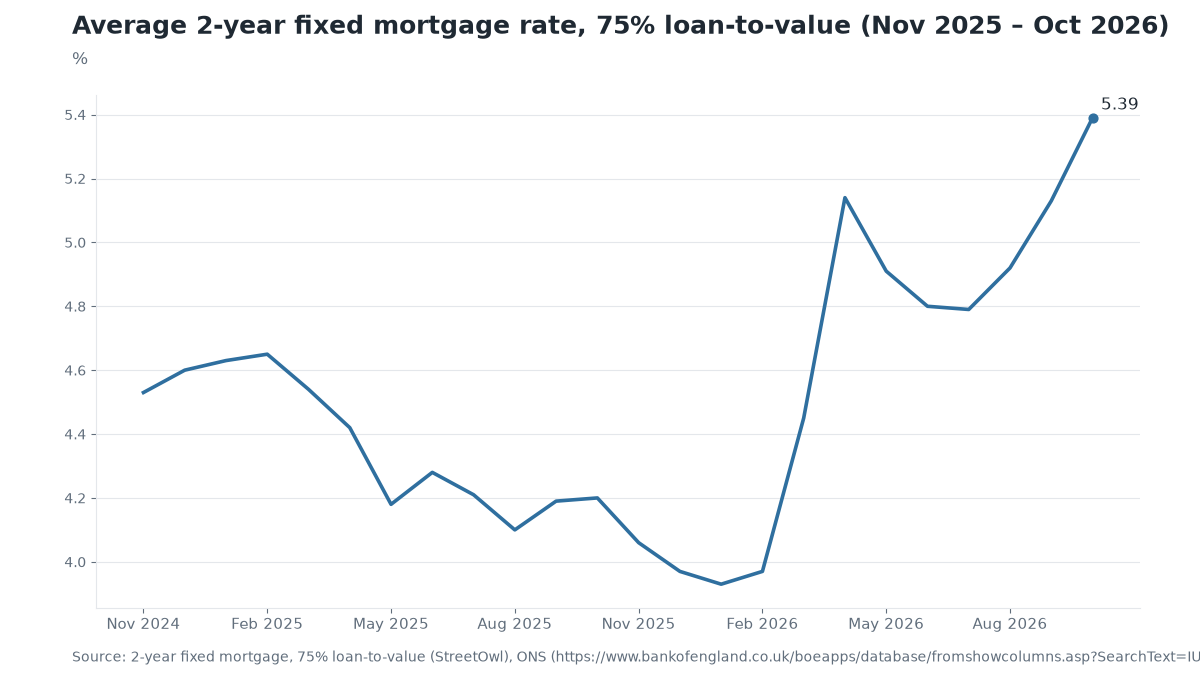
A fixed mortgage rate can create a false sense of security, masking the true cost of inaction until the term ends. For a 75% loan-to-value ratio, the average 2-year fixed rate was 3.93% in January 2026, rising to 5.39% by October 2026. This represents a year-on-year increase of 1.19 points. Please remember these are market averages, not specific offers for any one person.
If your fixed period expires and you do nothing, your loan typically reverts to the lender’s standard variable rate. This rate averaged 6.58% in October 2026. The gap between your locked-in rate and this market reality is the quiet penalty for not reviewing your deal. While some contracts may specify different revert rates, the general principle remains: ignoring your mortgage until the end date often leads to a more expensive outcome than proactive management.
[LINE CHART: Dataset 200, showing the 12-month climb]
Savings that are quietly losing value
Your savings pot is likely working against you. The average instant-access rate stands at 2.08% including introductory bonuses, dropping to 1.91% without them. Both figures sit below the current 3.5% CPI rate. Even the one-year fixed bond, which pays 4.46%, only marginally beats headline inflation, while the variable-rate cash ISA average of 1.8% is well behind.
When your savings rate is lower than the current inflation rate, your money loses purchasing power over time. This happens even as the nominal balance grows. Leaving funds untouched in a low-interest account creates a slow, invisible cost. You are effectively paying for the privilege of keeping your cash safe, yet the value of that cash shrinks in real terms.
This principle assumes inflation remains near current levels. If prices rise faster than your bank pays you, you are losing ground with every passing month. Access needs and tax positions, such as whether the pot is in an ISA, change the comparison. However, the core issue remains: passive saving in a high-inflation environment often results in a quieter, steady decline in your financial wellbeing.
What to do before your next billing date
Check the end date on your mortgage or rent contract and see if a renewal notice is due. Compare your savings or ISA rate against the current inflation measure cited earlier. Search your email for renewal or price-change notices on fixed utility, phone, or insurance contracts. If you are on a standard variable rate or your fix is ending, get a written quote from an alternative lender. Set a calendar reminder ahead of any fixed-period expiry so you have time to compare options.
These steps depend on your circumstances. A first-time buyer on a tracker faces different choices from a homeowner in the final year of a fix, and a saver with an emergency fund has more flexibility than one who needs instant access. Remember that this is general information, not personal financial advice. The Bank of England figures cited are market averages, not individual offers you will receive.
- Photograph or note the end date on your mortgage, rent or lease contract and check whether a renewal notice is due in the coming months
- Log in to your savings or ISA account and write down the current interest rate; then check the ONS website for the latest CPI figure to see whether your rate is above or below it
- Search your phone and email for the words 'renewal', 'your plan ends' or 'price change' to surface any fixed utility, broadband or insurance contract about to roll over
- If you are on a standard variable mortgage rate or your fixed period is ending, request a written comparison quote from an alternative lender
- Set a calendar reminder ahead of any fixed-period or contract expiry so the decision is made with time to compare rather than under pressure
Sources
- Prices: CPI inflation, twelve-month rate, Sep 2026 (ONS D7G7, via StreetOwl)
- Prices: RPI inflation, twelve-month rate, Sep 2026 (ONS CZBH, via StreetOwl)
- Inflation & interest rates & you: CPI INDEX 00: ALL ITEMS 2015=100, change 2016 to 2025, 2016 to 2025 (Office for National Statistics, via StreetOwl)
- What mortgages cost (advertised averages): 2-year fixed mortgage, 75% loan-to-value, Oct 2026 (Bank of England IUMBV34, via StreetOwl)
- What mortgages cost (advertised averages): Standard variable rate (the revert-to rate a fixed deal falls onto), Oct 2026 (Bank of England IUMTLMV, via StreetOwl)
- What savings pay: Instant-access savings account (including introductory bonuses), Oct 2026 (Bank of England IUMB6VJ, via StreetOwl)
- What savings pay: Instant-access savings account (excluding introductory bonuses), Oct 2026 (Bank of England IUMB6VK, via StreetOwl)
- What savings pay: 1-year fixed-rate savings bond, Oct 2026 (Bank of England IUMWTFA, via StreetOwl)
- What savings pay: Variable-rate cash ISA (including introductory bonuses), Oct 2026 (Bank of England IUMB6VL, via StreetOwl)
- 2-year fixed mortgage, 75% loan-to-value (StreetOwl)
This digest was drafted by StreetOwl’s own model from published figures and the sources listed, then read and approved by Michael Rossi on 11 November 2026 before it went up. It is general information, not financial advice: your circumstances are yours, and for a decision that matters, MoneyHelper (free, government-backed) or a regulated adviser is the place to go. General information, not personal financial advice. Figures checked on the dates shown.
← Back to StreetOwl