The 3.5% trap: why your 2.08% savings account is quietly losing ground
Prices rose 3.5% over the past year, but the average instant-access account pays just 2.08%. Here is what that gap means for your money and what you can do about it.
The gap you can feel but cannot see
In September 2026, inflation stood at 3.5%, while the average instant-access rate was 2.08% in October 2026. This leaves a typical saver with a negative real return before tax. Your balance still grows in pounds, so the loss is invisible on a monthly statement. The erosion appears only when you buy the same goods, as your money buys less.
The gap is wider than it looks. Savers actually received an average rate of 1.65% on sight deposits in September 2026. This is below the advertised 2.08%, deepening the real-terms deficit. You are falling behind prices, not just keeping up. This silent drain reduces your purchasing power monthly. It does not announce itself with fees or warnings. It simply lowers the value of your savings relative to living costs. You must look closely to see where your money is going.
A decade of prices versus a decade of savings
The Office for National Statistics tracks how the cost of living shifts over time. Between 2016 and 2025, the all-items Consumer Price Index rose by 37.4% in cash terms. This figure represents the total increase in the price of goods and services since the start of the era when most people held instant-access accounts. It reflects the daily reality of paying more for the same basket of items. For a household that has kept money in a standard savings account throughout these years, this climb in prices sets the backdrop against which their balance must be judged.
Within that broader trend, certain categories have climbed even higher. Food and non-alcoholic beverages saw a rise of 45% over the same window. This steeper increase hits household budgets particularly hard, as these are essential purchases. When the cost of basic sustenance outpaces general inflation, the pressure on your finances intensifies. If your savings account rate sat below the rate of inflation for much of this period, the real value of your money shrank year after year. Even if your nominal balance grew, it bought less than it did when you first deposited it. A pound saved in 2016 holds noticeably less purchasing power in 2025. This gradual erosion means that holding cash in low-yield accounts can quietly diminish your wealth over time.
The gap you are leaving on the table
October 2026 advertised averages show a distinct hierarchy. Instant-access accounts pay 2.08%, while a 1-year fixed bond pays 4.46% and a 2-year fixed bond pays 4.69%. Cash ISAs offer similar protection, with 1-year rates at 4.65% and 2-year rates at 4.60%. These are market averages, not specific provider offers, but they illustrate the trade-off. Locking money away usually earns more, but you cannot reach it if you need it tomorrow. The ISA wrapper adds tax-free interest, which can make the difference significant.
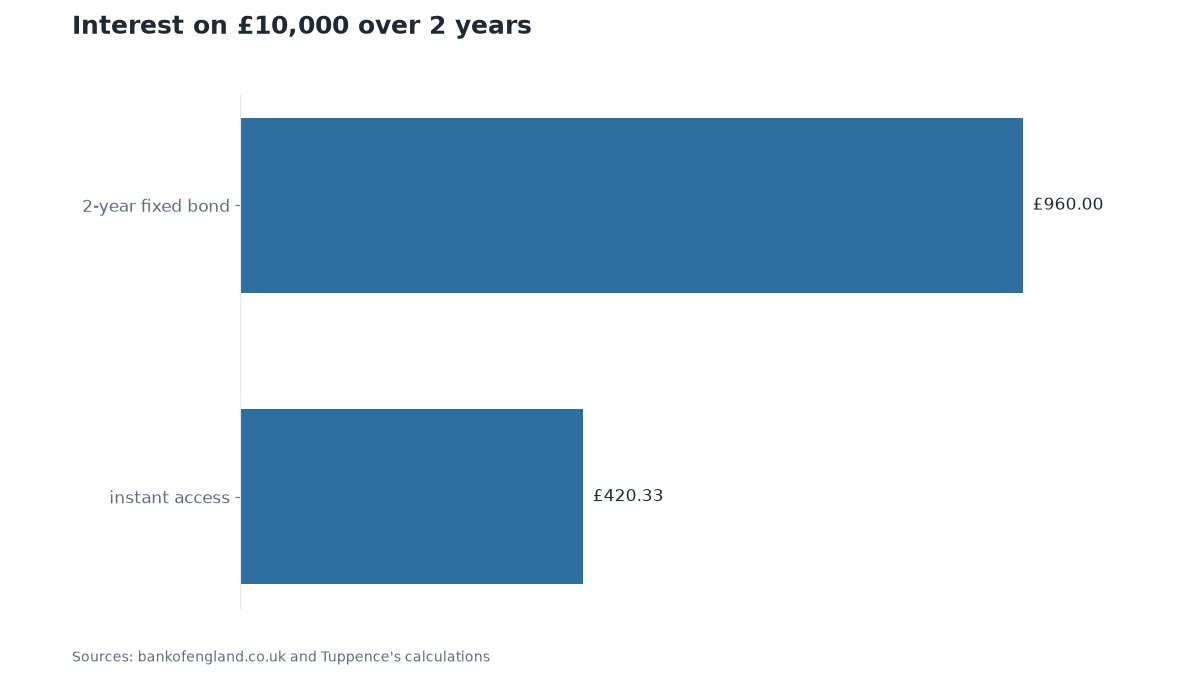
To make this concrete, consider a pot of £10,000 left for 2 years. If you keep it in instant access at 2.08%, you earn £420.33 before tax, with interest added yearly. If you move that same amount into a 2-year fixed bond at 4.69%, you earn £960 before tax, also with interest added yearly. The fixed bond earns £539.67 more than instant access over that period. This is the opportunity cost of keeping your money too liquid. While the fixed rate offers a higher return, you sacrifice the ability to access the cash in an emergency. It is wise to keep a separate, easily accessible emergency fund before committing money to a fixed term, ensuring you do not face penalties or reduced rates if you need to break the arrangement early.
What to do with your money this week
Start by checking the actual rate your current account pays, not just the headline. The average for instant-access deposits was 1.65% in September 2026, which is lower than the advertised market average of 1.91%. This discrepancy matters because your specific provider may pay less than the typical offer. Next, split your savings. Keep a buffer in instant access for emergencies, but move the rest into a fixed-term bond or a cash ISA. Locking money away usually earns a higher rate, such as the 4.69% average for two-year bonds, but you sacrifice immediate access. Before you commit, check for any penalties that apply if you break the term early.
If you already have a fixed term, note the end date and set a calendar reminder. This ensures you re-shop for a better deal before the rate lapses into a lower default. Finally, if you carry debt at rates well above the 4.69% average, weigh clearing that debt first. Paying off high-interest balances often yields a bigger financial benefit than earning interest on savings. These are general considerations, not personal financial advice. The right split depends on whether you expect to need the money within the next year or two. This approach helps most households with a rainy-day fund sitting in a default current account or a 1.91% instant-access account, especially when watching their balance grow slowly while shop bills keep climbing.
- savings pot: £10,000
- years: 2 years
- Log in to your bank app and note the exact interest rate your instant-access or current account is paying right now, not the promotional rate from when you opened it.
- Work out how much of your savings you will genuinely not need for the next year or two; that is the amount you can consider moving to a fixed term or cash ISA.
- Compare a few fixed-term or cash ISA options of the length you need, using the Bank of England monthly averages as a benchmark for whether a quoted rate is competitive.
- Set a calendar reminder a few months before your fixed term or ISA ends so you can re-shop before the money drops back onto a lower variable rate.
- If you carry credit-card or overdraft balances at rates above what a fixed savings product pays, talk through whether paying down that debt first makes more sense.
Sources
- Prices: CPI inflation, twelve-month rate, Sep 2026 (ONS D7G7, via StreetOwl)
- What savings pay: Instant-access savings account (including introductory bonuses), Oct 2026 (Bank of England IUMB6VJ, via StreetOwl)
- Borrowing and saving, as it happened: Effective interest rate paid on households' instant-access deposits, Sep 2026 (Bank of England CFMHSCV, via StreetOwl)
- Inflation & interest rates & you: CPI INDEX 00: ALL ITEMS 2015=100, change 2016 to 2025, 2016 to 2025 (Office for National Statistics, via StreetOwl)
- What savings pay: 1-year fixed-rate savings bond, Oct 2026 (Bank of England IUMWTFA, via StreetOwl)
- What savings pay: 2-year fixed-rate savings bond, Oct 2026 (Bank of England IUMB6RH, via StreetOwl)
- What savings pay: 1-year fixed-rate cash ISA, Oct 2026 (Bank of England IUMB6VN, via StreetOwl)
- What savings pay: 2-year fixed-rate cash ISA, Oct 2026 (Bank of England IUMZID2, via StreetOwl)
- What savings pay: Instant-access savings account (excluding introductory bonuses), Oct 2026 (Bank of England IUMB6VK, via StreetOwl)
This digest was drafted by StreetOwl’s own model from published figures and the sources listed, then read and approved by Michael Rossi on 10 November 2026 before it went up. It is general information, not financial advice: your circumstances are yours, and for a decision that matters, MoneyHelper (free, government-backed) or a regulated adviser is the place to go. General information, not personal financial advice. Figures checked on the dates shown.
← Back to StreetOwl