
Overpay your mortgage or put it in savings? Here's how to decide
Your mortgage rate and your savings rate may be closer than you think. The right call depends on which deal you're actually on and whether your fixed period is about to end.
The comparison most people get wrong
If you have spare cash each month or a lump sum, the choice usually falls between overpaying your mortgage or parking it in savings. The decision hinges on one simple comparison: the rate you actually pay on the loan versus the rate you actually earn on the deposit. In the August 2026 market, the average 2-year fixed mortgage at 75% loan-to-value sits at 4.92%. A 2-year fixed ISA pays 4.41%, leaving a small gap between the two. These are weighted averages of advertised rates, not a quote you will personally receive.
The picture shifts sharply if your fixed deal is ending. The standard variable rate averages 6.58%, which is more than 2 points above the best fixed savings. In that scenario, overpaying becomes the clear winner because you are avoiding a significantly higher cost. However, the right answer depends on your own rate, your remaining term, and whether you need the money back within a year or two.
Before you commit, check for early repayment charges and ensure you have an emergency fund. Paying down a loan that costs more than your savings earn usually leaves you better off, provided the savings rate is certain for the same period. Also consider that savings interest is taxed as income, whereas mortgage interest is not. This makes the tax-free return of overpaying worth more than a pre-tax return of the same nominal rate, especially if you are a higher-rate taxpayer.
Where the rates stand right now
The broader picture remains steady. Bank Rate has held at 3.75% since December 2025, and CPI inflation is running at 3.1%. This stability means neither side of the ledger is moving quickly, so your decision rests on the specific gap between your mortgage and your savings. On the debt side, the August 2026 averages show a 5-year fixed at 4.78% and a 10-year fixed at 5.25% for those borrowing 75% of the property value. The standard variable rate, where you land when a fix ends, stands at 6.58%.
On the savings side, returns are modest but consistent. A 1-year fixed ISA pays 4.40%, while a 2-year fixed bond offers 4.24%. Instant-access accounts trail behind at 2.07%. These rates are market averages, so your actual offer will vary. However, the tax position matters significantly. Your £20,000 ISA allowance, in force until 5 April 2027, shelters interest from income tax. This can widen the effective gap in favour of saving, as the tax-free return competes more closely with the after-tax cost of your mortgage.
Worked example: £200,000 mortgage, £200 a month overpayment
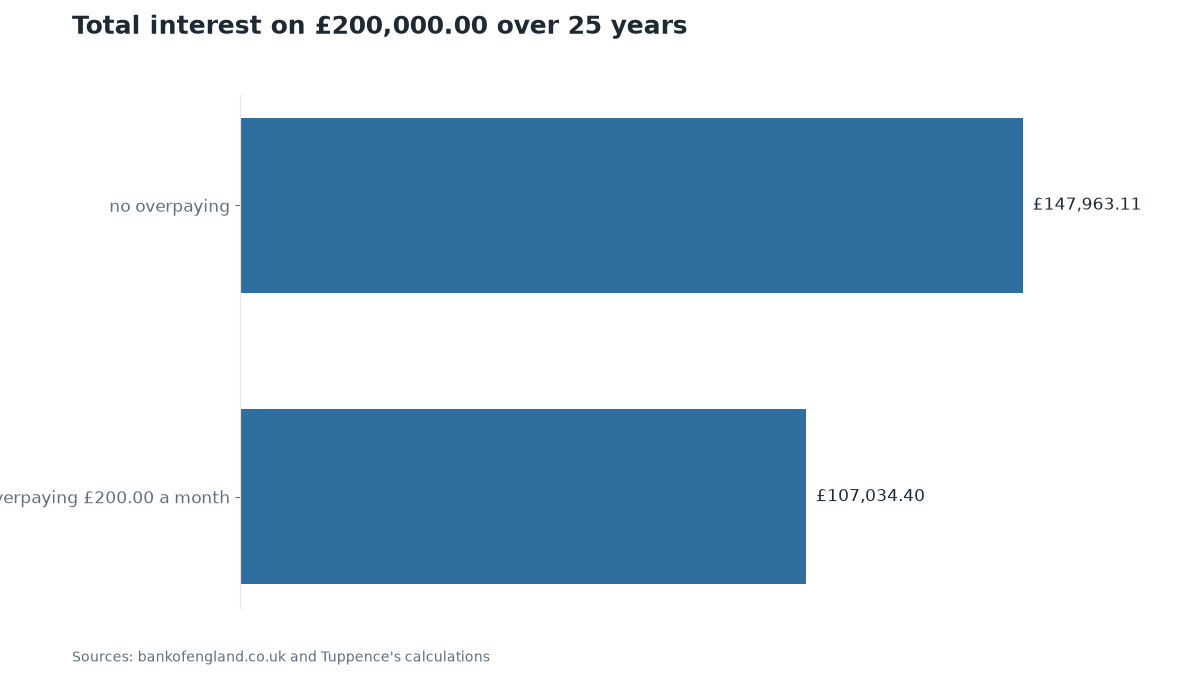
Consider a £200,000 balance with 25 years remaining at 4.92%. Without extra payments, your monthly cost is £1,159.88 and total interest is £147,963.11. Adding a £200 monthly overpayment reduces total interest to £107,034.40, saving you £40,928.71. The loan is cleared 74 months sooner, which is roughly 6.2 years earlier than the original schedule.
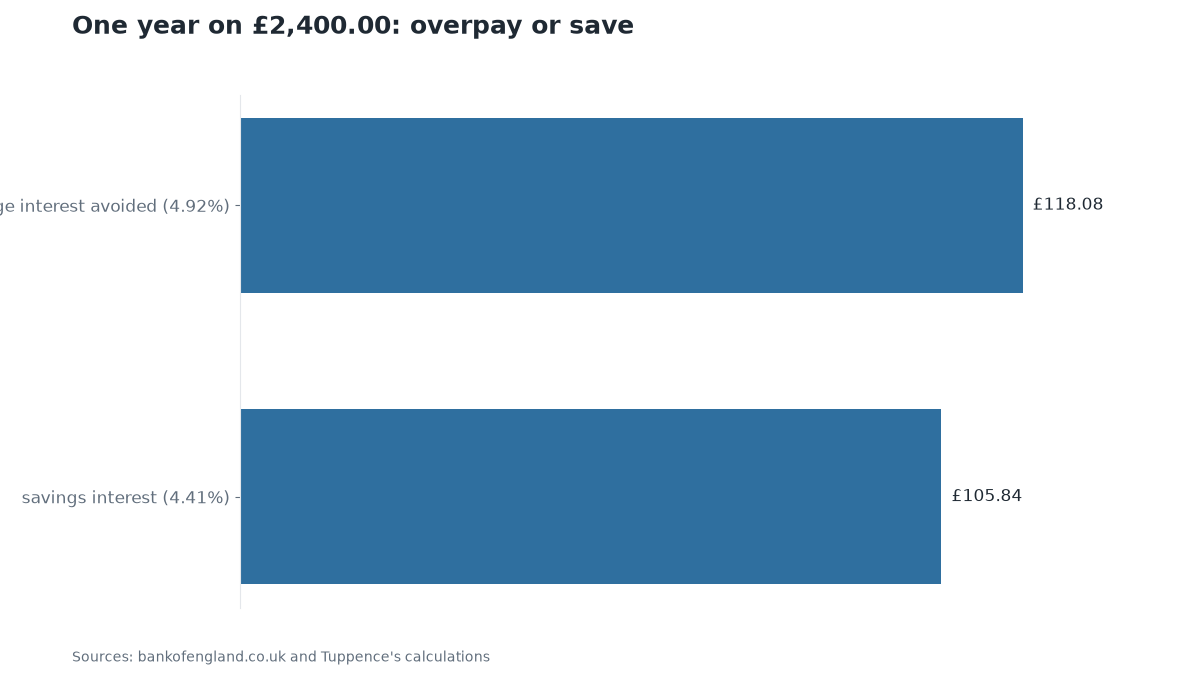
The immediate financial difference is small. On a year’s worth of overpayments, which is £2,400, you avoid £118.08 of mortgage interest. In a 4.41% ISA, that same sum earns £105.84. The rates are 0.51 percentage points apart, so overpaying puts you only £12.24 ahead in that first year before tax. However, the mortgage return is certain and tax-free, whereas savings interest is taxed as income unless sheltered in an ISA.
This narrow gap changes if your mortgage rate is higher. If you were paying the standard variable rate mentioned earlier, the interest saved by overpaying would far exceed what the ISA earns. In that case, the case for reducing your debt becomes much stronger. Check for early repayment charges first, but if your rate is significantly above your savings rate, overpaying is usually the better financial move.
What to do before you commit
Start by logging in to your mortgage provider’s portal to note your exact rate, deal type, and the end date of your current period. Check your agreement for early repayment charges, as some fixed deals penalize you for repaying early. Before directing surplus cash at the mortgage, keep a buffer of three to six months of essential expenses in an instant-access account to cover unexpected costs.
If you prefer to keep your money liquid, use your £20,000 ISA allowance to shelter the interest from income tax. The current 2-year fixed ISA average now exceeds the equivalent bond rate, meaning the tax-free advantage of savings is more pronounced than a direct comparison might suggest. A tax-free return is often worth more than a pre-tax return of the same nominal rate, particularly for higher-rate taxpayers, though this advantage narrows if you maximize your ISA allowance.
Revisit this decision every six months or whenever Bank Rate moves, because the gap between your mortgage and savings rates will shift. Monitoring these changes ensures your strategy remains aligned with your financial goals and the prevailing economic conditions. By staying proactive, you can adapt to market movements and make the most of your surplus cash without compromising your financial security.
- mortgage balance: £200,000
- remaining term: 25 years
- monthly overpayment: £200 a month
- Log in to your mortgage provider's portal and note your exact interest rate, the type of deal (fixed, tracker, or SVR), and the end date of your current period.
- Check for early repayment charges in your mortgage agreement before you commit to overpaying; some fixed deals charge a percentage of the amount repaid early.
- Keep a buffer of three to six months of essential expenses in an instant-access account before directing surplus cash at the mortgage.
- If your fixed deal ends within twelve months, compare your current rate against the SVR you would revert to, and weigh that against the best 1- or 2-year fixed savings rate available.
- If you prefer to keep the money liquid, use your £20,000 ISA allowance to shelter the interest from income tax.
- Revisit the decision every six months or whenever Bank Rate moves, because the gap between your mortgage and savings will shift.
Sources
- What mortgages cost (advertised averages): 2-year fixed mortgage, 75% loan-to-value, Aug 2026 (Bank of England IUMBV34, via StreetOwl)
- What savings pay: 2-year fixed-rate cash ISA, Aug 2026 (Bank of England IUMZID2, via StreetOwl)
- What mortgages cost (advertised averages): Standard variable rate (the revert-to rate a fixed deal falls onto), Aug 2026 (Bank of England IUMTLMV, via StreetOwl)
- What savings pay: Instant-access savings account (including introductory bonuses), Aug 2026 (Bank of England IUMB6VJ, via StreetOwl)
- What savings pay: Annual ISA allowance, 2026-04-06 to 2027-04-05 (GOV.UK, via StreetOwl)
- Prices: CPI inflation, twelve-month rate, Aug 2026 (ONS D7G7, via StreetOwl)
- Bank Rate: Bank Rate (the Bank of England's official interest rate), 2026-09-25 (Bank of England IUDBEDR, via StreetOwl)
- What savings pay: 1-year fixed-rate savings bond, Aug 2026 (Bank of England IUMWTFA, via StreetOwl)
- What mortgages cost (advertised averages): 5-year fixed mortgage, 75% loan-to-value, Aug 2026 (Bank of England IUMBV42, via StreetOwl)
- What mortgages cost (advertised averages): 10-year fixed mortgage, 75% loan-to-value, Aug 2026 (Bank of England IUMBV45, via StreetOwl)
- What savings pay: 1-year fixed-rate cash ISA, Aug 2026 (Bank of England IUMB6VN, via StreetOwl)
- What savings pay: 2-year fixed-rate savings bond, Aug 2026 (Bank of England IUMB6RH, via StreetOwl)
This digest was drafted by StreetOwl’s own model from published figures and the sources listed, then read and approved by Michael Rossi on 28 September 2026 before it went up. It is general information, not financial advice: your circumstances are yours, and for a decision that matters, MoneyHelper (free, government-backed) or a regulated adviser is the place to go. General information, not personal financial advice. Figures checked on the dates shown.
← Back to StreetOwl