If your energy supplier is on this list, check your credit balance
Ofgem's Q2 2026 data shows five suppliers well above the complaints average. If you hold a credit balance with one, here is what to do before it is too late.
The five suppliers with the most complaints
Ofgem’s Q2 2026 data shows a market average of 936 complaints per 100,000 accounts, down 11% on a year earlier. Five suppliers sit well above this. Utility Warehouse leads with 1,965, followed by OVO at 1,774, Tru Energy at 1,580, So Energy at 1,474, and Scottish Power at 1,397. Each is significantly higher than the average.
A high complaints rate signals service friction but does not predict insolvency. Ofgem data is self-reported and covers a three-month window; suppliers can maintain high rates for years without failing. Yet these firms face regulatory pressure. If you hold a credit balance with one of these five, check your position now.
Why a credit balance is not the same as money in the bank
A credit balance is money your supplier owes you for energy already paid for. It sits on their books, not in a regulated deposit account. If the supplier enters administration, recovering that balance is not certain and can take many months. The position differs between administration and liquidation, and some balances may be treated as preferential debts. Registering as a creditor with the insolvency practitioner is the usual route, but recovery depends on the supplier’s remaining assets.
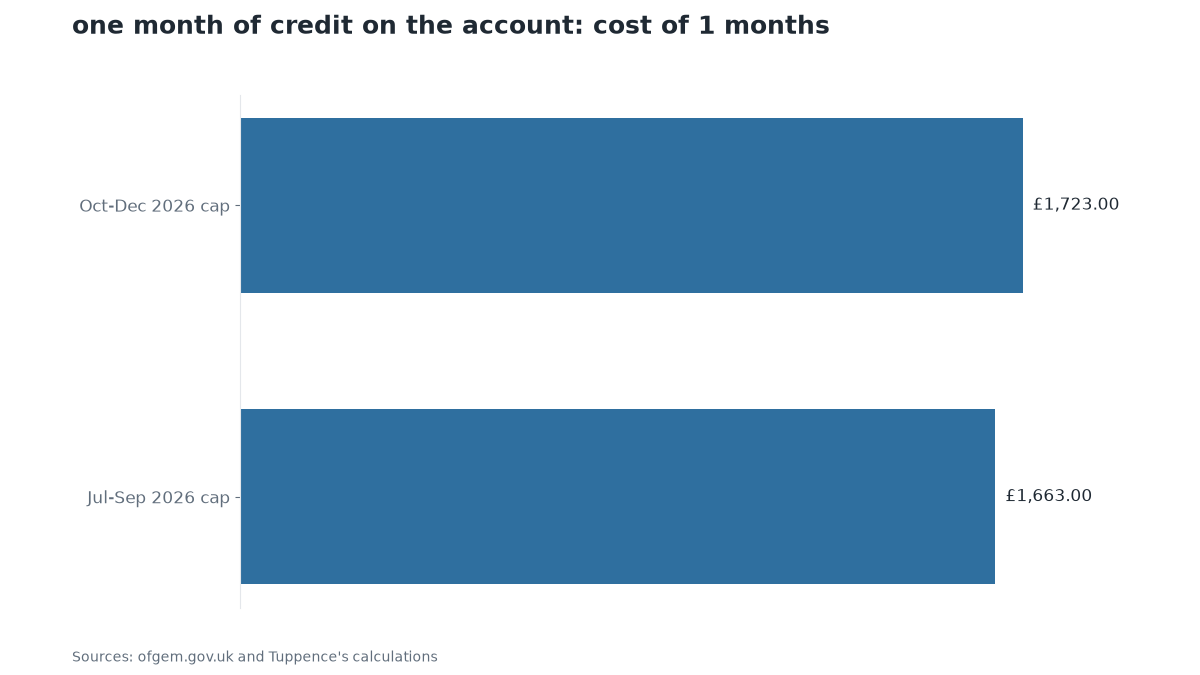
The scale matters. The current Ofgem cap for a typical dual-fuel household is £1,723 a year. This limit applies only to unit rates and standing charges, meaning it does not protect your credit balance if the supplier fails. It caps what they can charge you, not what they owe you from the past.
Worked example: what a typical credit balance is worth
For a household using 1 month of credit, the value shifts depending on the period. Ofgem sets the cap at £1,663 a year for Jul–Sep 2026. Using this as a proxy for a typical bill, 1 months at £1,663 equals £1,663. The next period, Oct–Dec 2026, sees the cap rise to £1,723 a year. At this rate, 1 months at £1,723 equals £1,723.
The difference for one month of credit on the account is £60. This means the Oct-Dec 2026 cap costs more than the Jul-Sep 2026 cap, representing a 3.61% increase. This is an illustration using the cap; actual balances vary by usage, tariff and meter type. However, it shows how the value of your prepaid energy changes with rate adjustments. If you hold this balance with a supplier facing financial difficulty, understanding its worth relative to current costs is a practical first step before taking further action.
What to do if you are with one of these suppliers
Log in or call to check your current credit balance. Request a refund or a direct-debit reduction to bring it to zero, and ask for written confirmation of the amount. If you are on a fixed tariff, note that switching mid-deal may carry an exit fee, so weigh that cost against the balance at risk before acting.
Keep a record of your meter readings, the last bill, and any correspondence. If the supplier has already entered administration, register as a creditor with the appointed insolvency practitioner and note the deadline. Missing this deadline can affect your ability to claim any money owed to you.
Who needs to act most urgently
If you use a prepayment meter with one of the named suppliers, your situation is particularly acute. You face a dual risk: service disruption and potential loss of credit. Verify your meter status immediately, as these customers have been the primary focus of recent regulatory action.
You also need to act if your credit balance exceeds roughly one month’s typical bill. Use the annual cap figure cited earlier as a guide. A balance significantly higher than that represents a larger sum at risk if the supplier fails. The further your balance drifts from zero, the greater your financial exposure becomes, making recovery more complex if the company enters administration.
Finally, consider the friction of switching. If you are on a fixed deal, an exit fee may apply. Weigh this cost against the balance you hold. If the fee is low compared to your credit, moving to a safer supplier may be prudent. If the fee is high, secure your balance by requesting a refund or reducing your direct debit to zero before leaving the tariff.
- months of credit held: 1 months
- Log in to your energy account or call your supplier to check your current credit or debit balance
- If you have a credit balance, ask the supplier to refund it or apply it to reduce your next direct-debit payment so the balance falls to zero
- Request written confirmation of your final balance and keep a copy of your last bill and meter reading
- If you are on a fixed tariff, check your contract for any early-exit fee before deciding whether to switch
- If your supplier has entered administration, register as a creditor with the appointed insolvency practitioner and note the deadline
Sources
- Energy: Ofgem energy price cap, typical dual-fuel household paying by direct debit, 2026-10-01 to 2026-12-31 (Ofgem, via StreetOwl)
- Which energy supplier gets the most complaints: Energy supplier complaints per 100,000 customer accounts, whole market, Q2 2026 (Ofgem (suppliers' own figures), via StreetOwl)
- Which energy supplier gets the most complaints: Agreed by suppliers in Ofgem cases listed on the tile, May 2025 to 2026-10-14 (Ofgem, via StreetOwl)
This digest was drafted by StreetOwl’s own model from published figures and the sources listed, then read and approved by Michael Rossi on 18 October 2026 before it went up. It is general information, not financial advice: your circumstances are yours, and for a decision that matters, MoneyHelper (free, government-backed) or a regulated adviser is the place to go. General information, not personal financial advice. Figures checked on the dates shown.
← Back to StreetOwl