
Five autumn money checks that take ten minutes each
From your mortgage fix to the account your savings are sitting in, these quick checks can catch real money leaking out of your household.
Is your mortgage fix about to end?
Check the end date on your current mortgage deal. If it is coming up within the next six months, do not wait until the final weeks to act. Start gathering comparison quotes now, because the last-minute rush often leads to poor decisions. You can find your specific expiry date by logging into your lender’s portal or checking your latest statement.
The risk of inaction is significant. When a fixed term ends, your mortgage typically reverts to the standard variable rate, which sits well above current fixed options. For a household with a 75% loan-to-value ratio, the advertised average for a two-year fix in August 2026 is 4.92%, while a five-year fix averages 4.78%. In contrast, the standard variable rate averages 6.58%. These are market averages, not individual offers, but they highlight a clear gap. The longer you remain on the higher variable rate, the more interest you pay.
Falling onto the standard variable rate can cost noticeably more than remortgaging in advance. However, the right move depends on your specific deal terms, any early repayment charges, and how long until expiry. Reviewing these factors early gives you time to compare options rather than reacting under pressure.
Where are your savings actually sitting?
Instant-access accounts average 2.07%, while a 1-year fixed bond averages 4.04%. A 2-year fixed bond averages 4.24%, and a 2-year fixed ISA averages 4.41%. Money you will not need for a year or more can earn noticeably more in a fixed-term product, though you lose flexibility. List your accounts, note the rates, and move any surplus beyond emergency needs into a fixed bond or ISA.
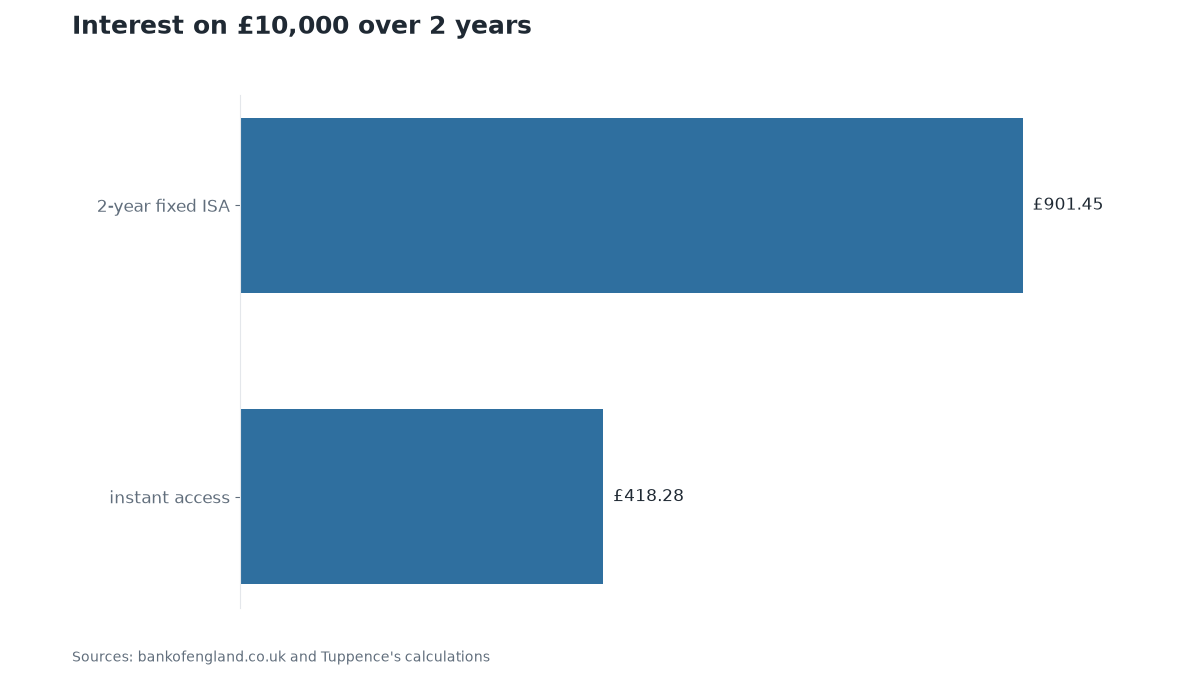
For a household with a £10,000 pot left for 2 years, the difference is clear. At the 2.07% instant-access average, you earn £418.28 before tax. At the 4.41% 2-year fixed-ISA average, you earn £901.45 before tax. These are market averages, not specific offers. The 2-year fixed ISA earns £483.17 more than instant access over 2 years.
Are you quietly paying interest on a credit card or overdraft?
The average representative APR on credit-card purchases stands at 24.71%, while the average arranged-overdraft rate is 34.53%. Both figures are far above any savings rate mentioned in this article. If you pay more than the minimum monthly repayment, you are on the interest-bearing side, and interest accrues on the outstanding balance every month. Even a few hundred pounds carried over can add up over a year. Carrying a balance on a credit card or sitting in an overdraft month to month is usually the most expensive borrowing a household can hold, so clearing that debt typically takes priority over saving or investing. Open your most recent credit-card and current-account statements. If there is any interest line item, work out the balance and set up a plan to clear it. If you can move the balance to a promotional balance-transfer card, note the end-date when the rate rises so you are not caught out.
Is your personal loan APR above where it should be?
A £5,000 personal loan averages 12.08% APR, while a £10,000 loan averages 6.9%. Smaller loans often carry a meaningfully higher rate. If you took out a modest loan recently, your APR might still be high compared to current market averages.
Refinancing into a slightly larger loan at a lower APR can reduce total interest. However, arrangement fees and early-repayment charges on your existing loan may wipe out the saving. You must weigh these costs against the potential interest reduction before switching.
Find the APR and remaining balance on your current loan. Get one or two like-for-like quotes at a slightly higher amount and compare the total cost, including fees, before committing. This quick check ensures you are not paying a premium for a smaller balance that no longer makes sense.
Are you being paid what you should be?
The National Living Wage for those aged 21 and over is £12.71 an hour, in force from 1 April 2026 to 31 March 2027. The rate for 18- to 20-year-olds is lower. After a job change, a promotion, a payroll system update, or a part-time-to-full-time switch, it is easy for a rate to slip below the minimum. A quick look at your latest payslip catches this. The National Living Wage is a legal floor, not a market rate, and a quick payslip check each pay cycle is the simplest way to catch underpayment early, whether it is a payroll error or an outdated contract.
Divide your gross pay for the period by the hours you actually worked and compare to £12.71, or the lower 18-20 rate if applicable. If you are self-employed, this does not apply, but the figure is a useful benchmark when setting your own rates.
- amount saved: £10,000
- years saved: 2 years
- Log in to your lender's portal or pull out your mortgage statement and note the fix end date; if it is within six months, start getting comparison quotes
- List every savings account, its rate, and whether it is instant or fixed; if you have a surplus beyond what you need for day-to-day emergencies, look at moving it into a fixed bond or ISA
- Open your latest credit-card and current-account statements and check for any interest line item; if there is one, work out the balance and set a clearing plan
- Find the APR and remaining balance on any personal loan, then get one or two like-for-like quotes at a comparable or slightly higher amount and compare total cost including fees
- Divide your latest gross pay by the hours you worked and compare to £12.71 an hour (or the lower 18-20 rate if it applies to you)
Sources
- What mortgages cost (advertised averages): 2-year fixed mortgage, 75% loan-to-value, Aug 2026 (Bank of England IUMBV34, via StreetOwl)
- What mortgages cost (advertised averages): 5-year fixed mortgage, 75% loan-to-value, Aug 2026 (Bank of England IUMBV42, via StreetOwl)
- What mortgages cost (advertised averages): Standard variable rate (the revert-to rate a fixed deal falls onto), Aug 2026 (Bank of England IUMTLMV, via StreetOwl)
- What savings pay: Instant-access savings account (including introductory bonuses), Aug 2026 (Bank of England IUMB6VJ, via StreetOwl)
- What savings pay: 1-year fixed-rate savings bond, Aug 2026 (Bank of England IUMWTFA, via StreetOwl)
- What savings pay: 2-year fixed-rate savings bond, Aug 2026 (Bank of England IUMB6RH, via StreetOwl)
- What borrowing costs: Credit card, representative APR on purchases, Aug 2026 (Bank of England IUMCCTL, via StreetOwl)
- What borrowing costs: Arranged overdraft, interest rate, Aug 2026 (Bank of England IUMODTL, via StreetOwl)
- What borrowing costs: Personal loan of £5,000, APR, Aug 2026 (Bank of England IUMBX67, via StreetOwl)
- What borrowing costs: Personal loan of £10,000, APR, Aug 2026 (Bank of England IUMHPTL, via StreetOwl)
- Pay and jobs: National Living Wage, aged 21 and over, 2026-04-01 to 2027-03-31 (GOV.UK, via StreetOwl)
- What savings pay: 2-year fixed-rate cash ISA, Aug 2026 (Bank of England IUMZID2, via StreetOwl)
This digest was drafted by StreetOwl’s own model from published figures and the sources listed, then read and approved by Michael Rossi on 5 October 2026 before it went up. It is general information, not financial advice: your circumstances are yours, and for a decision that matters, MoneyHelper (free, government-backed) or a regulated adviser is the place to go. General information, not personal financial advice. Figures checked on the dates shown.
← Back to StreetOwl