
Black Friday deals can cost 24.71% if you pay by card
A big Black Friday purchase can quietly add a quarter of its price in interest if you carry the credit card balance. Here's what to do instead.
The discount you're really paying
The Bank of England’s August 2026 data places the representative APR on credit card purchases at 24.71%. This figure has remained unchanged since July and sits 0.06 points higher than the rate recorded in August 2025. It is important to understand that this is a market average, weighted by how much of each product was taken out, rather than a specific offer you will necessarily receive. Your individual rate may be higher or lower depending on your provider and circumstances.
Black Friday and Boxing Week often encourage large, one-off purchases, making the credit card the default payment method at the till. The real issue arises because many shoppers assume they will clear the balance in full next month. They rarely stop to check what the interest would cost if they do not. This assumption can be dangerous, as carrying a balance while your savings earn interest is usually a net loss. The card interest rate typically far exceeds the savings rate, meaning the discount you think you are getting can be quickly eroded by the cost of borrowing.
Worked example: a £500 deal, two ways to pay
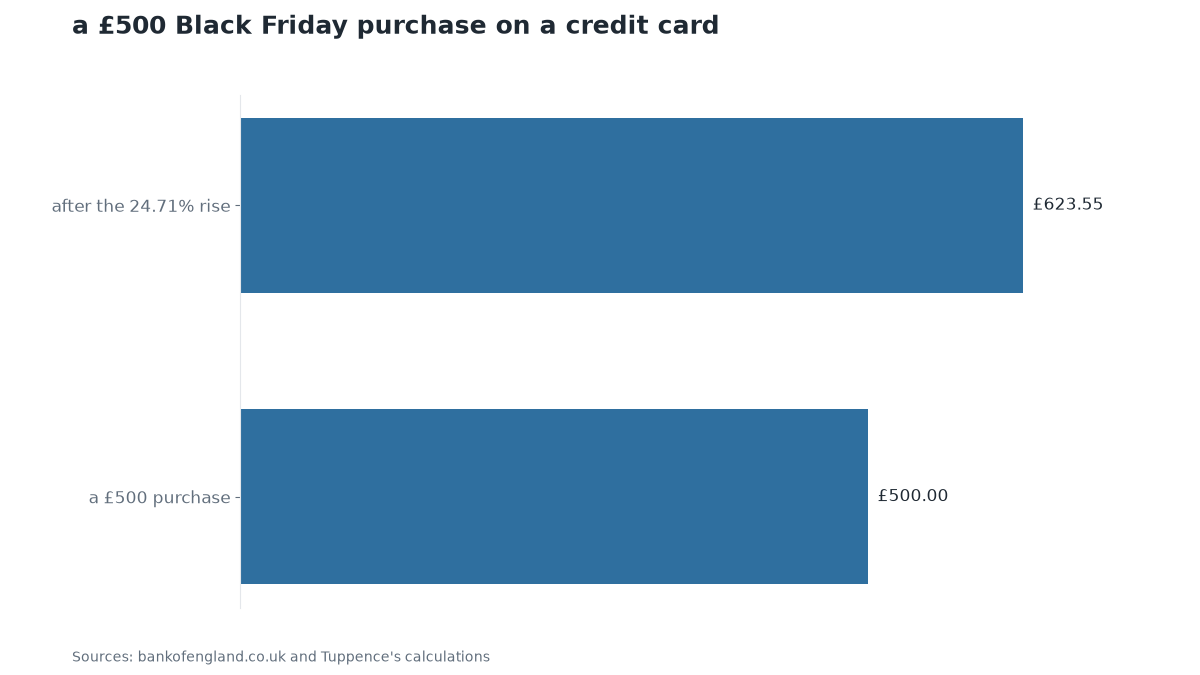
Take a hypothetical £500 Black Friday purchase as your starting point. If you carry this balance on a credit card for a year at the 24.71% representative APR, the total amount due rises to £623.55. This means the interest alone adds £123.55 to your original outlay. That sum is roughly a quarter of the purchase price, effectively wiping out the discount you thought you had secured.
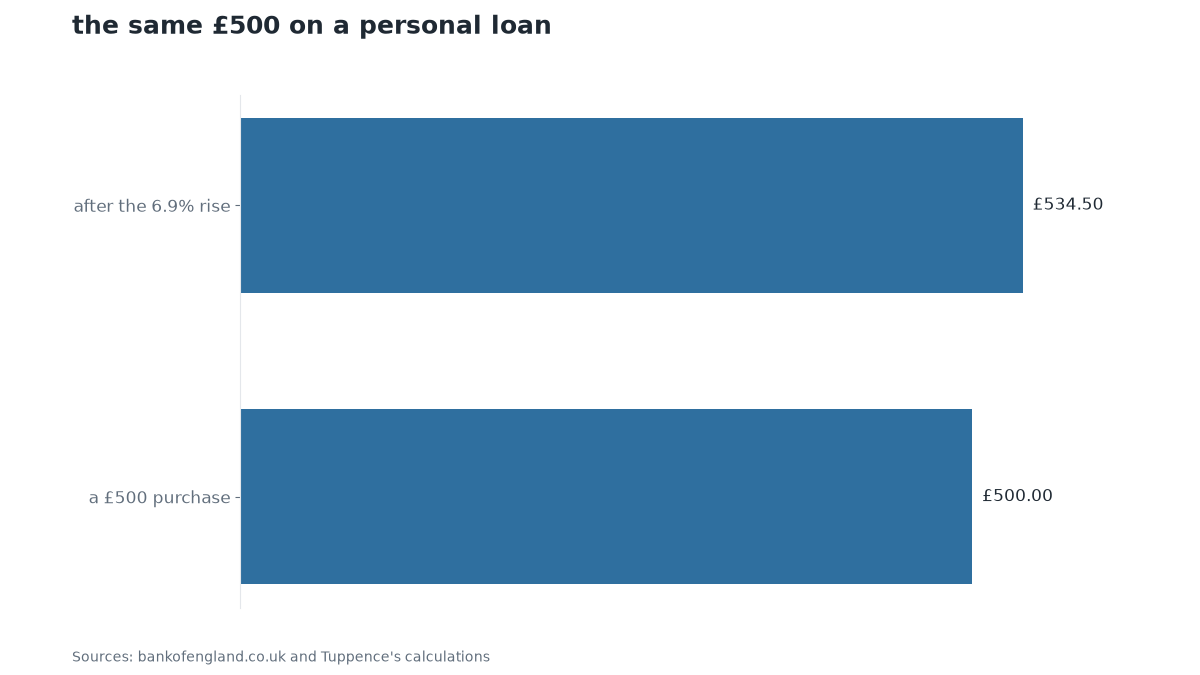
Now consider the same £500 spread over a personal loan. The representative APR for a £10,000 loan stands at 6.9%. Applying this rate to your example amount results in a total cost of £534.50. The difference here is just £34.50 in interest. This highlights a significant gap between the two methods of borrowing. The extra cost of using the card is the true price of that convenience.
These figures are market averages, not personal quotes. Your individual rates may vary. The software will compute the exact interest and difference for each option and produce a bar chart to visualise the gap. For this worked example, the difference for a £500 Black Friday purchase on a credit card is £123.55, while the difference for the same £500 on a personal loan is £34.50.
Where 24.71% sits among your other borrowing costs
That representative rate on card purchases is more than double the 12.08% average for a £5,000 personal loan and substantially higher than the 6.9% rate for a £10,000 loan. These loan figures are market averages weighted by volume, not specific offers, but they illustrate that spreading a large purchase over a personal loan is often cheaper than carrying a card balance, provided you check for arrangement fees and compare the total cost of credit over the full term. If you use an arranged overdraft instead, the interest rate climbs to 34.53%, making it the most expensive way to fund an impulse purchase.
Your savings account earns little by comparison. An instant-access savings account currently pays 2.07%, while a two-year fixed cash ISA offers 4.41%. Carrying card debt while holding cash is therefore a net loss, as the interest you pay on the card far exceeds the interest you earn on your savings. Bank Rate stands at 3.75%, anchoring variable-rate products. The spread between this anchor and the card APR is what makes it the priciest form of everyday borrowing. While some cards offer interest-free introductory periods, the representative APR reflects the ongoing cost once that period ends.
What to do before you swipe
Before paying, check the item’s price history to confirm today’s sticker is a genuine deal. If you need to spread the cost, obtain a personal-loan quote before reaching the till so you are comparing real numbers. The grace period is your only zero-interest window, so set a direct debit to clear the card balance in full before the payment due date.
If you know you will carry a balance, switch to the cheapest borrowing option first. Use the card only for its cashback or points, then repay the principal with your loan. This advice helps anyone planning a big one-off purchase around Black Friday or Boxing Week who defaults to the credit card. This is general information, not personal financial advice, and individual rates will differ.
- Check the item's price history over the past few months before assuming it is a genuine deal
- If you need to spread the cost, get a personal-loan quote before you reach the till
- Set a direct debit to clear the card balance in full before the payment due date
- If you know you will carry a balance, switch to the cheapest borrowing option first
- Put the interest you would have paid into a savings account instead
Sources
- What borrowing costs: Credit card, representative APR on purchases, Aug 2026 (Bank of England IUMCCTL, via StreetOwl)
- What borrowing costs: Personal loan of £10,000, APR, Aug 2026 (Bank of England IUMHPTL, via StreetOwl)
- What borrowing costs: Personal loan of £5,000, APR, Aug 2026 (Bank of England IUMBX67, via StreetOwl)
- What borrowing costs: Arranged overdraft, interest rate, Aug 2026 (Bank of England IUMODTL, via StreetOwl)
- What savings pay: Instant-access savings account (including introductory bonuses), Aug 2026 (Bank of England IUMB6VJ, via StreetOwl)
- What savings pay: 2-year fixed-rate cash ISA, Aug 2026 (Bank of England IUMZID2, via StreetOwl)
- Bank Rate: Bank Rate (the Bank of England's official interest rate), 2026-09-30 (Bank of England IUDBEDR, via StreetOwl)
This digest was drafted by StreetOwl’s own model from published figures and the sources listed, then read and approved by Michael Rossi on 3 October 2026 before it went up. It is general information, not financial advice: your circumstances are yours, and for a decision that matters, MoneyHelper (free, government-backed) or a regulated adviser is the place to go. General information, not personal financial advice. Figures checked on the dates shown.
← Back to StreetOwl