
A few hundred a month to spare? Here's the one comparison that decides
It comes down to two numbers on your statements and a small tax adjustment. The rest is preference.
Two numbers, one tax twist
The decision rests on comparing the rate on your mortgage with the rate on the savings account you would put the money in. Everything else is preference or risk tolerance. There is a small asymmetry to consider: interest you earn in a general savings account is taxable income, while the interest you stop paying by overpaying is not. The personal savings allowance means basic-rate taxpayers can earn a set amount of interest tax-free, which narrows the effective gap. If your mortgage rate exceeds the savings rate by more than the tax adjustment, overpaying is the simpler and more certain route. For a household using a standard amount of monthly surplus, this calculation determines whether the money works harder in the bank or reduces the debt. You must also consider the flexibility of your position. Money in a savings account remains accessible, allowing you to handle unexpected expenses without penalty. Money used to overpay a mortgage is locked in until you can withdraw it, a process that may incur fees or take time to complete. If you have no emergency fund, building that first is often the prudent step. Only after you have secured a buffer should you direct all remaining surplus toward reducing the loan balance. This approach balances financial security with the goal of becoming debt-free as quickly as possible. It ensures you are not caught off guard by a sudden need for cash while still making steady progress on your primary liability.
Worked example: £150,000, 18 years, £300 a month
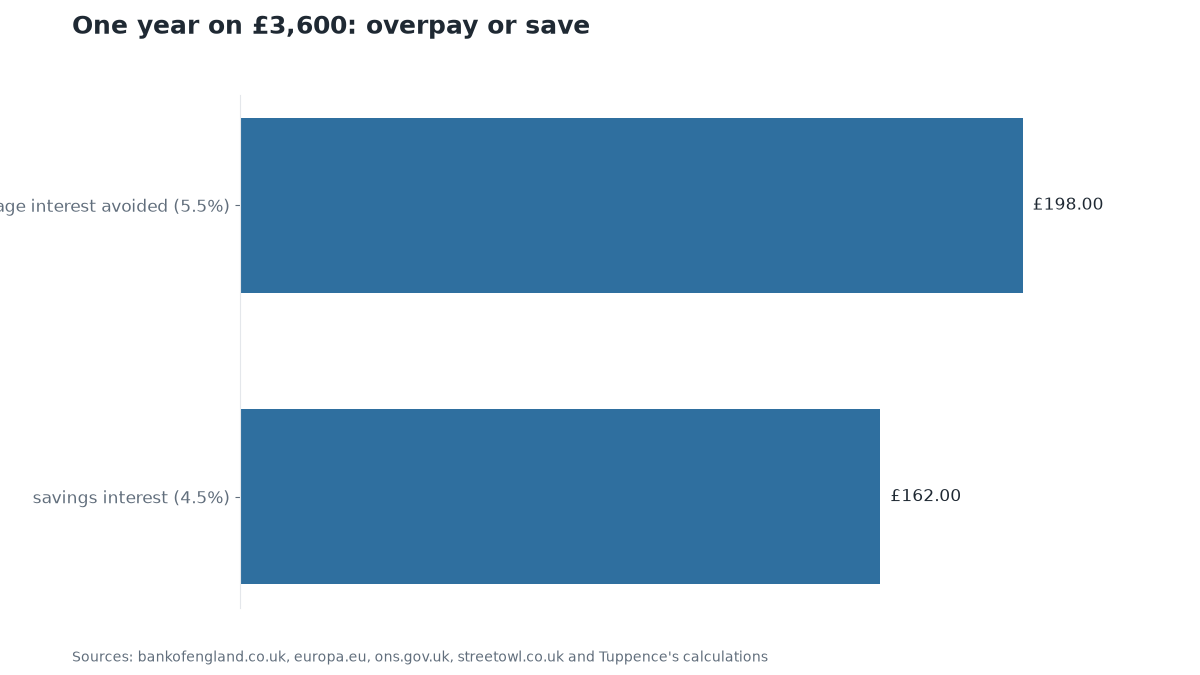
You face a choice between overpaying your mortgage or saving. With a mortgage rate of 5.5% and a savings rate of 4.5%, the math favors paying down debt. The common argument that you lose money by overpaying relies on a simple gap calculation, but it ignores how interest actually compounds and how tax affects your returns.
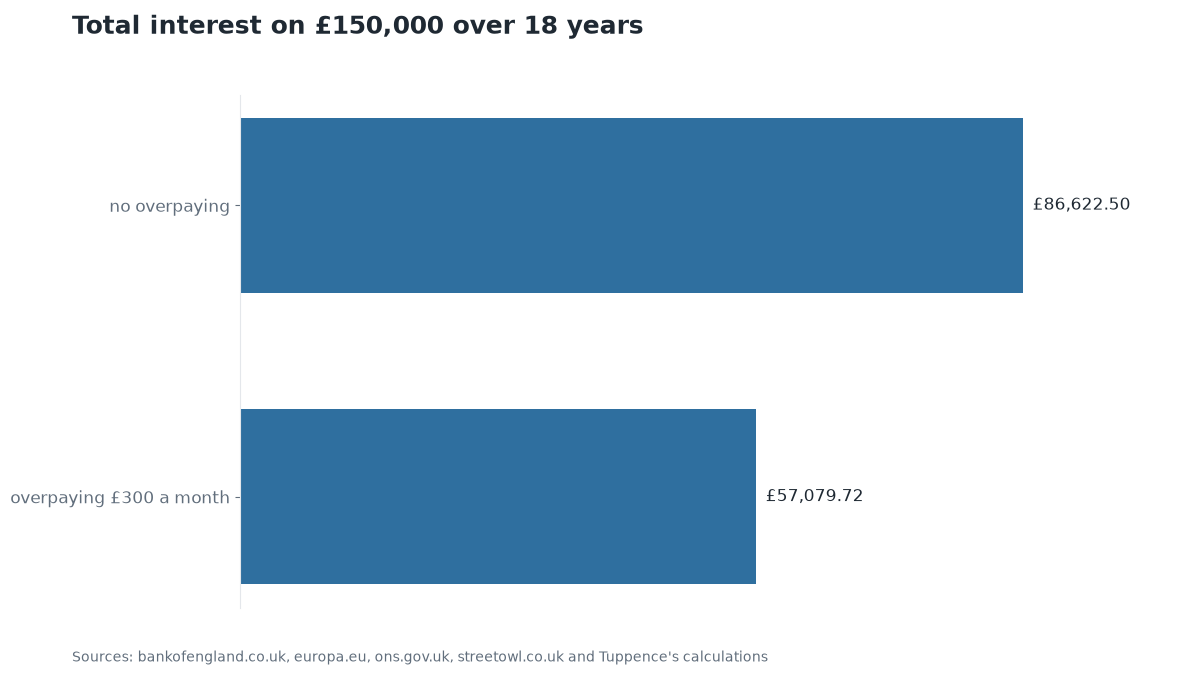
When you overpay, you reduce the principal balance, which lowers the interest charged each month. If you pay off your £150,000 mortgage without extra payments, you will pay approximately £86,622.50 in total interest over the 18-year term. By overpaying, that total interest drops to £57,079.72. This means you save £29,542.78 in interest costs. That saving is a clean gain because no tax is deducted from it.
Conversely, if you put that money into savings, you earn interest, but the taxman takes a cut. As a taxpayer, your effective savings rate may drop below the nominal 4.5%. This widens the gap between your borrowing cost and your savings return. Since your mortgage rate is higher than your effective savings rate, you are effectively earning a 5.5% return by reducing debt, compared to a lower, taxable return from saving.
Before you commit, ensure you keep an emergency fund of three to six months of expenses in an accessible account. Also, check your mortgage agreement for early repayment charges, as penalties can wipe out the interest savings. Assuming no penalties and a stable rate environment, overpaying is the stronger financial move. You secure a tax-free saving of £29,542.78 over the life of the loan. This is a significant sum that remains entirely yours, without the drag of income tax that would apply to interest earned in a savings account.
Before you redirect that standing order
You have seen the basic math: your mortgage rate is 5.5% and your savings earn 4.5%. The headline difference is 1%. However, overpaying your mortgage offers a compounding benefit that savings cannot match. When you make an overpayment, that cash goes directly to the principal, shrinking the base amount on which future interest is calculated. In a standard amortizing loan, every payment reduces the debt, meaning less interest accrues over the remaining term.
Consider a £150,000 mortgage over 18 years. Without overpayments, the total interest paid is £86,622.50. If you add a monthly overpayment of £300, the total interest drops to £57,079.70. The difference is £29,542.80. This is not a simple 1% saving; it is the cumulative effect of paying down debt faster. The loan finishes in 149 months instead of over two hundred, saving you 67 months of payments.
The 1% gap is also before tax. Interest earned in a general savings account is taxable income. If you are a basic-rate taxpayer, you pay a portion of that interest to the tax authority. This reduces your effective savings yield. Meanwhile, the interest you save by overpaying your mortgage is not taxed because it never happens. This asymmetry means the effective gap between your mortgage cost and your savings return is wider than the headline figure suggests.
The primary argument for saving is liquidity. Cash is available immediately for emergencies. Mortgage equity is illiquid. If you overpay and then need cash, you may face early repayment charges or need to take out a costly loan. This is why the decision is a risk assessment. If you have a robust emergency fund, the liquidity risk of overpaying is low. If you do not, building that fund first is essential. Do not overpay your mortgage at the expense of having no financial buffer. Being forced into a high-cost loan later is a far greater cost than the interest saved.
Check your mortgage agreement for early repayment charges. If you are in a fixed-rate period, overpaying above the permitted limit can incur fees. If the fees are low, overpaying is usually beneficial. Ensure you have enough cash to cover your expenses before directing extra payments to your mortgage. Automate your overpayment to ensure consistency. For most people with a stable income and an emergency fund, overpaying a mortgage at 5.5% when savings earn 4.5% is the financially superior choice. The tax advantage and principal reduction make it a strong move, provided you keep your cash buffer.
- example mortgage rate: £5.50 %
- mortgage balance: £150,000
- remaining term: 18 years
- monthly overpayment: £300 a month
- example savings rate: £4.50 %
- Open your most recent mortgage statement and write down the current interest rate, remaining balance, and months left on the term
- Check the annual rate on the savings account you are considering and note whether it is fixed or variable
- Scan your mortgage agreement for any early repayment charge and the window in which it applies
- Decide how much surplus cash you can redirect each month while keeping a three-month buffer in instant access
- If your mortgage rate is higher than the savings rate, redirect the standing order; if it is lower, keep the cash where it earns
Sources
- Bank Rate: Bank Rate (the Bank of England's official interest rate), 2026-10-01 (Bank of England IUDBEDR, via StreetOwl)
- Real inflation — your shop: Rice, in all forms, Jan 2026 to Aug 2026 (ONS consumption segment indices (research-grade, not accredited official statistics), via StreetOwl)
- Holiday money: best-value destinations now: Holiday value score, Euro, 2 Oct 2026 (StreetOwl, from ECB and World Bank data, via StreetOwl)
- Holiday money: best-value destinations now: £1 in Philippine peso, 2 Oct 2026 (European Central Bank, via StreetOwl)
- Insurance risk where you live: Motor insurance risk, Hackney, 2026-10-03 (StreetOwl, from police.uk, DfT and ONS data, via StreetOwl)
This digest was drafted by StreetOwl’s own model from published figures and the sources listed, then read and approved by Michael Rossi on 4 October 2026 before it went up. It is general information, not financial advice: your circumstances are yours, and for a decision that matters, MoneyHelper (free, government-backed) or a regulated adviser is the place to go. General information, not personal financial advice. Figures checked on the dates shown.
← Back to StreetOwl