53p in every £1 of petrol is tax: the real cost of your commute
Over half of what you pay at the pump is not the cost of oil, but fixed duty and VAT. Here is what that means for your monthly fuel bill.
The 53p split: tax vs the rest
When you fill your tank, more than half the cost is not driven by the oil market. Currently, 53p of every £1 you pay is accounted for by fuel duty and VAT. This fixed regulatory charge sits below the tax burden on other goods. Cigarettes carry a duty and VAT share of about 80%, while wine follows at 50%, and beer at a pub typically includes around 30% tax. Spirits are taxed at a similar high rate. This distinction matters because the 53% tax component is a policy decision, not a commodity price. It does not fluctuate daily with global supply chains or refinery output. Instead, it remains a constant slice of the total cost until the government decides to adjust rates. While crude oil prices can rise or fall, this tax element stays steady. This creates a floor under the pump price that is independent of international market conditions. Understanding this split helps clarify why petrol prices do not mirror oil price movements one-for-one, as a substantial part of what you pay is fixed by domestic regulation rather than global trade dynamics.
What the tax is doing to your weekly fill
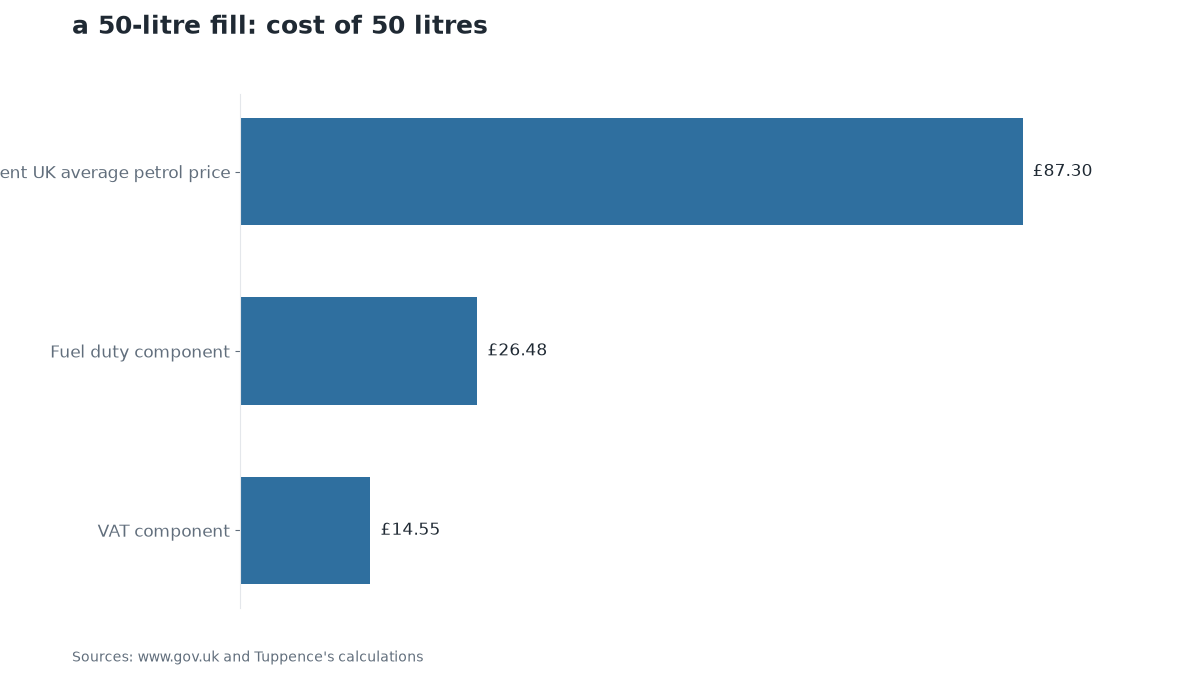
The current UK average petrol price is 174.6p a litre. This breaks down into 52.95p fuel duty, 29.1p VAT, and 92.5p for crude, refining, and retail. The combined tax portion is nearly equal to the 92.5p cost of the fuel itself.
For a 50 litre fill, the total cost is £87.30. This includes £26.48 in fuel duty and £14.55 in VAT. Subtracting the VAT from the total leaves a difference of £72.75. This means the full price is 500% more than the VAT component alone. Over 10,000 miles a year, this tax burden costs you approximately £835.
Since the tax is a fixed charge, it remains a major part of your bill regardless of oil market changes. Knowing this split helps you budget accurately, recognising that over half your spend is a regulatory charge rather than a variable commodity cost.
Why crude oil is only part of the story
Brent crude averaged $128.50 a barrel in early October 2026, up 100% from a year earlier. Yet this spike represents only 60.6p of the 174.6p pump price. The remaining 31.9p covers refining, delivery, and retail margins, leaving the tax burden as the dominant fixed cost. This structure creates a specific dollar sensitivity: a $10 move in crude translates to roughly 5.7p per litre at the pump.
It is easy to assume that because oil has doubled, your fuel bill should have doubled. The data shows this is not the case. A substantial portion of the price is statutory, not market-driven. When you see headlines about crude oil volatility, remember that the variable part of your cost is smaller than the fixed part. This means that even if global oil prices fall, the 53p tax component remains unchanged.
Consequently, cheaper petrol is primarily a political decision. The oil market determines the base cost, but the government sets the tax floor. Understanding this split helps you see that waiting for a drop in global crude prices may not yield the large savings you expect, as the fixed duty remains a constant drain on your monthly budget.
What to do about it
You can quantify your personal exposure by calculating your annual fuel duty burden. Take your typical monthly mileage and multiply it by the tax share of the pump price established earlier. This gives you a clear figure for the fixed regulatory cost you pay each year, independent of oil market fluctuations. Knowing this amount helps you see how much of your spend is policy-driven rather than commodity-driven.
Next, check your local pump prices against the national median of 173.9p a litre. This median is derived from data across 8,085 forecourts, meaning half are cheaper. If your local price is significantly higher, the difference is largely due to retail margins rather than tax. Switching to a forecourt closer to this median can reduce your total spend without altering the underlying duty structure.
Finally, consider if a different vehicle would change your fixed tax exposure. Electric vehicles do not incur fuel duty or VAT on electricity consumption in the same way petrol does. While the purchase price and energy costs differ, the absence of the per-litre tax burden means the structure of your running costs changes fundamentally. This is a long-term decision, but it is worth evaluating against your current annual duty calculation.
- fill size: 50 litres
- Calculate your annual fuel duty by multiplying your monthly miles by the 53% tax share.
- Check your local pump prices against the national median of 173.9p to find cheaper retail margins.
- Consider if a different vehicle (like an EV) would reduce the fixed tax burden on your commute.
Sources
- Taxes: Duty and VAT as a share of a typical pump price, petrol and diesel, current HMRC rates (StreetOwl, from HMRC duty rates, via StreetOwl)
- Taxes: Duty and VAT as a share of a typical shelf price, cigarettes, current HMRC rates (StreetOwl, from HMRC duty rates, via StreetOwl)
- Taxes: Duty and VAT as a share of a typical shelf price, spirits, current HMRC rates (StreetOwl, from HMRC duty rates, via StreetOwl)
- Oil to pump: Petrol, UK average pump price, week of 19 October 2026 (Department for Energy Security and Net Zero, via StreetOwl)
- Oil to pump: Crude oil in a litre of petrol, week of 19 October 2026 (StreetOwl, from EIA, Federal Reserve and DESNZ data, via StreetOwl)
- Taxes: Extra duty and VAT a year: 10 cigarettes a day, 14 units a week, 10,000 petrol miles, current HMRC rates (StreetOwl arithmetic from HMRC rates, via StreetOwl)
- Pump prices: Petrol (E10), national median pump price, 2026-10-21 (StreetOwl, from retailer open data fuel-e10, via StreetOwl)
This digest was drafted by StreetOwl’s own model from published figures and the sources listed, then read and approved by Michael Rossi on 22 October 2026 before it went up. It is general information, not financial advice: your circumstances are yours, and for a decision that matters, MoneyHelper (free, government-backed) or a regulated adviser is the place to go. General information, not personal financial advice. Figures checked on the dates shown.
← Back to StreetOwl