47% of your fuel is tax: what is really in a litre of petrol
Nearly half of what you pay at the pump is government tax, and the oil beneath it has risen sharply in a year. Here is the breakdown and what it means for your running costs.
What is actually in a litre
The average petrol price is 172.8p a litre. Department for Transport data for the week of 2 November shows fuel duty at 52.95p and VAT at 28.8p, meaning 47% of the price is tax. The remaining 91p covers the physical product: 54.9p for crude oil and 36.1p for refining, delivery and the retailer. This means the actual oil is barely a third of what you pay.
Fuel duty is a fixed pence-per-litre charge, so the tax per mile does not fall when oil prices drop; only commodity and distribution costs move. VAT is ad valorem, so the total tax share shifts as the base price changes. Note that the 5p duty cut in the 2026 Budget temporarily reduces the duty component, meaning the fixed amount is not truly fixed across a policy boundary.
The oil underneath is climbing
The raw material cost has shifted dramatically since last year. In the week of 2 November 2026, petrol averaged 172.8p a litre, up from 134.4p a year earlier. Diesel saw a similar jump, rising from 142.6p to 198.6p over that same period. This is not just a temporary blip. Wholesale diesel prices hit all-time highs in mid-September, and the IEA expects gasoil supply to remain below demand through the fourth quarter of 2026. Lost stocks are not expected to be rebuilt before the second half of 2027, meaning this pressure is likely to persist.
For any fuel-burning mode of transport, fuel is typically one of the largest single operating costs. When the underlying commodity price rises sustainably, it feeds through to running costs or ticket prices, even if operators try to absorb part of the increase. The exact share varies by operator, route, vehicle efficiency and load factor. Airlines also face a different tax regime to road fuel, so the tax share of a ticket is not the same as the 47% seen at the petrol pump.
Worked example: a year of driving, then and now
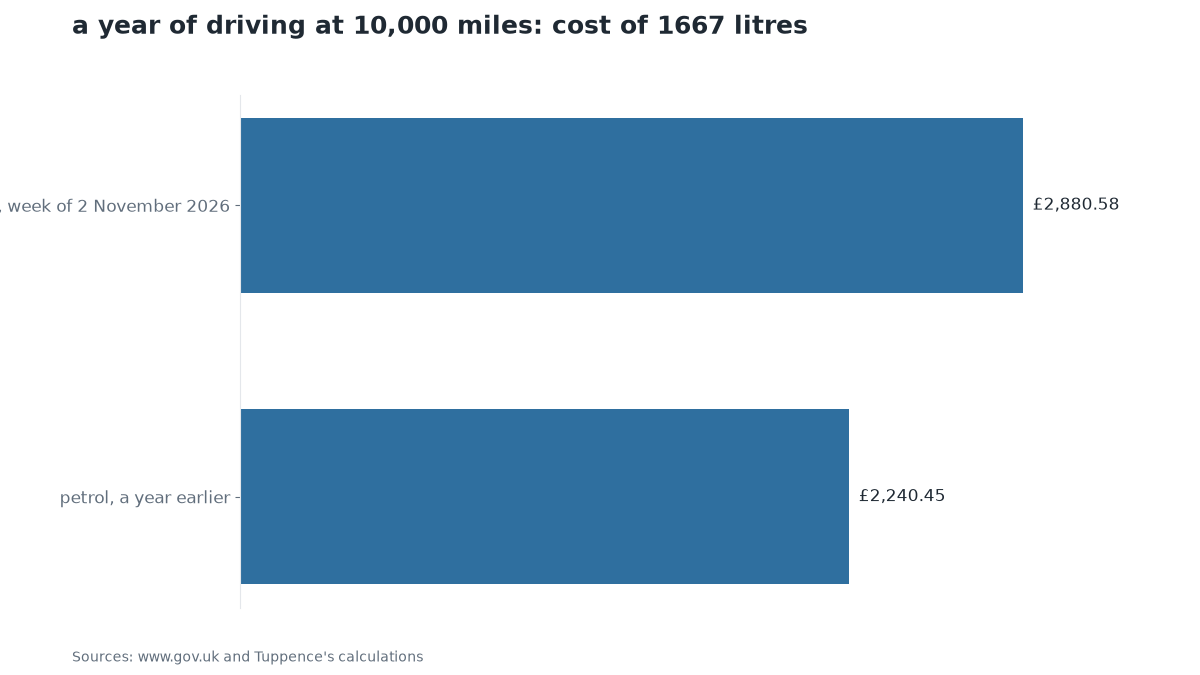
For a household driving 10,000 miles a year, the assumed fuel use is 1,667 litres. You can substitute your own mileage and efficiency, but this baseline helps show the impact. At the current average price, the cost for the week of 2 November 2026 is £2,880.58. A year earlier, the same amount cost £2,240.45. The difference for a year of driving is £640.13, meaning current prices are 28.57% higher.
Diesel drivers face a steeper rise, moving from 142.6p to 198.6p. The fuel tax component alone for 10,000 miles is about £870, so the total bill including the commodity cost is higher still. This breakdown highlights how much of your running costs are fixed by government rates rather than just the price of oil.
The diesel squeeze and the temporary duty cut
Diesel has hit a record 200.01p a litre, and the International Energy Agency expects tight supply through the fourth quarter of 2026. The government extended the 5p fuel duty cut to July 2027 in the 28 October Budget. This measure reduces the 52.95p duty component by 5p per litre. However, it does not lower the costs of crude oil, refining, or distribution. Those underlying factors remain high due to global supply constraints. Consequently, the relief is partial. Once July 2027 arrives, the duty reverts to its previous level unless further action is taken. For now, the temporary cut softens the blow, but it does not solve the structural price increase. You should view this as a pause rather than a permanent change. The physical cost of diesel continues to climb independently of tax policy.
What to do about it
Before you fill up, check the national median pump prices: 169.9p for petrol and 198.9p for diesel. These are the median of 8,090 forecourts, meaning half are cheaper. If your local station is above these medians, look for a cheaper option nearby.
If you drive diesel, the national median is 198.9p a litre. The IEA expects gasoil supply to stay tight through Q4 2026. When budgeting for the year ahead or planning a larger fuel purchase, note the 5p duty cut deadline of July 2027. This temporary relief will expire, so prices may rise again after that date.
These are general observations, not personal financial advice. The right response depends on your mileage, vehicle type and whether you can shift travel to lower-cost locations or off-peak times. Consider your individual circumstances before deciding when and where to buy fuel.
- fuel used in a year: 1,667 litres
- annual mileage: 10,000 miles
- Look up today's national median petrol and diesel prices on the DfT weekly fuel data or a forecourt-comparison site, and note whether your usual station is above or below the median
- Work out your own annual fuel tax: multiply your yearly miles by the litres you use, then apply the 52.95p duty and 28.8p VAT per litre from the DfT weekly data to see how much of your fuel bill is government revenue
- Mark the July 2027 deadline for the 5p duty cut in your calendar; after that date the duty reverts unless the government extends it again
- If you drive diesel, check whether your local station's price is tracking the national median of 198.9p or sitting above it, given the IEA's warning that gasoil supply stays tight through Q4 2026
- Compare your actual running cost per mile (fuel plus tax) against a rail or bus ticket for the same journey, remembering that rail fares are regulated and indexed to RPI (3.9% in September 2026) rather than to wholesale fuel prices
Sources
- Oil to pump: Petrol, UK average pump price, week of 2 November 2026 (Department for Energy Security and Net Zero, via StreetOwl)
- Oil to pump: Crude oil in a litre of petrol, week of 2 November 2026 (StreetOwl, from EIA, Federal Reserve and DESNZ data, via StreetOwl)
- Fuel security: will there be a shortage, and when?: Trigger (Occurring, Now): Global distillate price shortage, 2026-11-02 (StreetOwl, from the sources named in the text, via StreetOwl)
- Taxes: Extra duty and VAT a year: 10 cigarettes a day, 14 units a week, 10,000 petrol miles, current HMRC rates (StreetOwl arithmetic from HMRC rates, via StreetOwl)
- Pump prices: Petrol (E10), national median pump price, 2026-11-08 (StreetOwl, from retailer open data fuel-e10, via StreetOwl)
- Prices: RPI inflation, twelve-month rate, Sep 2026 (ONS CZBH, via StreetOwl)
This digest was drafted by StreetOwl’s own model from published figures and the sources listed, then read and approved by Michael Rossi on 9 November 2026 before it went up. It is general information, not financial advice: your circumstances are yours, and for a decision that matters, MoneyHelper (free, government-backed) or a regulated adviser is the place to go. General information, not personal financial advice. Figures checked on the dates shown.
← Back to StreetOwl