The economics of… Budget or premium washing machine: what does an extra £550 buy?
Edition 6 · By Michael Rossi · 5 November 2026 · next review 5 February 2027
A £799 Miele and a £249 Indesit wash the same 8kg load for about the same electricity. The extra £550 pays its way only if the Miele lasts about 17 years.
“An £800 washing machine is not three times better than a £250 one. That is the law of diminishing value: past a certain point, every extra pound buys less than the one before it.”
The question
Two freestanding washing machines on the same retailer's shelf. The Indesit MyTime IMA864 costs £249. The Miele W1 WEB365 WCS costs £799, reduced from £899. Both take an 8kg load, both spin at 1,400rpm, both carry an A energy rating. The gap is exactly £550.
So what do you actually get for the extra £550, and does it pay you back? Prices were checked on 5 November 2026 and move often; the reasoning below holds as long as the gap is roughly the same.
What both do the same
Washing clothes. Independent testers keep finding that price is a poor guide to how clean the washing comes out. Which?, testing Miele's dearest machine in December 2025, put it plainly: "paying more for a machine doesn't always guarantee better performance". Australia's consumer group CHOICE found cheaper machines beating dearer ones on dirt removal in its tests.
Electricity is close too. The Indesit is rated at 42kWh per 100 washes. The Miele is labelled "A-20%", meaning it beats the A threshold by a fifth. Even if it used a full fifth less than the Indesit, that is a saving of under £5 a year at today's price cap.
What the extra £550 buys
| Indesit £249 | Miele £799 | Does it pay you back in money? | |
|---|---|---|---|
| Guarantee | 1 year | 2 years | A little. The same retailer sells three years of cover for the Miele at £84, so a year of cover is worth roughly £28. |
| Electricity | 42kWh per 100 washes, about £24 a year | A-20%: at most about £5 a year less | A little: under £100 over twenty years. |
| Noise on spin | 76dB | 72dB | No. A comfort: roughly a quarter quieter to the ear. |
| Extras | The basics | Wi-Fi app, load sensing, AddLoad (add a forgotten sock mid-wash), 20-minute quick wash | No. Convenience. |
| How long it is built to last | Not published. Budget machines typically last 5 to 8 years. | Tested for 5,000 washes, about 20 years of normal use | Yes, and this is the only big one. |
Read down the last column. Only one line can return the £550 in hard money, and that is durability. Everything else is either small change or comfort.
The sum: what a year of washing costs
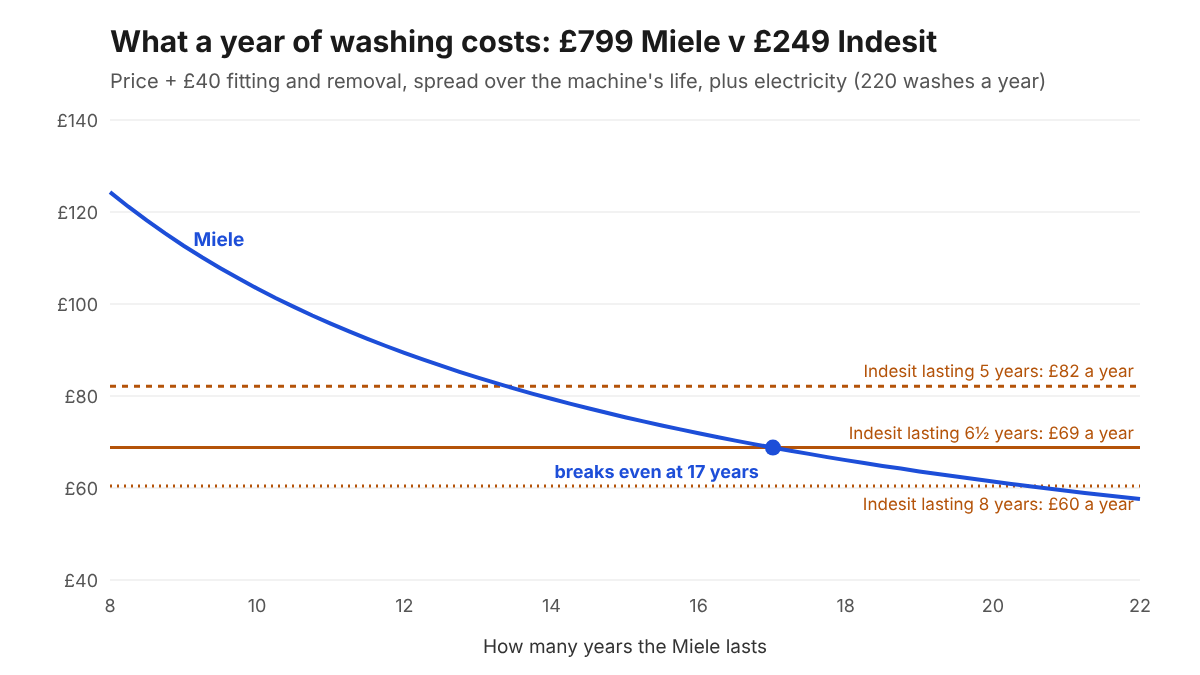
Spread each machine's price over its working life, add £40 each time for delivery, fitting and taking the old one away, and add electricity for 220 washes a year (the figure the energy label assumes) at 26.32p per kWh, the Ofgem price cap from October to December 2026.
If the Indesit lasts six and a half years, the middle of the typical range, a year of washing costs about £69. The Miele costs £61 a year if it reaches 20 years, £75 if it manages 15, and £89 if it gives up at 12.
The break-even point is about 17 years. If the cheap machine dies at five, the Miele needs only 13 to catch up; if the cheap machine keeps going for eight, the Miele needs more than 20.
If everything goes to type, the Miele comes out about £150 ahead over twenty years. That is £7.40 a year: the reward for being right about a machine still working in 2046.
The catches
Twenty years is a test result, not a promise. Miele runs its machines for the equivalent of 5,000 washes; its guarantee is two years. Since July 2021, makers of new models must also keep spare parts available to professional repairers for up to ten years, which helps both machines, but internal parts such as motors and pumps are not sold to the public.
Money today is worth more than money later. The £550 left in savings earns interest. At, say, 4% a year it roughly doubles in 18 years, which on its own would wipe out the £150 advantage. Treat that rate as an illustration, not a forecast.
Heavy use changes the answer. A large family running twice the average number of washes wears out a cheap machine faster. Industry estimates put budget machines at 3 to 5 years under heavy use and Miele at 10 to 15. On those midpoints the Miele comes out about £15 a year cheaper. The more you wash, the more durability is worth.
And you have to still be there. A washing machine plumbed into a kitchen often stays with the house when you move.
Brand cost and added value
Split the £550 in two. The added value is the part you could put a price on: one more year of guarantee (about £28), a little less electricity (up to about £100 over two decades), and a long design life that might save you two replacements. The brand cost is the rest: the quieter spin, the app, the badge on the door and the confidence that comes with it.
There is nothing wrong with paying for comfort. The point of the law of diminishing value is to know when you are doing it.
Does the law of diminishing value apply?
Yes. The £799 machine does not wash three times better than the £249 one. It is not three times quieter or three times cheaper to run. Its whole case rests on lasting roughly three times as long, and even then it only edges ahead.
What the numbers say: if you wash an average amount, the budget machine is level or ahead, and you keep £550 in your pocket today. If you wash a lot and expect to stay put for well over a decade, the premium machine roughly pays its way, with quiet and convenience thrown in. In between sits a third route that one long-running repair site recommends: move up a brand tier, not up a model. A mid-range machine such as Bosch's Series 2 was £399 on the same shelf.
Next weeks: does the law hold for a £100 hair dryer against a £35 one, or a £200,000 car against a £20,000 one?
This is an explainer, not financial advice. For free, impartial guidance, see MoneyHelper.
What the sums assume
- 220 washes a year (energy-label basis); 440 for the heavy-use case
- Electricity 26.32p/kWh, Ofgem cap Oct–Dec 2026, direct debit average
- £40 per machine for delivery, fitting and removal (AO: £30 installation + £10 disconnection)
- Budget lifespan 5–8 years, midpoint 6.5; heavy use 4 v 12.5 years (Whitegoods Help, indicative)
- Miele electricity treated as 20% below the Indesit's 42kWh/100 — generous to the Miele
- Prices held flat in today's money; the 4% savings rate is an illustration
Sources
- Appliances Direct: Indesit MyTime IMA864 and other 8kg washing machines (prices checked 5 November 2026)
- Appliances Direct: Miele WEB365WCS W1 8kg washing machine
- AO: Indesit MyTime IMA864 specification (energy, noise, guarantee)
- Miele: the Miele test lab (5,000 wash cycles)
- Which?, "Is Miele's cheapest washing machine also the best?", 4 December 2025
- Which?, Best washing machine brands (reliability survey, July 2025)
- CHOICE, Splurge vs save: washing machines, March 2022
- Whitegoods Help, Is a more expensive washing machine a better one? (reviewed April 2026)
- Whitegoods Help, How long should a washing machine last? (reviewed April 2026)
- Whitegoods Help, Right to repair for white goods
- Ofgem, Changes to energy price cap between 1 October and 31 December 2026