
Zurich
Zurich (German: Zürich, Swiss German: Züri) is the largest city in Switzerland and an international financial centre. Zurich is close to some excellent skiing resorts and many people headed for the Swiss Alps don't spend much time in Zurich itself, but you'd be missing a lot if you don't explore Zurich.
Most read about in January, least in December. That is when people look it up, which tends to run a month or two ahead of when they go.
Before you book
The Foreign, Commonwealth & Development Office publishes the UK’s official travel advice. It changes without notice and travelling against it usually invalidates your insurance, so read it at the source rather than anywhere else — including here.
FCDO travel adviceUnderstand

While Zurich is Switzerland's biggest city and a cultural centre of German-speaking Switzerland, Bern is the Swiss capital. It has a population of some 430,000 (2022) in the city, and 1.8 million (2011) in the metro area. Zurich is on Lake Zurich, where the lake meets the river Limmat, in the north of Switzerland. Despite it not being the administrative capital of any more than its Kanton, Zurich punches well above its weight in terms of major media and business headquarters and due to it being at the heart of Switzerland's excessively punctual and meticulously maintained train network and being home to Switzerland's most important airport, it is often the first part of Switzerland that visitors get to see.
While Zurich can be expensive, it is also clean, efficient and blessed with a high standard of living, which together with the high wages, explains why people bear with the high prices. Zurich has drawn people from the rest of Switzerland for centuries, but in the 20th and 21st centuries it has also begun to draw both people and companies from outside Switzerland and in some cases even outside Europe. This means that you will hear a lot more languages than just Swiss German and the overall atmosphere is a lot more cosmopolitan than you might think. Zurich is home to ETH Zurich, one of the world's leading technical universities, which has produced a number of Nobel laureates and numerous innovations and due to Switzerland's long history of neutrality it also houses headquarters of the likes of FIFA and the International Ice Hockey Federation. Zurich is also home to a number of large banking and insurance conglomerates that grew on the fabled Swiss banking secret and still enjoy good reputations in the financial sector. Most shops and supermarkets are closed on Sundays. Travellers should plan their shopping for Saturday.
History
The city's Latin name, Turicum, was used for a Roman customs station at the Limmat, which has some remnants today. The Alemanni, a Germanic tribe, settled in the 5th century. While the Church used to rule early Medieval Zurich, the Guilds (Zünfte) took power in 1336, establishing Zurich as an autonomous republic. The Guilds have survived until today, though their role today is mostly ceremonial. Zurich became the fifth canton of the Swiss Confederacy in 1351, and has been its capital at times. However, Switzerland's famous neutrality and stability is a modern thing, as many battles have been fought in and around Zurich. The canton lost the Old Zürich War between 1440 and 1446 against the confederacy, and was re-admitted in 1450. Ulrich Zwingli led the Protestant Reformation in Switzerland during the early 16th century. As the Thirty Years War ended in 1648, the Holy Roman Empire lost its grip on Switzerland, which has mostly been independent since then. The 1830s and 40s saw a series of revolts and war, including the Züriputsch, a revolt of conservative landowners of the canton, against the city of Zurich, and the 1847 Sonderbund War. In 1848 Switzerland adopted a constitution, which established the country as a federal republic. While the government settled in Bern, many federal institutions, including the new Polytechnic University (ETH) have their seat in Zurich. The Zurich Stock Exchange was founded in 1877, and the city rose as a financial centre in the 20th century, as Switzerland remained neutral in the World Wars, and could maintain lower taxes on capital than the European great powers. Even though Switzerland has opted out of NATO and the European Union, Zurich is today one of central Europe's most cosmopolitan cities.
Getting there

By plane
1 Zurich Airport (ZRH IATA) is Switzerland's largest and busiest airport, handling roughly 30 million passengers a year. It is in the community of Kloten and it is 10 minutes by train from the main station. The trains depart about every 10-15 minutes, during the day, but less frequently at earlier or later hours. A single ticket to Zürich HB (the hauptbahnhof, or the main station) costs Fr. 6.80. Several bus lines connect to the airport and provide access to the Winterthur region near it. There is also tram 10 from Zurich terminating at the airport, a rather slow option, but it might be faster door to door for some destinations in Zurich. Most major airlines fly to Zurich but flag-carrier Swiss is still the biggest player at ZRH and offers the widest range of connections. Almost every large hotel in Zurich provides shuttle buses from the airport to your hotel. The stops for these buses are a short walk to the right from Terminal 1 arrivals. Zurich Airport has high passenger costs due to several noise reduction and approach restrictions. Most no-frill airlines fly to Basel which is 1 hour away by train. EasyJet offer several flights to Germany, the UK and Southern Europe. If you are travelling without a Schengen Visa to another destination in Europe (via Zurich airport) and if you are not a European citizen, you must not stay in Europe for longer than 90 days — even if your final destination would allow citizens of your country to stay for more than 90 days. Failure to do so will lead to very high fines (around €8100) should you try to leave Europe via Zurich airport . Zurich Airport offers free WiFi for all guests for a maximum of two hours. A mobile phone capable of receiving texts in Switzerland is required. Travelers have to connect to the "ZurichAirport" network and register their cell phone number. The user will receive the access code via text message. After the free hour, there is a five-hour waiting period before you can access the next free hour.
By train
Regular trains to and from other Swiss and European cities leave from and arrive at Zürich HB (Hauptbahnhof), the main train station, located in the city centre at the end of Bahnhofstrasse, with easy access to mass transit. Zurich HB is served by the local S-Bahn commuter trains, InterCity (IC and ICN) connections throughout Switzerland, Italy, Germany's IC and ICE, France's TGV Lyria and Austria's Railjet with some direct connections reaching destinations as far in Eastern Europe as Budapest. While Switzerland itself does not have many high speed lines, Zurich is connected to the high speed rail networks of neighboring countries. The once extensive sleeper train network has been cut down a lot in the 21st century, but there are still some ÖBB Nightjets connecting Austria and Germany with Zurich. Non-nightjet sleeper trains also run to Zurich from Prague and Budapest. Platforms 3 to 18 are aboveground. Underground, Platforms 41–44 are below ground on the northeastern end of the station (follow signs toward "Landesmuseum"), platforms 31–34 are in the middle of the station (follow signs toward "Löwenstrasse"), and platforms 21–22 (only used by the S4 and S10) are on the southwestern end. An interactive map can be found here. Domestic train tickets within Switzerland are available through the SBB Website though there are few early bird discounts. International tickets can sometimes be bought through the SBB as well, but often you can get better offers through the DB website (German) the SNCF website (France) or the websites of ÖBB and Trenitalia for Austria and Italy respectively. All adjacent railways have (sometimes significant) discounts for early booking on international trains, so if you know your plans far in advance, by all means book early. The train station and the connecting underground mall has shops, restaurants, and a grocery store which locals use when they need to do Sunday shopping, as it is not subject to the closing hours laws otherwise in force in the city. It also hosts a Christmas market and other events in the big entrance hall. There are some 24-hour lockers in level B1 available for Fr. 6-9 per 24 hr (maximum 3 days). Just to the east of the train station on the Bahnhofbrücke bridge, there is a large Coop supermarket open Monday to Saturday till 22:00.
By car
The region around Zurich has probably the highest density of highways in the country, which makes it very convenient to access. A1 goes past Zurich just north of the city, with two feeders into the city centre. A3 and A4 end just south of the city. The regional highways A51, A52 and A53 all also lead to Zurich. While this makes it that there are many ways to drive into the city from every direction, it also means that there is a lot of congestion, especially during morning and evening hours. Parking is also hard to get at affordable rates, so it might therefore be faster and more convenient to travel by public transport.
Getting around

Public transport
Zurich is famous for its highly efficient, clean and safe public transport system, managed by the Zürcher Verkehrsverbund (ZVV) which covers the entire canton of Zurich and extends into nearby regions. The network includes trams, buses, S-Bahn (suburban trains), cable cars, and boats. The size and complexity of the network may be daunting at first, but you will soon realize that there are many ways to get from one place to another, all efficient. Tickets and timetable information for Switzerland is available on sbb.ch or can be obtained using the SBB Mobile (iOS, Android apps) (requires a working internet connection). Alternatively, use ZVV's own timetable app or purchase tickets with the ZVV-Tickets app. The free Wemlin App (iOS, Android) gives you offline access to timetable information and network maps for the canton of Zurich area without internet connection and is therefore ideally for on the go usage in case you don't want to use data roaming. You may want to consider using the EasyRide function of the SBB Mobile app, which allows you to "check-in" to rides and calculates the cheapest ticket charge at the end of the day. The Zurich transit system is divided into numerous fare zones. A ticket for zone 110, which covers the city proper, will suffice for most travelers. The more zones you pass through, the more you'll have to pay for your journey. Each zone has the same price, except Zurich (110) and Winterthur (120), which cost double. There are single tickets, punch cards (Mehrfahrtkarten, these provide six rides for the price of five), day cards (these are designed for round trips and valid for 24 hours), monthly cards, and annual cards. The monthly and annual cards are collectively referred to as ZVV NetzPass. You should buy tickets using the SBB app. Tickets can also be purchased from a ticket vending machine before boarding or from one of the ticket selling kiosks in major train stations. The ticket vending machines are in German, English, French and Italian and offer almost all regular tickets available (not personal tickets though). Simply enter your destination and pick a ticket. The machine may suggest several routes, of which you generally want to pick the cheapest one – never pick the "All zones" option unless you actually intend to pass through eight or more zones! Your ticket gives you access to all modes of transport within the selected zones, at any time of day or night. Both the ZVV and the SBB app provide a "check-in/check-out" mechanism: check in before you start your trip, check out when you end your trip. The best-priced ticket for your day is computed at the end of the day and charged on the following day. It does require data access and localization, as well as means of payment (typically credit card) to be added to the app. It is very important to check-in before the time of the departure of the means of transportation you enter, as fines may be issued otherwise. If you're staying for a longer period, consider a monthly ZVV NetzPass, because even though there are no regular tickets valid for something between 1 day and a month, it takes only 10 "zone 110" day cards for a "zone 110" monthly card to be cheaper. When travelling in all zones, it takes only 8 day cards for the monthly card to be cheaper. A 24-hour ticket for zone 110 costs just the same as two single rides. If you don't mind starting your travels after 09:00, the "ZVV-9-UhrPass" is the best option. It is available as a daily, monthly, or annual ticket, and is much cheaper than a normal ticket, which is especially good given that the 09:00 rule does not apply on weekends. There are also so-called Z-passes, which can be used not only in Zurich, but also in one of the neighbouring cantons (Aargau, Schaffhausen, Schwyz, Zug, St. Gallen, or Thurgau); however, only one additional canton is possible, so if you're not going to one neighbouring canton more often than the others you are probably better off with just a normal all zones Zurich monthly card and buying single ticket from the last valid station to your final destination. The Z-pass system also has its zones, even in the neighbouring cantons. It is only available as monthly and annual cards and can not be bought from ticket vending machines. For all details regarding fares, see the ZVV home page linked to above. The Swiss Travel Pass (not to be confused with the SwissPass) is valid on all public transport in Zurich and, if you are a tourist visiting most of Switzerland, this may be your best way to saving money and time spent trying to figure out zones, routes, and fare options. Eurail and Interrail passes are only valid on the S-Bahn and boats (although the ZVV website claims a "reduction" for other routes for Interrail holders). Nevertheless, you may find you don't need the trams and buses if you don't mind walking around a little.
By tram and bus
Several tram lines, trolleybuses and buses cover the city at street level. Like all other public transport in Zurich, you must purchase and validate tickets before boarding, or risk a fine if they decide to spot check. You can find a timetable at every stop which is usually accurate to the minute, however delays do occur due to heavy traffic, rerouting, or other factors.
By rail
The 'S-Bahn' is Zurich's convenient and fast suburban rail system which covers nearly all suburbs of Zurich and beyond. Zurich's S-Bahn system provides convenient and fast service throughout the region. All lines except the rural ones pass through the Hauptbahnhof. The ZVV offers directions for a series of excursions on the S-Bahn. You must have a validated ticket before you board. If you do not have a ticket you will be liable for an on-the-spot fine of Fr. 100.
See

Most of the interesting sights are in the old town around the river and lakefront.
1 Bahnhofstrasse. One of the busiest and best-known shopping streets in the world. Highly refined. Certainly a must-see for every tourist in Zurich!
2 Lindenhof. The hill in the heart of the old town. A beautiful view of the city and one time location of a Roman fort. 3 Lake Promenade (Utoquai, Seefeldquai). Especially during summer, the lake is a beautiful place to spend the evening or the weekend. Starting from Bellevue, the boardwalk goes for about three kilometers along the lake towards Tiefenbrunnen. About halfway from Bellevue there is a meadow where you will find thousands of people on a sunny day. 4 Grossmünster, Zwingliplatz. Nov-Feb 10:00-17:00, Mar-Oct 10:00-18:00. Old Romanesque church, symbol of reformed Zurich, where reformer Huldrych Zwingli was appointed the people's priest in 1519. Go up the tower for a great view of Zurich, though the stairs can be quite small and steep. Tower Fr. 4, Fr. 2 for students. (updated May 2017) 5 Fraumünster, Kämbelgasse 2. November-February 10:00-17:00, March-October 10:00-18:00. Old Gothic church (former convent) with window paintings made by Marc Chagall. No photos or videos allowed inside. Fr. 5. (updated May 2017) 6 Schanzengraben. A small canal that used to be part of the city fortifications between Limmat and Sihl. From the main station, go to Gessnerallee, find the stairways down to the tiny creek, and walk all the way to the lake. 7 Langstrasse. Red light district of Zurich, with more drug dealers and police than usual, but interesting because even this most notorious spot in Switzerland is so clean and safe. The area is the most overtly multicultural spot of the town. Ateliers and stylish bars sit side by side the strip clubs. 8 Friedhof Fluntern. cemetery with lots of famous people most notably James Joyce who lived in Zurich for quite some time, the writer Elias Canetti and a few nobel prize winners are also buried there (updated Dec 2017) 9 Zoo, Zürichbergstrasse 221, ☏ +41 44 254 25 00, zoo@zoo.ch. Mar-Oct 09:00–18:00, Nov-Feb 09:00–17:00. With the new Masoala Rainforest Hall, the Zoo is really worth a visit! Fr. 26 for adults (Fr. 19 for those under 25). (updated Jul 2017) 10 China Garden, Bellerivestrasse 138, ☏ +41 44 380 31 51. Apr-Oct daily 11:00–19:00. This small but beautiful Chinese garden was offered to the city of Zurich by the Chinese city of Kunming as symbol of gratitude after Zurich helped Kunming with technical knowledge. It can be very well combined with a stroll along the lake or a visit to the Pavillon Le Corbusier. (updated Nov 2024) 11 Niederdorf. The old town offers beautiful alleys, restaurants and shopping mainly aimed at younger consumers. In the evenings, people visit the Niederdorf's many bars. (updated Aug 2015) 12 Zurich West. This modern quarter used to be an industrial one, but modern urban developments made it into a centre of vibrant night life.
Do

Take the 1 Polybahn, Central 1. Operates M-F 06:45–19:15, Sa 07:30–14:00, closed on Su and public holidays. A 19th-century funicular, up the steep hill for a fine view. Starts at tram station Central and goes up to the ETH. Nice terrace up there. During the week, the student cafeteria below the terrace is also open to the public. Fr. 1.20, free with Zürich Card or a valid ZVV ticket for Zone 110. (updated Aug 2015) 2 Oberer/Unterer Letten. If you go to Zurich during summer take your swimwear with you. The clean river at both the public river baths "Oberer Letten" (mainly youngsters) and "Unterer Letten" (also families) is used by the locals to cool down after hot days. Jump in upstream and the river will carry you down. Right in the middle of the town there is also a wooden floating bath for women only Frauenbad Stadthausquai at the start of the Limmat. Showers and free lockers are provided but you must bring your own lock. Free. (updated Dec 2017) Go skiing by train — Buy a snow'n'rail ticket (train & skipass) at the Hauptbahnhof during winter months, train out in morning, back in evening. Flumserberg is the closest large ski-resort, popular with people from Zurich, with a good range of runs for beginners and intermediates. Retreat to the right side of the resort if the rest gets busy. Take a 3 trip on the Zürichsee. With one of the two old steam ships. There are a few different routes you can choose from, which will vary mainly in the distance. Journeys usually start from Bürkliplatz. Steam ships operate between April and mid-October. ZVV tickets valid. (updated Aug 2015) Rent a small rowboat or pedalo. Take a 4 Limmat river cruise, Landesmuseum Pier, contact@zvv.ch. Offers views of the old town and Lake Zurich. Operates between April and October. Fr. 4.30, free with Zürich Card or a valid ZVV ticket for Zone 110. (updated Jul 2015) Go up 5 Uetliberg. A hill overlooking Zurich. You can hike up, or take a train from the "SZU" part of the main station on the S10, which takes about 20 minutes from Zurich HB. Enjoy the 360-degree view from a tall viewing tower (not for vertigo sufferers!) This is also the Start of the Planetenweg (planetary walk), a 12-km (8-mile) walk along the ridge with models of the planets along the way. These are scaled down in true proportion to the solar system. To look at Zurich from the other hills, go to the Irchel (Tram station Milchbuck) or Käferberg (Bucheggplatz, walk up the hill and keep right of the forest). Free with Zürich Card or a valid ZVV ticket for the Zones 110, 154, and 155 (costs 4 zones). CHF 2.50 to go up the observation tower. (updated Jul 2015) Football: the city has two teams playing football in Super League, the Swiss top tier. Both FC Zürich and Grasshoppers play at Letzigrund, capacity 26,000, at 500 Badenerstrasse, 1 km west of the main railway station. In 2025 it hosted matches in the UEFA Women's Euro Finals. Go club-hopping — Zurich has proportionately the largest number of clubs per capita in Europe. The Grossmünster sometimes has organ concerts in the evenings. Check the front door for notices.
Events
Street Parade. The biggest open air techno rave in Europe. It happens one day each year on the second Saturday of August, during which trucks which function as mobile soundsystems ("Love mobiles") start driving along the lake side, starting from the east at Utoquai and ending at the west at Hafen Enge. Every year this event attracts nearly a million visitors who dance in the streets to the music which you can hear from anywhere in the city. After the Street Parade the party doesn't stop, there are open air parties along the route until midnight and club parties at various locations in town until late the next day, to keep the party going. Don't be surprised if the city's cleanliness isn't up to its usual standard the next day. Check out Lethargy festival that happens during the same weekend if you're into less commercial electronic music. Free. (updated Dec 2017) Swiss national day. 1st of August — Celebrations are carried out in many cities in the evenings and fireworks are launched at night. Watch them over the lake, or if you're experienced with safely launching fireworks yourself, you can buy them in the days leading up to the national holiday and have fun. The display over the Rheinfall, one hour away by S-Bahn, is also extremely popular. Free. (updated Jul 2017) Sechseläuten (Sächsilüüte). On the third Monday of April, the guilds of Zurich celebrate their traditional spring festival with the burning of the snow man (Böögg). A procession of several hundreds of people with historical guild costumes and horses takes place in the centre of the town. Free. (updated Aug 2024) 6 Caliente Festival (Around Helvetiaplatz). The largest Latin festival in Europe. Held every year in early July. Try all types of Latin American food and listen to samba, merengue & co. Huge crowds. Free. (updated Jul 2017)
Züri Fäscht. A weekend festival celebrating Zurich, which occurs every 3 years (last held 7-9 July 2023). It is visited by around 2 million people. In 2023, the committee that had so far organized the Züri Fäscht cancelled their involvement with the event and the partnership with the city. Whether another organization will take over for 2026 is, as of August 2024, unknown. Free. (updated Aug 2024) 7 Zürcher Theater Spektakel, Landiwiese (Buses No. 161, 165, and Theater-Spektakel-Bus: stop Landiwiese), ☏ +41 900 320 320. Last two weeks of Aug, from 17:00. A festival for the performing arts. Held along the lake on the Landiwiese near Rote Fabrik and features a number of free performances. Usually in August. varies. (updated Jul 2019)
Shopping

Currency: Switzerland is a land of banks and financial institutions, so getting local cash from ATMs at banks, railway stations and within shopping malls should pose no problem. Euros are accepted at many larger stores and places that cater to international visitors, though the exchange rate offered will be much worse than what your bank offers you. Eighth-series Swiss banknotes were withdrawn in April 2021 (10 Fr Le Corbusier, 20 Fr Honegger, 50 Fr Taeuber-Arp) but can be exchanged without time limit at any Swiss National Bank. You want the ninth series.
Shopping districts
For shopping in Zurich there are three different areas in the centre:
1 Bahnhofstrasse. Runs from the Zürich Train Main station "Hauptbahnhof" right down to the lake. Bahnhofsstrasse is famous for being one of the most exclusive and expensive shopping streets in the world. Here you can get anything from diamond rings to chocolate to fur coats. Globus and Jelmoli are two fiercely competitive department stores, both of which carry items from many high-end brands. 2 Niederdorf. The Old Part of Zurich which expands from "Bellevue" by the Lake right to "Central" which is just over the river from the train station. The Niederdorf is more for young people. Aside from a lot of fast food places you will find a lot of trendy clothes stores here. 3 Löwenstrasse. Runs west of Bahnhofstrasse from the main train station, has shops selling everyday items and a large branch of Migros, a department store chain.
Eat

The quintessential Zürich dish is Zürcher Geschnetzeltes (Swiss-German: Zürigschnätzlets), sliced veal in a cream and wine sauce. Various kinds of grilled wurst (sausages) are also popular. These are most often accompanied by boiled potatoes, rösti, a Swiss potato pancake (grated potato, formed into a pancake then pan fried until crisp in butter or oil similar to hash browns) or chnöpfli, in German sometimes called Spätzle (small noodle dumplings). Veal is still very popular, though the use of turkey and other meats as a substitute is growing. While fondue (melted cheese in a central pot, dip bread into it) and Raclette (cheese melted in small portions, served with potatoes and pickles) are not really local to Zürich (they come from Western Switzerland) they are commonly available at restaurants aimed at tourists. Swiss people usually eat those dishes at home and only during winter. The bread available in Zürich is generally delicious. There are many varieties, and your best bet is to go to a bakery or a supermarket in the morning or just after work hours, when most people are doing their shopping and bread is coming out fresh. Try grilled bratwurst from street stands, served with a large crusty roll of sourdough bread and mustard, or sandwiches made with fresh baked bretzeln (large, soft pretzels). A typically Swiss bread is the zopf, a braided soft bread that is commonly served on Sundays (the other name for it is Sonntagszopf). For breakfast, try a bowl of müesli, which was invented as a health food in Switzerland. The Sprüngli confectionery store tea rooms serve a deluxe version of this fiber-filled cereal with whole milk, crushed berries and cream. There are a huge variety of cheeses available at the supermarkets, specialty stores and markets, as well as all kinds of hams and dried sausages. Dairy products are generally delicious, especially the butter. Do not miss the supermarkets! You should take a thorough look through Migros or Coop and maybe even assemble your own lunch or dinner some time. Even the cheap, budget prepackaged desserts in the supermarket exceed the quality of what you may be used to. For those with a sweet tooth, there's a huge variety of chocolates to enjoy, from the cheapest chocolate bar to individually handmade truffles. (See the Shopping section above). The chocolate bar displays at the supermarkets will overwhelm you! Also enjoy pastries and cakes from the various Konditorei scattered around town. In pastry shops, you can also find special pastry from Zurich: The most famous of them is probably Tirggel, a rather hard pastry made of flour and honey. Although traditionally made and eaten during the Winter holidays, many pastry shops (including larger supermarkets) sell them throughout the year. Often, they've got sights of Zurich printed on the top, can be stored for months and thus make up a pretty good and cheap souvenir. Another famous type of pastry are Luxemburgerli exclusively sold by the confectionery chain of Sprüngli (part of the famous chocolatier Lindt & Sprüngli). A typical cake is the Mandelfisch, an almond cake shaped like a fish. Like most European cities, Zürich abounds with cafés where you can enjoy a leisurely cup of coffee, glass of wine or other beverage, and watch the world go by. There are many international dining options available too. The current hot trend seems to be pan-Asian noodle, rice, and sushi places. However, due to the long distance from the sea and the lack of original, well-trained Chinese and Japanese cooks, the quality cannot live up to that of the original countries. Instead, the Italian cuisine holds the highest popularity among the foreign restaurants. They can be found throughout the city and are relatively cheap. Turkish fast food restaurants are also a delicious, cheap option. Vegetarian food is easy to find throughout the city. Vegans may have a little trouble because cheese is used generously in most food, but should be fine living off supermarkets at the very least. Hiltl, the first vegetarian-only restaurant in Europe, is also worth a visit. You choose from the buffet, where your meal is priced by weight or from a variety of à la carte menus, which are a bit more pricey, but include vegetarian/vegan versions of popular Swiss meals like Züri-Gschnätzlets or Beef Stroganoff amongst Indian food and classic vegetarian plates. Another vegan friendly restaurant is "Bona Dea", which is located directly at Zurich Mainstation. Supermarkets generally have a very limited selection of spices.
City centre
1 Rheinfelder Bierhalle, Niederdorfstrasse 76 (at the beginning of the Niederdorf, near Central), ☏ +41 44 251 54 64. In this huge and boisterous restaurant you get good value food and rich portions (only try the Jumbo Jumbo Cordon-Bleu when really hungry). Cheap beer. Service can range from very good to poor depending who is working that day. (updated Aug 2022) 2 Pizzeria Molino, Limmatquai 16, ☏ +41 44 261 01 17. Pizzas and pastas in a relaxed setting. Check website for more locations. (updated Aug 2022) 3 Zurich Fried Chicken, Niederdorfstrasse 41. (updated Aug 2022) 4 Baba's take-away (Restaurant Pumpstation), Seeanlaga Utoquai, ☏ +41 44 260 96 69. Part of the Restaurant Pumpstation is located direct at the lake promenade (south of Banhof Stadelhofen). From April–October, serves fresh grilled sausages, ribs, and chicken for about Fr. 6-10. (updated Jul 2017) 5 1001, Niederdorfstrasse 4. A nice Turkish place with remarkably good kebab, friendly service, and possibility to seat conveniently inside. (updated Aug 2022) 6 Sternen Grill, Theaterstrasse 22. Zurich's most famous sausage stand near Bellevue tram stop. Red or white sausages for around Fr. 6 (Aug 2015), a piece of bread and (hot!) mustard is included. (updated Aug 2022)
Neighborhood Langstraße
7 Gambrinus, Langstrasse 103 (near Helvetiaplatz). A typical Swiss restaurant with good food and cold beer. It is located in the Red Light District (Langstrasse) of Zurich and is not the ideal place to bring children or acquaintances. Gambrinus looks like a pub more than anything else, but the staff are friendly and speak English. Try the Zürigschnätzlets mit Rösti or the fondue (one of the best in town). From Fr. 14 (Aug 2015). (updated Aug 2022) 8 Ah-Hua, Ankerstrasse 110 (next to Helvetiaplatz). Offers delicious Thai dishes to budget prices. Great pit-stop in a Langstrasse pub crawl. (updated Aug 2022) 9 Bank, Molkenstrasse 15, ☏ +41 44 211 80 04. Restaurant, café, bar and bakery in old bank. Mostly organic and Mediterranean food. (updated Aug 2022)
Drink
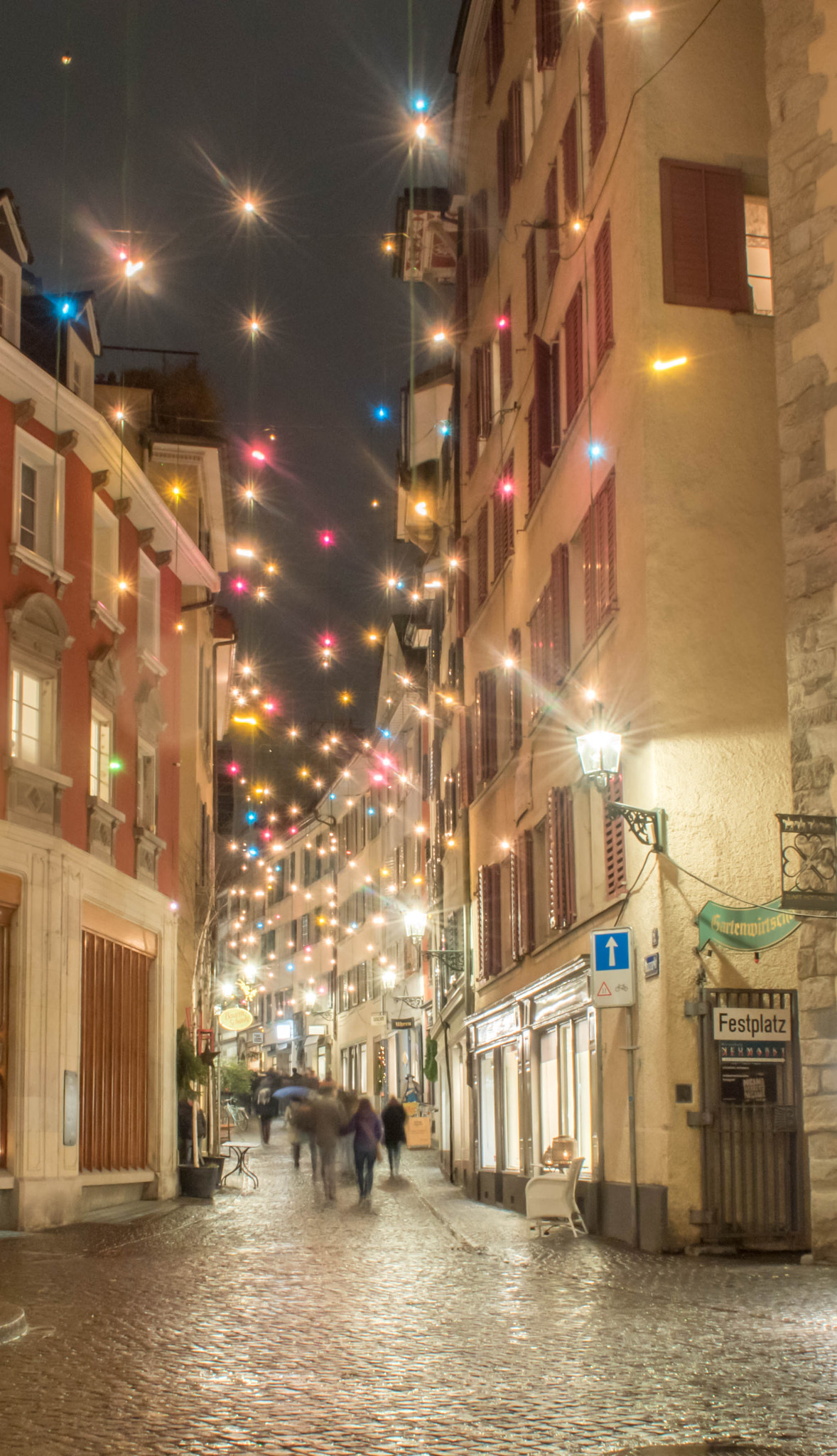
Zurich has a lot of places to go out. There are a lot of clubs, restaurants, cafés, bars but also many museums and theatres. Few of them are particularly wild, but there are certainly many options. The most common drinks in Zurich include: Beer, Swiss white wine (e.g. Fendant), Swiss red wine (is delicious), and Spanish red wine (is generally good value here). At apéro time (after work), you will find many people drinking a Cüpli (glass of sparkling wine).Tap water in the city is of high quality and safe to drink. Bring a reusable bottle to save money and reduce plastic waste.
Bars
1 Bar & Lounge 42, Neumühlequai 42 (5 walking minutes from Zurich HB (Main Train Station)), ☏ +41 44 360 73 24, info@barandlounge42.ch. Daily 09:00-00:30. New York in the middle of Zurich. Exclusive whiskey, unique cocktails, premium liquors, snacks, a homemade gin and an elegant smoker's lounge with a broad selection of cigars. (updated Apr 2018)
Centre
2 Bierhalle Wolf, Limmatquai 132 (At the northern end of the old town, facing the river), ☏ +41 44 251 01 30, info@bierhalle-wolf.ch. A lively beer hall often with live music. In addition to the beer selection, they serve great local food. 3 Edi's Weinstube, Stüssihofstatt 14. nice wine bar in Niederdorf where you can get the cheapest okay wine in Zurich (updated Dec 2017) 4 Federal, Main Station (Tram 3,4,6,7,10,11,13,14, Bus 31, Main Station). A big brasserie-like bar inside the Main Station with a choice of 100 Swiss beers. 5 Nachtflug, Stüssihofstatt 4 (Niederdorf). Stylish, coffee and some snacks during the day, large choice of drinks at night. 6 James Joyce bar, Pelikanstrasse 8. Where the writer used to drink. Now mostly frequented by bankers. 7 Oliver Twist, Rindermarkt 6, ☏ +41 44 252 47 10. An Irish/British pub with a good atmosphere, and many English-speaking foreigners. Has English ales on draught. 8 Öpfelchammer (apple chamber), Rindermarkt 12, ☏ +41 44 251 23 36. Not a real pub or café, they only serve wine or water. But if you succeed in climbing over the roof beams, you get a free glass of wine to drink hanging upside down and you can mark your name into the wood afterwards. 9 Widder Garage, Widdergasse 6, ☏ +41 44 224 25 26. By far the best stocked whiskey bar in town, with a separate whiskey menu containing 250 single malts. In the famous hotel of the same name. (updated Dec 2017) 10 Corazón, Zähringerplatz 11, ☏ +41 44 261 09 59. A Spanish-themed bar with a good selection of wines and excellent service. 11 Bohemia, Klosbachstrasse 2 (at Kreuzplatz, just up from Stadelhofen), ☏ +41 44 383 70 60, bohemia@bohemia.ch. Trendy place popular for its coffee during the day and an even better nightlife. Usually a popular place for college students. 12 Barfussbar, Stadthausquai 12 (a 3 minutes walk from Bürkliplatz along the Limmat), ☏ +41 44 251 33 31, info@barfussbar.ch. W Th Su 20:00–00:00, summer only. During the day this is a public bath for women only. But at night (after 20:00) men are also allowed. It is a beautiful place to spend a warm summer night with a great view of Zurich. 13 Rimini, Badweg 10 (Go down Badweg from Talstrasse). Su-F 19:30–00:00, Sa 17:00–00:00, only in summer and only when it's not raining. Another open air bar. This one is at the men's public baths. Really cool atmosphere because of the nice colored lights and the straw mats and pillows. 14 El Lokal, Gessnerallee 11 (on the Sihl). Bar, restaurant, and intimate gig venue attracting alternative crowd, "soccer vs elvis vs che guevara" themed.
Sleep

Zurich is the financial centre of Switzerland and most travellers come with an expense account. The hospitality sector focuses therefore mostly on the 4- and 5-star sector. Zurich is known for its superb hotels, but these won't come cheap. Best is to go on a company rate, because rack rates are sometimes ridiculous.
Budget
Couchsurfing. Has a lot of members in Zurich. Public transport is very fast and good, so also consider staying in surrounding areas instead of in the city centre. Remember that couchsurfing is about the community and not only a free place to crash. (updated Oct 2017) 1 Youth hostel, Mutschellenstrasse 114 (2-kilometre, 15-minute tram ride from the centre), ☏ +41 43 399 78 00, zuerich@youthhostel.ch. A little way out of the centre, but the city is easily reached by public transport (take the S-Bahn to Wollishofen and walk over the hill). A clean and sleek facility, if a little quiet. From Fr. 42 for a dormitory bed with breakfast; Fr. 104 for a single room with shower. 2 Hotel Marta, Zähringerstrasse 36, ☏ +41 44 251 45 50, fax: +41 44 251 45 40, info@martahaus.ch. A "clean and friendly" place which doubles as a hostel and a one-star hotel. They also have weekly and monthly rates for rooms, and a couple of studio apartments. (updated Aug 2018) 3 Otter, Oberdorfstrasse 7, ☏ +41 44 251 22 07, fax: +41 44 251 22 75. A good hotel for the price. The rooms have been decorated with the kind of care that one normally expects in a much more expensive hotel, each with its own theme. You can choose from the jungle room with its hammock, or the pink Carmen, or go for the top floor apartment. Each floor's three rooms share a bath, shower and toilet (WC), with the exception of the apartment which has its own shower. Fr. 115 for a single room, Fr. 150 for a double, and Fr. 200 for 2-person apartment (Fr. 240 for 4-person apartment). 4 Hotel Splendid, Rosengasse 5. This hotel is relatively cheap. The rooms are clean but spare. Private showers and bathrooms are not available, you share with your floor. What is really great is the location, right close to the Gemüsebrücke and the city centre. Fr. 62-85 for a single, from Fr. 160 for a 4-person room, plus Fr. 2.50 City-Taxe per person. 5 Etap Hotel, Technoparkstrasse 2 (Zurich West), ☏ +41 43 276 20 00, fax: +41 44 276 20 01. This hotel is in a great place if you want to party, next to some great bars and restaurants. The rooms are clean and comfortable. It's also near a tram station, which takes 10 minutes to get to the main train station. 90 Fr (low season) to Fr. 115 (high season) for a single room, and from Fr. 100 for double/triple occupancy. For Zurich, this is cheap. (updated Jul 2016) 6 Hotel Schäfli, Badergasse 6, ☏ +41 44 251 41 44, fax: +41 44 2513476. The location is the draw in this somewhat run-down hotel. Situated in the old town near the station and by the charming Niederdorfstrasse, where there are tons of bars and restaurants. The shower has a timer. Be sure to get all the coins for the shower you need by Saturday, as the reception desk closes on Sundays. Fr. 102 for a double room. 7 Hotel Neufeld, Friesenbergstrasse 15, ☏ +41 43 960 7373, fax: +41 43 960 7374. The comfortable, modern 3-star owner-run hotel is located just a few minutes away from the city centre. All 40 new renovated rooms are comfortable and modern furnished. Perfect for businespeople and tourists. The rates start from Fr. 110 for a single and Fr. 155 for a double room, including tax breakfast and free wifi. 8 Hotel St. Georges, Weberstrasse 11, ☏ +41 44 241 11 44, fax: +41 241 11 42, st-georges@bluewin.ch. Traditional and charming owner run hotel in the city centre, 10 minutes walking distance to the train station. Convenient for businespeople as well as tourists and backpackers. The rates start from Fr. 99 for a single and Fr. 228 for a double room, including tax, breakfast and free Wifi.
Mid-range
9 Hotel Adler, Rosengasse 10, ☏ +41 44 266 9696, fax: +41 44 266 96 69, info@hotel-adler.ch. Clean rooms and breakfast is included in the price. They have a terrific restaurant attached and associated with the hotel that has delicious fondue. The hotel is in a great area for foot exploration. With many bars, restaurants, and cafes all within a few minutes. They have a single computer on the second floor with free internet access. Fr. 110-230 single room; Fr. 180-310 double. 10 Ambassador à l'Opéra, Falkenstrasse 6, CH-8008, ☏ +41 44 258 9898, fax: +41 44 258 9800, welcome@ambassadorhotel.ch. Four-star boutique hotel situated in the town centre, opposite the Opera House and only 10 min away from the main station Hauptbahnhof and 30 minutes from the Zurich airport. Renovated and exquisitely decorated. Single room from Fr. 220, two-person room from Fr. 390 in the low season. 11 Helmhaus, Schifflände 30, ☏ +41 44 266 9595, fax: +41 44 266 9566, hotel@helmhaus.ch. Three tram stops with tram number 4 from the main station. Located directly next to the Limmat in the old town of Zurich. Very traditional four star hotel with first-class service, style and modern comfort. Single room from Fr. 230, double room from Fr. 300. 12 Sorell Hotel Rex, Weinbergstrasse 92, ☏ +41 44 360 2525, fax: +41 44 251 2476, rex@sorellhotels.ch. Three-star hotel, 5 minutes by tram number 7 from the Hauptbahnhof. All rooms are non-smoking. Single room from Fr. 140, twin room from Fr. 190. (updated Jan 2017) 13 Wellenberg, Niederdorfstrasse 10, ☏ +41 43 888 4444, fax: +41 43 888 44 45, reservation@hotel-wellenberg.ch. The four-star Art Deco Hotel Wellenberg with its idyllic inner court terrace is in the car-free old town of Zurich, 10 walking minutes from the Hauptbahnhof. The rooms are modern and elegant. One-person room from Fr. 290, two-person room from Fr. 370. 14 Palais Kraft, Kraftstrasse 33, ☏ +41 44 388 8485, fax: +41 44 388 84 86, welcome@palaiskraft.com. Three luxury rooms in Zurich's most prestigious residential building. Located 2km from the centre, above the university district at Toblerplatz (Trams 5 and 6, direction Zoo), in the heart of Zurich's prime residential area. The rooms come with a large well-stocked fridge, kitchenette, 32" or bigger flat screen TV, wireless internet access, and open to the terrace of the Palais Kraft. Beginning at Fr. 385 per room/night, including continental breakfast, soft drinks, snacks, internet, local calls, and all taxes. Fr. 330 double-bed guest room with bath and kitchenette. 15 Designer Hotel Greulich, Herman-Greulich-Strasse 56, ☏ +41 43-243 4243, fax: +41 43-243 4200, info@greulich.ch. Located in the heart of Zurich's vibrant Aussersihl district, the stunning Hotel Greulich is a haven of style and comfort with a renowned gourmet restaurant. Online booking. 16 Hotel St. Gotthard Zürich, Bahnhofstrasse 87, ☏ +41 44 227 7700, reservation@hotelstgotthard.ch. Business hotel. A five-floor building, with 143 spacious rooms, 11 of which aresSuites, comfortable lobby and three restaurants, the Hotel Gotthard meets all the expectations of the demanding traveller. The Hotel Gotthard lies center of the city, located on the Bahnhofstrasse, within 10 minutes walk from sightseeing, the business district and Lake Zurich. 17 Crowne Plaza Zürich, Badenerstrasse 420, ☏ +41 44 404 4444, info@cpzurich.ch. Clean rooms and breakfast included in most of the rates. It has a fitness centre, a bar and a restaurant. It is about 200 m away from Albisreiden Tram station (tram number 3). €150-300 per night depending on the room type and the season. 18 Dorint Airport-Hotel Zürich, Riethofstrasse 40, 8152 Opfikon-Glattbrugg, ☏ +41 448081000, info.zuerich@dorint.com. The hotel (opened in 2014) is located near the airport and offers 235 rooms. from 160 CHF per room/night. (updated Sep 2017)
Stay safe

Zürich, like all cities in Switzerland, is relatively safe. Nevertheless, be on guard for thieves and pickpockets. Carry your wallet or purse in a secure way, not in your hip pocket or a backpack outer pocket. In particular, thieves are known to operate around the Zurich main train station. Do not let your bags out of sight for even a moment. Certain areas along the lakefront are frequented by young people who sometimes try to pick a fight when they are drunk. Do not let them provoke you, as they are likely to be there in numbers and will use any excuse to go at you. You may also notice many of said young people smoking something that isn't a cigarette. Switzerland is surprisingly lenient about such things but it is hardly a cause for alarm. Public transport is very safe. You can use it without any special precautions. If you decide to bicycle in the city, understand that Zurich is a city of public transport. Beware of tram tracks which can get your wheel stuck and send you flying into traffic, of the trams themselves which travel these tracks frequently (and may scare you into getting stuck into the track), and the buses, which make frequent stops in the rightmost lane. In short, bicycling downtown should be only done by those experienced with cycling with such traffic.
Gay and lesbian travellers
Being Switzerland's most liberal city (the socialist and green parties now fare extremely well here), Zurich is the favourite place to live for Switzerland's (German-speaking) gays and lesbians. The Canton of Zurich was the second canton, after Geneva, to allow registered partnerships for same-sex partners for example. The city of Zurich is probably the place in Switzerland that offers the most open environment for gays and lesbians. Gays and lesbians need not take special precaution for their safety on the streets. It is always possible for random homophobic behaviour to happen, though.
Go next

Some interesting destinations nearby:
Baden — This town is known for its castle ruin and the thermal baths. It takes 15 minutes by train to get there from Zurich. Greifensee — A lake and village next to the nearby town of Uster. The village of Greifensee is within a conservation area and very untouched. Lucerne — Probably Switzerland's most popular destination. Go there to see the famous chapel bridge or the impressive transport museum. Rapperswil — Located at the opposite end of lake Zurich. A small, picturesque town, good for a stroll. It is possible to go there by boat from Zurich. The Rhine falls — Europe's largest waterfall. It is located near Schaffhausen, which has a nice old town in the Renaissance style. Winterthur — Around 25 minutes from Zurich, this city is worth a visit on a rainy day to visit some of its many museums. Technorama is the most popular one, an interactive science centre. A bit further away, but also worth a day trip:
Appenzell — As close to the stereotypical image of Switzerland with wooden farm houses and traditional clothes as it gets. An interesting visit is the cheese factory, where the Appenzell cheese is made. Augusta Raurica — Close to Basel, this is one of the best preserved Roman sites north of the Alps. Bellinzona — Since the opening of the new Gotthard tunnel in 2016, the Italian speaking part of Switzerland is less than two hours away by train. Go to Bellinzona to see its three castle, which are inscribed as a UNESCO world heritage site. Biel — Traditional watch making town. Visit the Omega factory to learn more about the watch industry. Chur — Not only a nice city, but a good hub for hiking or skiing in the mountainous Graubünden region. Fribourg — Home town to the famous Swiss fondue. A good choice if you want to make a short trip into the French part of Switzerland. Solothurn — A small city on the river Aare noted for the giant cathedral and baroque old town.
The guide text on this page is from the Wikivoyage article Zurich, written by Wikivoyage contributors and published under CC BY-SA 4.0. The authors are listed in the article’s edit history. It has been shortened and re-laid-out for this page; that adapted text is available under the same licence. Nothing else on this page is.
Wikivoyage is written by travellers, not by us. Opening hours, prices and whether a place still exists are exactly the details that go out of date, so check anything you are relying on.
“1,578 readers a month” and the ranking are ours, counted from Wikimedia’s published pageviews (CC0) — the median of twelve complete months. They count people reading about a place, which is not the same as people going there.