
Munich
Munich (German: München, Bavarian: Minga) is the capital of the federal state of Bavaria in the south of Germany. Within the city limits, Munich in 2024 has a population of just under 1.6 million, the third most populous city in Germany. Greater Munich including its suburbs has a population of 3 million. The Munich metropolitan region, which encompasses cities such as Augsburg and Ingolstadt, has a population of 6.2 million. Standing on the river Isar in Southern Bavaria, it is famous for its beautiful architecture, fine culture, history and the annual Oktoberfest beer festival. Munich has a thriving cultural scene and striking architecture. It was heavily damaged by Allied bombing during World War II, but many of its historic buildings were rebuilt, including its largest church, the Frauenkirche, and the City Hall. Other big draws are its sports events, zoo and trade exhibitions. Munich is a global centre of engineering, science, innovation, and research, exemplified by its two research universities, a multitude of scientific institutions, and world-class technology and science museums like the Deutsches Museum and BMW Museum. It is a major centre of art, finance, publishing, culture and media, education and business. Its economy is also based on high-tech, automobiles, the service sector and creative industries, as well as IT and biotech. It enjoys a very high standard and quality of life. Munich is one of the most prosperous and fastest growing cities in Germany.
Most read about in August, least in April. That is when people look it up, which tends to run a month or two ahead of when they go.
Before you book
The Foreign, Commonwealth & Development Office publishes the UK’s official travel advice for Germany. It changes without notice and travelling against it usually invalidates your insurance, so read it at the source rather than anywhere else — including here.
FCDO travel adviceUnderstand

1 Tourist information, Neues Rathaus, Marienplatz, ☏ +49 89 233 96500, tourismus.gs@muenchen.de. M-F 10:00-18:00, Sa 09:00-17:00, Su 10:00-14:00. The official tourist office is in New Town Hall and can make bookings for tours, hotels and events. (updated Apr 2026) Munich tourism website
History
When the last Ice Age retreated 12,000 years ago, it dumped gravel and silt across this area, leaving a heath that was well-drained and suitable for grazing, but not particularly fertile. Munich, like other German cities, has been settled from prehistory, but by convention the "founding date" is taken as the first documentary mention. That came in 1158 in a document signed in Augsburg, at a time when Munich was just a bridge over the Isar controlled by monks, hence the monk on the city coat of arms. Henry the Lion built a rival bridge so the highway became re-aligned and the town grew rapidly. In 1175 Munich was awarded city status and built its first defensive walls. But Henry fell out with the ruling Staufer dynasty, whereupon Otto I Wittelsbach became Duke of Bavaria (his descendants ruled here until 1918), while Munich was handed over to the Bishop of Freising. In 1255, when an inheritance split the Duchy of Bavaria, Munich became the ducal residence of Upper Bavaria. The late 15th century saw a revival of Gothic arts: the Old Town Hall was enlarged, and Frauenkirche cathedral was built. The Bavarian statelets were re-united in 1506 with Munich as capital. That meant patronage and prestige, but also politicking, intrigue and shenanigans. The city became a centre for Renaissance arts and for the religious counter-reformation: the Catholic League (an alliance of princes within the Holy Roman Empire) was founded here in 1609. The northern superpower was Sweden until the rise of Russia, and in 1632 during the Thirty Years' War Swedish troops occupied Munich. Bavaria industrialised from the late 18th century but during the Napoleonic Wars Bonaparte brushed aside Bavarian and Prussian resistance, consolidated small duchies, and placed puppet rulers on their thrones. The Wittelsbachs were wily enough to be enhanced by this, with Bavaria promoted to a kingdom incorporating Franconia, and wilier still to rule on while Bonaparte fell, rose again then finally fell. King Ludwig I went on a ruinously expensive building spree to turn the city into an artistic and cultural showcase, best seen today at Kunstareal. The revolutions that roiled Europe in the 1840s ousted Ludwig and his favourite dancing-girl yet still the dynasty clung on. The 19th century witnessed the unification of Germany, the rise of Berlin as a dominant political centre, and the gradual erosion of royal authority in favour of secular leaders, most notably Otto von Bismarck. Following the nation's defeat in 1918, a period of intense civil unrest ensued. The Bavarian royal family was forced into exile after being overthrown by Kurt Eisner, a revolutionary who established a short-lived socialist state. Eisner was subsequently assassinated, and the "Soviet Republic" was forcibly suppressed. In 1924, Eisner's assassin was released from prison due to severe overcrowding within the cells. The vacated space was occupied by another right-wing radical, Adolf Hitler, who had been imprisoned for his role in the 1923 Munich Beer Hall Putsch against the Weimar Republic. Whilst incarcerated, Hitler composed a volume entitled Mein Kampf; the book eventually became a commercial success, securing his personal wealth. Munich was thus the stronghold of the National Socialist Workers Party (NSDAP) in the years when few knew of it, and when those few fatally underestimated its raw appeal to a populace embittered by the surrender terms and the 1920s Great Depression. The Nazis gained national power in 1933 and promptly created their first concentration camp at Dachau, 15 km northwest of the city. The 1938 Munich Agreement was the other European nations' last attempt to avoid war, ditching their accords with Czechoslovakia to accede to Hitler's invasion. "Munich" remains to this day a political jibe against appeasement. Churchill wrote "England has chosen shame, and will get war." It soon came. In 1942 / 43 Munich was the base of White Rose (Weiße Rose) resistance movement, little more than half-a-dozen students distributing anti-government leaflets. They were convicted of treason and guillotined. By 1944 the Allied advance brought Munich within air range and it was heavily bombed. Reconstruction took decades. One milestone was the 1972 Olympic Games in Munich; the infrastructure legacy was the construction of the S-Bahn and U-Bahn, and the fine Olympia park. But the Games were a disaster, as Palestinian terrorists took Israeli Olympic athletes hostage, the response was botched throughout, and all the hostages were killed.
Post-war Munich shared the ups and downs of Germany, boosted by re-unification of the country and by membership of the European Community / Union, but impeded by the rundown of traditional industries, financial turmoils, and nowadays the effects of Covid and the war in Ukraine. Housing is in short supply so rents are astronomical. City politics are dominated by the centre-left SPD, which is at odds with the right-wing CSU that controls Bavaria. However, the two parties have combined forces to shovel federal and European funding in this direction, to the chagrin of other cities. Green politics are gaining traction and there is much to be done to make Munich a more sustainable city.
What's inside

Munich is divided into 25 administrative districts, but these don't always match "natural" neighbourhoods or make sense to visitors. It's therefore convenient to divide it into the "travel districts" set out below. Most of the key attractions are in Altstadt and Maxvorstadt; the districts of Ludwigsvorstadt-Isarvorstadt and Haidhausen are major night-life spots. The other areas, while mostly residential, feature some hidden gems which are worth a visit.
Getting there

By plane
Main article: Munich Airport
1 München Flughafen / Munich Airport (MUC IATA), Terminalstraße Mitte, Oberding (30 km northeast of city centre near Freising). Munich's busy airport has flights from most major cities in west Europe, and within Germany from Berlin, Düsseldorf, Frankfurt, Hamburg and Hanover. There are two terminals connected by a walkway: Lufthansa and partners use T2, others including budget airlines use T1. Built in the 1990s, the airport is efficient, modern and spacious, with the usual facilities. S-Bahn S1 or S8 trains take 40-50 min to city centre: these run every 15 min daytime and at reduced frequency all night. (You need a 5-zone ticket, see Munich#Get around for fares.) A regional train also runs to Regensburg. Intercity buses from Munich may stop at the airport. Taxi fares are fixed: in 2022 you pay €106 to or from Hauptbahnhof and €94 to or from Messe. (updated Apr 2026) Memmingen Airport (FMM IATA) is also known as Allgäu-Airport, and by Ryanair as "Munich West". The "west" bit of that is accurate, it's 110 km west. Ryanair fly there mostly from west Europe, while Wizz fly from east Europe and the Balkans. A shuttle bus runs from the airport to Memmingen bus and railway station, and Ryanair sometimes have a direct bus to Munich connecting with their flights. The hourly train from Memmingen takes 60-90 min. Frankfurt Airport(FRA IATA) may be a better choice for intercontinental routes - it has many direct flights from North America, the Gulf and Far East. Trains run direct from the airport to Munich in 3 hr 30 min.
By train
International direct trains run to Munich from:
Getting around

The innermost city is walkable and the outer fringes are suitable for a car. For everything else use the excellent public transport system.
By public transport
This is an integrated system where one ticket is valid for interchanges across all modes of transport. Check the Munich MVV website for network maps, fare zones and prices, timetables, journey planner and P&R parking lots. S-Bahn suburban trains (look for a white "S" on a green background) bring you from the airport to the city centre. All lines run east-west through Hauptbahnhof, Altstadt and Ostbahnhof then fan out, looking like the force field around a bar magnet. The central tunnel (Stammstrecke) suffers line congestion and a second tunnel is under construction, with some upheaval along its route. U-Bahn underground lines are signed with a white "U" on a blue background. They are the way to go north-south, for instance to the University and Kunstareal art districts, Olympiapark and Allianz Arena. They also run east to Messe trade fair halls. Trams circle the inner city and are the way to reach Nymphenburg Palace. They're a good option east of the river, where Max-Weber-Platz is a secondary hub. Buses connect the spaces between rail and tram routes so they're more useful in the outer suburbs. Most visitors won't use them. Which ticket? is a question of single versus day (or longer) ticket, one rider versus group ticket, and how many zones.
A single trip in the M city centre zone costs €4.20 (as of April 2026) for an adult. You must validate your ticket before you travel; the machine may do so automatically. It's valid for an hour but not for return trips, even if you found the place closed and turned straight back. A second single ticket to come back works out slightly cheaper than a day ticket, but you may need to factor in your change in coins, see below. Virtually every attraction described on these pages is within M zone, but from the airport you need a five zone ticket for €14.30. Children aged 6-14 have a single fare of €1.90 for anywhere in the system, accompanied under-6s ride free. See the MVV website for discounts for 15-20 year olds. A day ticket is automatically validated from the time of issue to 06:00 next morning. M zone tickets cost €10.20, from the airport it's €16.30, and for children anywhere it's €3.70. For two to five adults buy a "group" ticket; two children aged 6-14 count as one adult. The M zone group day ticket is €18.70 and from the airport is €30.50; the "AirportPLUS" ticket is pretty much the same thing. MVV also tout a "München Card" which includes discounts on visitor attractions, but these are €5 more than the corresponding transport-only ticket and you'll barely break even. The "CityTourCard" also has a similarly dubious value. There are other combinations for intermediate zones (with or without M) and for zone 6. Few travellers will use them so check the options and fares on the MVV website. See also Upper Bavaria#Get around for fare deals across the region, which can take you all the way to Austria and are an excellent value. A weekly ticket (formerly IsarCard) for Zone M costs €23.80, which is a saving if you make return trips on at least three days. For longer stays, a monthly ticket for Zone M is available from €59.50 on, for Zone M+M2 the price is already €95.80. However, unless you specifically need the "transferability" of this ticket (allowing others to use it), the Deutschlandticket is almost always the better alternative. At €63.00 per month (as of 2026), it is not significantly more expensive than the local monthly pass but also grants you unlimited travel on all regional trains and local transport throughout Germany.
See
Stately avenues
Four royal avenues were laid out in the 19th century, with imposing architecture. Briennerstraße starts at Odeonsplatz (where you can find Feldherrnhalle, Theatinerkirche and the Residenz) on the northern fringe of Altstadt. It runs east to west past Wittelsbacherplatz (with Alfons-Palais and the statue of Maximilian I), Karolinenplatz (the black obelisk honours the Bavarian Army), to Königsplatz. This is Athens-on-the-Isar, with the Doric Propylaea, the Ionic Glyptothek and the Corinthian State Museum of Classical Art. The east end of Briennerstraße is lined with upscale shops, galleries, cafés and restaurants. Ludwigstraße runs north from Odeonsplatz through Maxvorstadt into Schwabing. It's lined by Italian Renaissance and Neo-Romanesque buildings, such as St Ludwig's Church and the main campus of the Ludwig-Maximilians-Universität München (LMU Munich). Ludwigstraße ends at Siegestor, a triumphal arch crowned with a statue of Bavaria with a quadriga of lions, but the avenue continues north as Leopoldstraße. Maximilianstraße starts at Max-Joseph-Platz by the Residenz and National Theatre, and runs east across the river Isar to end at Maximilianeum, the Bavarian state parliament. The avenue is framed by neo-Gothic buildings with a hint of English Perpendicular. Its west end together with Residenzstraße has Munich's most upscale shopping and hotels. Prinzregentenstraße runs parallel 500 m north of Maximilianstraße from Prinz-Carl-Palais. Museums along it are Haus der Kunst, the Bavarian National Museum and Schackgalerie. It forms the southern boundary of English Garden, where the Eisbach is one of the world's most unlikely surfing spots. The avenue crosses the Isar, circles the Friedensengel monument, and on the east bank passes Villa Stuck.
Museums, galleries and palaces
Discounts: Keep your ticket after visiting one of the museums owned by the City, i.e., Münchner Stadtmuseum, Villa Stuck, Jüdisches Museum, Valentin-Karlstadt-Musäum or the NS-Dokumentationszentrums and get free entry into another one of these on the following two calendar days. Museums operated by the State of Bavaria, i.e., the large art galleries Pinakotheken, Sammlung Brandhorst, Nationalmuseum and the small ones around Josephsplatz, Museum Fünf Kontinente (ethnography) charge only €1 on Sundays. Permanent exhibitions only, hours normally 10:00-17:00.
Many sites are closed Monday, and charge only €1 on Sunday, but check individual places for exceptions to this. Kunstareal in Maxvorstadt is the fabulous result of Bavarian kings' project to transform Munich into Germany's art capital in the 19th century. This art quarter hosts some 16 museums (including the three famous Pinakotheken), 40 galleries and 7 art schools. Neue Pinakothek is closed until 2025. Altstadt the historic city centre is itself a museum piece. Münchner Stadtmuseum and the Jewish Museum are in Altstadt with more on the north fringe of Lehel, such as the Residenz, Haus der Kunst and Bayerisches Nationalmuseum. Deutsches Museum of Science and Technology (tram 17 ) occupies an entire river island in Isarvorstadt. It has branches for transport near Bavariapark and for aviation in Oberschleißheim north of the city. The MVG transport museum is in the east. BMW Museum, documenting the history of the famous car manufacturer, is in the north of the city. "Bling palaces" were built from the 17th to the 19th century for luxury and show not for defence. Some have found modern uses, but those you can tour include the Residenz in Altstadt, Schloss Nymphenburg (the standout) (tram 17 ) and Schloss Schleißheim in the north, and Dachau further north.
Do
Events
St Patricks's Day is on 17 March, but in Munich is held over the nearest weekend, with parades and a street festival. Locations vary but parades are likely to be around Odeonsplatz in Altstadt and Münchner Freiheit further north. May Day is a public holiday in Germany. Many Bavarian villages erect maypoles, dress up in Lederhosn and Dirndln, and cavort to the tunes of oompah bands. Locations vary but in Munich city the likeliest spot is Viktualienmarkt south of Town Hall. Lange Nacht der Musik is an all-night event in May, with 400 concerts and other musical events, and shuttle buses between venues. Tollwood organise two extended music festivals: June-July in Olympic Park in northern Munich, and Nov-Dec (with a Christmas market) on the Wies'n site in Ludwigsvorstadt. Corso Leopold is a street fair taking over 2 km of Leopoldstraße in north Munich, traditionally in June and September. Theatron Pfingsfestival is a music festival in Olympiapark in June, with the stage on a platform on the lake. Theatron also organise Musiksomer here in August. Christopher Street Day is a Rainbow Pride or LGBTQ+ event, held over two weeks in June. It's named after Christopher Street in Greenwich Manhattan, New York which was the scene of the 1969 Stonewall uprising against police oppression. Multiple venues, the big parade is around Marienplatz in Altstadt. Münchner Sommernachtstraum (Midsummer Night's Dream) is a music festival with fireworks on Olympiapark in July. Kocherlball ("Cooks' Ball") is held by the Chinese Tower in English Garden in July. 19th-century servants were briefly allowed out to party, but they had to be back on duty by midday, so it's held from 06:00 to 10:00. Many dance in old costume. Impark is held on Olympia Park in August. It's a mixture of fairground, live music and sports events.
Isarinselfest (Isar island festival) is a street fair along the river bank in Lehel on a September weekend. Oktoberfest, is the world's largest beer festival, held from mid-September to the first Sunday in October. Known locally as Wies'n for being held at Theresienwiese, a huge meadow west of Altstadt in the district of Ludwigsvorstadt, cavernous tent from breweries across Munich are erected with eccentric design to attract beer aficionados, as the other half of the field transforms into an amusement park. Electronic Music Festivals: Munich is a hotspot for rave and electronic dance music in Germany. Events in or near the city include Isle of Summer, Greenfields, Back to the Woods, Schall im Schilf, Wannda Circus Open Air, Contact Festival and EOS Festival.
Theatre, opera and music
Theatres are mostly in Altstadt, Ludwigsvorstadt-Isarvorstadt and Maxvorstadt. Plays are almost always in German, while opera, ballet and music transcend language. Gasteig arts centre on the east riverbank is closed for rebuilding until 2027. The Philharmonic Orchestra and other residents have moved to HP8, a temporary home in Sendling. Cinema: foreign movies are normally dubbed with German voices. Adverts will indicate if the movie is in its original version with no overdubbing, OmU for original with German subtitles, and OmeU for original with English subtitles. "Cinema" movie theatre by Stiglmaierplatz shows all movies in their original language. Museum Lichtspiele in Haidhausen and the multiplex Mathäser at Stachus often show movies in their original version.
Shopping

Shopping districts
Most city-centre stores open M-Sa 09:30-20:00, with those further out closing by 18:00. See district pages for individual stores.
Maximilianstraße / Residenzstraße / Theatinerstraße (U-Bahn: Odeonsplatz or Marienplatz) in Altstadt have high end luxury goods. Kaufingerstraße / Neuhauser Straße (S- & U-Bahn: Karlsplatz (Stachus) or Marienplatz) is a pedestrian zone in Altstadt. It's the main area for mid-priced goods, with department stores, chains and a few independents. As it's close to the station, it gets crowded during the evening rush hour. Hohenzollernstraße (U-Bahn U2: Hohenzollernstraße) is in northern Munich. It has a collection of clothes shops, which sell reasonably-priced traditional Lederhosn and Dirndl. East end of this street is Leopoldstraße. Leopoldstraße (U-Bahn U3, U6: Münchner Freiheit, Giselastraße or Universität) is a busy boulevard in the university district. It has chain stores, fast food joints, budget restaurants, cinemas, sidewalk cafes and coffee shops. Boutiques and independents are down the side streets, and on summer evenings local artists display their works. Schellingstraße (U-Bahn U3, U6: Universität) west of the university main campuses offers everything studenty, such as clothes, small book stores, cafés and of course cheap eats. Gärtnerplatz (U-Bahn U2: Fraunhoferstraße) south of Altstadt is the place for antiques, crafts and other quirky wares.
Markets
Wochenmarkt means weekly markets, with an emphasis on fresh food, often called "Farmers' markets". There are several across the city: Viktualienmarkt in Altstadt and Elisabethmarkt in Schwabing are open M-Sa. Christmas markets (Weihnachtsmarkt or Christkindlmärkt) are held in the four weeks of Advent up to Christmas Eve, offering as much mulled wine, sausage and wood-carved knick-knacks as you can handle. They're typically open daily 12:00 to 20:00. The biggest and most touristy is in Marienplatz in Altstadt, spilling down Viktualienmarkt and Rindermarkt. At the north boundary of Altstadt with Maxvorstadt, the market on Wittelsbacher Platz is medieval-themed. Others are by the Chinese Tower in English Garden, and in Schwabing at Münchner Freiheit. Smaller events further out involve the year-round food market acquiring extra booths selling speciality items for Christmas. Flohmarkt means Flea Market. They're typically on a weekend, with private citizens selling their surplus belongings with few commercial traders. Some of these blend into local fairs and festivities. The largest examples are Auer Dult three times a year in Haidhausen, Theresienwiese in spring on the Oktoberfest site in Ludwigsvorstadt, and on Olympiapark in the north. Hofflohmärkte are a German speciality: "courtyard markets" where residents open their private courtyards, often with several in a neighbourhood combining with a street flea-market. They're held nation-wide with a score of locations in Munich alone, see website for details. Schloss Nymphenburg has bragging rights for the fanciest setting.
Eat

Bavarian cuisine is the main offering, majoring on sausages and other pork. Munich specialities are Weißwurst (a breakfast sausage served until noon and not a second later, washed down with Weissbier), Schweinsbraten (roasted pork) or Schweinshaxe (roasted pig's knuckle). Other trad dishes such as schnitzel are popular but not specifically Bavarian. Beer gardens and beer halls serve heaps of all these. Leberkässemmeln is a white roll filled with a thick warm slice of "Leberkäse" — which, despite its name, contains neither liver nor cheese. It's a mix of veal, pork, spices and a hint of lemon zest baked in an open pan and served with a sweet and grainy mustard. Buy these filling, inexpensive snacks at butchers rather than bakers. Bavarian / Austrian cakes and tortes can be bought by the slice at countless bakeries and cafés. There's also a great array of bread: one local snack is pretzels, "Brezn". International cuisines are widely available, especially Italian, with a strong showing also of Chinese, Turkish, Arab and Japanese. Vegetarian, vegan and GF food is found in many restaurants, and there are specialist vegetarian cafes. Bakeries sell bread, pastries, sandwiches, salads and sometimes broader offerings such as soup. One Munich-only bakery chain is Rischart. See "Buy" above for fresh and seasonal food markets.
Drink
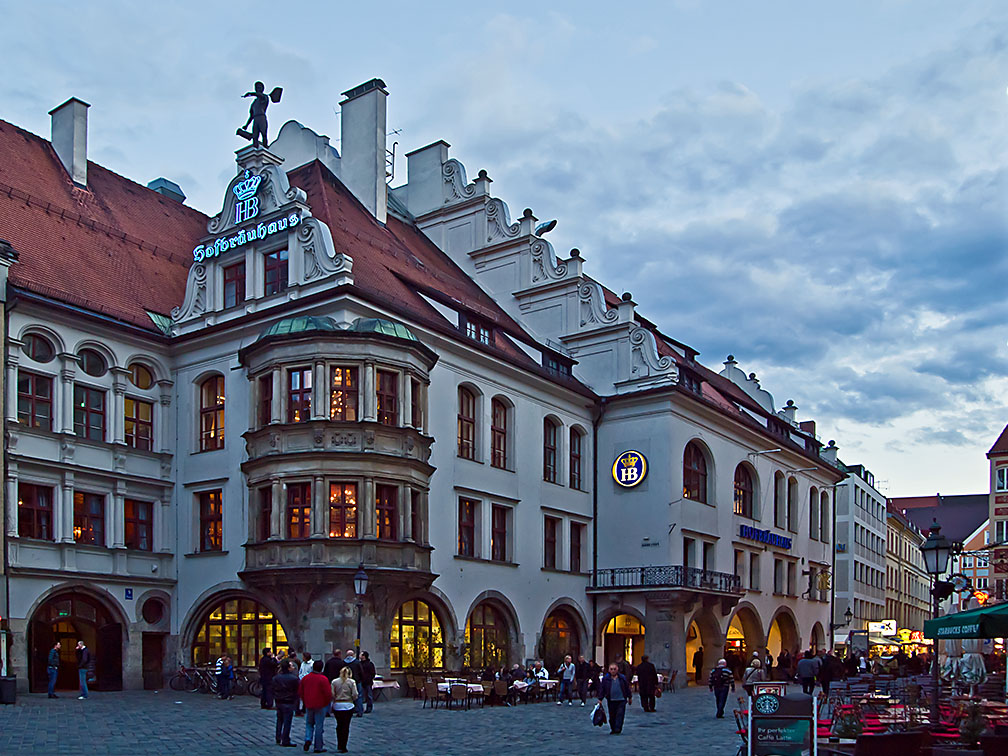
Oktoberfest is the huge event held over 16-17 days in Theresienwiese in Ludwigsvorstadt. You need to feel comfortable in dense crowds. Beer halls serve the product of a particular brewery and are often within their historic brewing and cellar premises, cleared when production moved elsewhere. Concentrated in Altstadt, there's typically a ground-floor "brown table" area, an upstairs swankier "white table" restaurant, and suites for events and functions. Outside if space permits is a beer garden. The beer hall in which Hitler launched the infamous Munich putsch of 1923 has been demolished. Beer gardens may be summer-only but several are year-round, albeit weather-dependent. They may be self- or table-service, and all serve traditional meals or snacks such Riesenbrezn (big pretzels) and Steckerlfisch (cured fish). You're allowed to bring your own food but not drink. Drinks are typically litre mugs (Maß) of beer or of Radler, a shandy of beer and lemonade. Beer gardens are family-friendly (with play areas within parental sight) and diverse, welcoming a motley crowd including well-behaved dogs. There are over two dozen around the city, good examples being Hofbräuhaus in Altstadt (very touristy), Viktualienmarkt in Altstadt (with beer from all the major breweries), Chinese Tower in English Garden, Paulaner and Bavariapark in Ludwigsvorstadt, and Löwenbräukeller and Augustiner in Maxvorstadt. Paulaner am Nockherberg in Haidhausen hosts a strong beer festival in March. Bars number over a thousand, so you can but make a start. Some oddities worth seeking out are Goldene Bar in Lehel, Minna Thiel (with a DJ in an old railbus) and Bar Sehnsucht in Maxvorstadt, Cronlein (in a former rest room) and CCC Container Collective in Haidhausen, and Alte Utting (a lake steamer perched on railway tracks) in Ludwigsvorstadt. There are also numerous rooftop bars in Munich.
Clubs and discos of Munich have launched many a famous name. In the 1990s the city became a centre for rave and techno. You need a photo-ID to get in: 18 is the standard minimum age. Dress codes are casual. While the door policy in Munich clubs is generally more loose than strict, some clubs deny entry to larger groups of people who just seem to be out for a random party and don't fit the club scene at hand. Popular nightlife districts are Ludwigsvorstadt-Isarvorstadt, Maxvorstadt, the northern part of Sendling and Haidhausen; the latter includes the industrial-scale Werksviertel entertainment complex. See Cope for local listing services and Do for music festivals. Techno clubs include Blitz Club, Bahnwärter Thiel, Rote Sonne, Harry Klein, DNA Club, Palais, Charlie, Pimpernel and Legal. Mixed programs of Electro, House, Indie, Rock and Hip-Hop are at Call Me Drella, Wannda Circus, Minna Thiel, Backstage, Tonhalle, Pathos, Muffatwerk, Ampere, and the party ship Alte Utting. Upscale clubs that appeal to a posh, wealthy audience are Pacha and P1 Beer Beer is very famous in Munich. In particular, there is a traditional beer recognized by Munich, and you can check where the traditional brewery is by referring to the link [1]
Sleep
Camping: there are four regular sites around the city fringes. The Hauptbahnhof area has the densest concentration of accommodation, with hostels, budget hotels (not all of them vice-dens) and upscale hotels like Le Meridien and Sofitel. There is major construction here until 2027, so expect some noise, mud and street disruption. The other main areas for budget to mid-range are Schwabing and the university quarter, and around Ostbahnhof. They hike their prices in summer, during trade fairs at Messe, and of course during Oktoberfest. Prices drop as you move further out along the S- and U-Bahn routes, but all are within the same inner city fare zone. Upscale accommodation is close to Altstadt but there's little within the medieval centre, which is cunningly designed to keep out taxis and hire cars. The best is along its northeast edge in Lehel. Oktoberfest (last two weeks in September) jam-packs not only Munich in all price ranges, but everywhere within an hour or two travel time, if only you could find room on the overcrowded trains. There are several pop-up campsites around the city edges, look especially in east and southwest districts. Visitors not aiming for the beerfest should come another time.
Stay safe

Boasting one of the lowest crime rates of any major European city, Munich is a very safe city, and violent crime is rare. Walking around, day or night, is not an issue, and you will most likely not encounter any crime at all, though you should still take the usual precautions against pickpocketing (especially in the central districts of Altstadt-Lehel and the Ludwigsvorstadt area immediately south of the central station), such as not leaving your camera unattended or venturing alone through parks at night. While some of Munich's boroughs like Neuperlach and Hasenbergl have a reputation for seediness among locals, crime levels are actually average. Munich is an open-minded, international city with a large number of immigrants and expatriates living in the city (almost 40% of residents have a foreign origin, mostly from Turkey, the Balkans, and Poland), so you are very unlikely to encounter any problems because you are a foreigner. Gay and lesbian people should not experience any issues either: Munich has a large gay and lesbian community, and the Rosa Liste, a gay rights party, was part of the city government from 1996 to 2014. A safety hazard in Munich is the local beer-drinking culture in combination with the high accessibility of alcohol. Think twice before trying to keep up with the locals or looking for your maximum level of alcohol intoxication; being drunk will sharply raise your chances of injuring yourself. You should also keep your distance if you see drunk people fighting, such as in the bars around the central station. Of course, heavy drinking at the time of Oktoberfest will inevitably make people lose control and result in some violent behaviour. Another issue for people not used to driving or walking on ice or snow is wintry road and pavement conditions. If you've been to other major cities outside Bavaria before the encounters with the Munich police might be a bit of a culture shock, who mostly follow the "law and order" ideas of the regional politics here. Don't be surprised that minor infractions that could slide in Berlin will often get you into hot water with the Munich police. On the whole however they are helpful and there to make people feel safer and corruption is nearly unheard of.
Scams
Scammers with typically Irish accents (based on multiple accounts) claim to be stranded after losing access to their bank cards. To appear legitimate, they sometimes present fake passports and use fraudulent mobile banking apps that display false “successful transfers”, convincing victims to hand over cash as an emergency loan. If approached in this way, the recommended response is to refuse assistance and immediately contact the police so the perpetrators can be dealt with.
The emergency telephone number in Munich is 112 (like everywhere in the EU), which will connect you to emergency medical services, police, or fire brigade. The emergency telephone number 110 (Germany only) will connect you directly to the police. All major hospitals have emergency rooms (Notaufnahme) that offer 24/7 medical assistance not only to patients brought in by ambulance but to walk-in customers as well. Waiting time might be lengthy if you are not considered an emergency case.
Go next

All of Germany is within easy reach of Munich, for instance Cologne takes 4½ hours and Berlin takes 5½ hours by ICE train. The destinations outlined below are a selection of those within a journey of an hour or two, well within a day-trip from Munich: see Upper Bavaria for more. See individual "Get in" pages for practicalities, but train is quickest, and the Bayern-Ticket is a bargain deal for day trips across the region.
Andechs has a monastery in a beautiful setting above the Ammersee, with a famous brewery and beer garden. Chiemsee has a large lake with a castle and a monastery on its islands. Dachau is best known for its concentration camp, now a museum, but also has a Renaissance palace. Füssen at the foot of the Alps is dominated by Neuschwanstein, the "Disney-castle" in all the tourist brochures, and equally-interesting Hohenschwangau. Garmisch-Partenkirchen is an Alpine resort. Take the rack railway to the top of Zugspitze, Germany's highest mountain. Nuremberg is a medieval walled city with many outstanding museums, including coverage of the Nazi era and its downfall. Regensburg is a beautiful medieval city and UNESCO World Heritage Site on the Danube. Salzburg in Austria is a historic city with Hohensalzburg Fortress glowering above. Ulm, birthplace of Einstein, has a medieval centre with the world's tallest church spire.
More pictures of Munich


From this destination's category on Wikimedia Commons. Each photograph is credited to its own author under its own licence.
The guide text on this page is from the Wikivoyage article Munich, written by Wikivoyage contributors and published under CC BY-SA 4.0. The authors are listed in the article’s edit history. It has been shortened and re-laid-out for this page; that adapted text is available under the same licence. Nothing else on this page is.
Wikivoyage is written by travellers, not by us. Opening hours, prices and whether a place still exists are exactly the details that go out of date, so check anything you are relying on.
“2,502 readers a month” and the ranking are ours, counted from Wikimedia’s published pageviews (CC0) — the median of twelve complete months. They count people reading about a place, which is not the same as people going there.