
Ho Chi Minh City
Ho Chi Minh City (Vietnamese: Thành phố Hồ Chí Minh), commonly known as Saigon (Vietnamese: Sài Gòn) or by the abbreviations HCMC or HCM, is the largest city in Vietnam (population and area) and the former capital of the Republic of Vietnam (South Vietnam). Tourist attractions in the city are mainly related to periods of French colonization and the Vietnam War. There are several museums, and a backpackers' district on Phạm Ngũ Lão Street and Bùi Viện Street, District 1.
Most read about in July, least in April. That is when people look it up, which tends to run a month or two ahead of when they go.
Before you book
The Foreign, Commonwealth & Development Office publishes the UK’s official travel advice for Vietnam. It changes without notice and travelling against it usually invalidates your insurance, so read it at the source rather than anywhere else — including here.
FCDO travel adviceUnderstand
Following the fall of Saigon in 1975, Saigon was renamed Ho Chi Minh City. However the old name Saigon is still widely used by both Vietnamese and foreigners, especially when referring to the most central part of the city to which most tourists flock. Although the capital of a united Vietnam is Hanoi in the north, Ho Chi Minh City remains Vietnam's main economic and financial centre. While it does not have the long history that cities like Hanoi and Hue have, it is Vietnam's most modern and cosmopolitan city, with influences from the French former colonial rulers and the ethnic Chinese community in Cholon deeply embedded in the local culture, perhaps most visible in its cuisine. Though Vietnam has been united since the conclusion of the Vietnam War, cultural differences arising from the division of Vietnam can be seen to this day. To this day, locals in Ho Chi Minh City tend to be more business-minded and less ideological than those in Hanoi in the north. In addition, Southerners also tend to be more hospitable towards Western visitors than Northerners. The Vietnam War — called the "American War" in Vietnam — remains a sensitive topic, and it is advisable not to bring it up in discussions with locals. Do not assume that all Vietnamese think alike, as many Southerners are still bitter about having lost to the North.
History
The first evidence of a settlement in the area dates back to the Funan Empire (1st - 6th century AD). Following the fall of the Funan Empire, the area eventually came under the control of Champa, during which it was named Baigaur. With the rise of the Khmer Empire, the Chams were eventually forced out, and the settlement was incorporated into the Khmer Empire and renamed Prey Nokor. It grew to have an ethnic Khmer majority, which remained even after the fall of the Khmer Empire, and it was not until the 17th century that ethnic Vietnamese started settling in the area. In 1698, by which time it already had an ethnic Vietnamese majority, the Nguyễn lords sent Nguyễn Hữu Cảnh to the area to establish Vietnamese administrative structures, thus incorporating it into the Vietnam's Lê dynasty. In time, the city of Prey Nokor came to be known by the names Gia Định and Sài Gòn. The former was the name used for the city until French rule commenced, with the city officially called Saïgon in French. Saigon was ceded to the French under the Treaty of Saigon in 1862, and became the capital of the French colony of Cochinchina, which covered most of what is today southern Vietnam. As a result, the city has a rich French colonial heritage, with many magnificent French colonial buildings in the city centre, along with a strong cafe culture. After independence in 1955, Saigon became the capital of the capitalist South Vietnam, with Hanoi becoming the capital of the communist North Vietnam. Saigon was captured by communist North Vietnamese forces in 1975, thus reuniting Vietnam under communist rule.
Future
The Thu Thiem district on the east side of the Saigon River was cleared around 2010 for high-rise redevelopment. The government plans to move the residents of District 1 into the new housing, and then rebuild much more of that district.
Getting there

By plane
1 Tan Son Nhat International Airport (SGN IATA, Tân Sơn Nhất) (8 km from the city center). Vietnam's largest airport with numerous international flights from major cities in East Asia and Southeast Asia, with some intercontinental services to Australia, Europe and the United States, and around 19 domestic connections. You can get to the city center by taxi, but the buses are much cheaper. There are several routes, and all the buses are air-conditioned. Bus 152 is a city bus. It costs 5,000 VND (luggage is an extra 5,000 VND) and departs every 15 minutes. Bus 109 is an express bus. It costs 20,000 VND (luggage is an extra 20,000 VND) and departs every 45 minutes. If you're going from the airport to the city center, you can buy tickets at the terminal. If you're going from the city center to the airport, you can buy tickets from the conductor.
By train
2 Saigon railway station (Ga Sài Gòn), 1 Nguyen Thong St (On Cach Mang Thang Tam (CMT8) northwest of the city centre, a short taxi or public bus ride away from the main hotel districts, or less than 3 km on foot.). Tickets can be bought from the official Vietnamese Railways website. There is also a ticket office at the train station with limited English proficiency. Furthermore, it is possible to purchase from the official train ticket office at 275C Pham Ngu Lao, Pham Ngu Lao Ward, District 1. In both latter cases beware of scams. (updated May 2019) There are five daily departures from (and to) Hanoi along the "Reunification line". Although several of the trains are called "express", all journeys take 30–35 hr. The fastest train is SE3 departing from Hanoi at 23:00 and arriving at 05:00 two days later.
By bus
If you take a bus into Ho Chi Minh City, you will end up at one of the following bus stations:
Getting around

Getting around HCMC can be a challenge: traffic slows to a crawl for most of the day, the heat and chaotic streets make walking long distances impractical, and the public transport system has not kept up with the city's explosive growth.
By train
Ho Chi Minh City's first metro line opened in December 2024, connecting Ben Thanh Market in the city center with Suối Tiên and the Eastern Bus Terminus in the northeast. While it's only mildly useful for short hops around the city center now, a full network of eight lines is planned for the future. Tickets are distance-based, ranging from 7,000 to 20,000 VND. You can pay by tapping a contactless Mastercard or Visa on the fare gates, including those linked to Apple Pay and Google Pay. Daily and monthly tickets are available from the HURC app. Single journey tickets, 1 day tickets, 3 day tickets, and reloadable smart cards are available from ticket machines at all stations. Trains run every 8-12 minutes from 5 AM to 10 PM, with the full trip taking around 30 minutes. Most stations are elevated, though three are underground. All stations are equipped with escalators and elevators for accessibility, with signs and announcements in both Vietnamese and English. Many stations also offer bike parking facilities. Use Exit 3 at Ben Thanh Station for direct access to Ben Thanh Market. Use Exit 6 at Ben Thanh Station for direct access to Ham Nghi Bus Transfer Station.
By boat
Saigon Waterbus operates a service on the Saigon River from District 1 into Thu Duc City in the north of the city. It is geared more towards local commuters than tourists, but one of its stops is located near the Hotel Majestic, making it easily accessible from the Opera House and other downtown attractions.
See

Historical sites and museums
1 People's Committee Hall, Nguyen Hue St. Built as the Hôtel de Ville, it's a striking cream and yellow French colonial building beautifully floodlit at night. No entry, but the statue of Uncle Ho in front is a very popular place for photos. 2 Ho Chi Minh Museum, 65 Lý Tự Trọng, Bến Nghé (in the center of the city, a few blocks from Ben Thanh Market, the Reunification Palace, and Notre Dame Cathedral). The museum, housed in a French colonial-era building, narrates the history of Ho Chi Minh City from pre-history to the present and also has exhibits on local culture and traditions. Outside, on the museum grounds, you will find cars and military vehicles of historical significance. The museum also relates the life of the modern-day father of Vietnam. The exhibits include various personal possessions of Ho Chi Minh but are mainly photographs. You may find it a little jingoistic. 30,000 dong (Feb 2020). 3 Museum of Vietnamese History, 2 Nguyễn Bỉnh Khiêm, Bến Nghé, Quận 1 (at the intersection of Le Duan St and Nguyen Binh Khiem, just inside the zoo gates). Daily 08:30-11:30, 13:30-17:00. The museum has a fine collection of Vietnamese antiquities. Read up on Vietnamese history first or you'll have no idea what you're looking at. Outside, the Botanical Gardens are very nice and a good place for a cheap lunch away from the crowds. Six times a day, you can see a 20-minute water puppet show (adult 50,000 dong, child 35,000 dong). It's quite amusing, even for adults. 30,000 dong. (updated Feb 2020) 4 Independence Palace (Also known as Reunification Palace), 135 Nam Ky Khoi Nghia St, ☏ +84 8 969 3272. Daily 07:30-11:00, 13:00-16:00. This is a restored 4-floor time warp to the 1960s left largely untouched from the day Saigon fell to the North; construction started in 1962 and finished in 1966. It was South Vietnam's presidential palace. The war ended on 30 Apr 1975 when Tank 843 crashed through the gate. A replica of that tank is now parked on the lawn outside. Be sure to check out the aggressively 1960s recreation room on the third floor, featuring a circular sofa, and the eerie basement, full of vintage 1960s phones, radios and office equipment, supposedly left exactly as it was found when the North took over. There is also a photo gallery and a propaganda film recounting how the South Vietnamese supporters and American imperialists succumbed to Ho Chi Minh's indomitable revolutionary forces, at which point the South Vietnamese supporters were forgiven and everyone lived happily ever after. Free guided tours and an audio guide are available (90,000 dong). The audio guide is extremely informative, but not necessary. There is a nice outdoor café on the grounds outside the palace. 40,000 dong. (updated Nov 2025) 5 War Remnants Museum, 28 Vo Van Tan St, ☏ +84 8 930 2112, +84 8 930 6325, +84 8 930 5587, warrmhcm@gmail.com. Open daily 07:30-12:00, 13:30-17:00, last admission 16:30. The museum was opened in a hurry, less than five months after the fall of the South Vietnamese regime. It has moved to new premises with 3 storeys of exhibits and various US military hardware (tanks, jets, helicopters, howitzers) on display outside the building. This disturbing display of man's cruelty during the Vietnam (American) War includes halls full of gruesome photographs, a simulated "tiger cage" prison and jars of deformed foetuses attributed to contamination by Agent Orange. An exhibit on the 3rd floor tells the story of the war journalists from all over the world who documented, and often disappeared or died in the war. Watch out for the amputees who will try to sell you their wares on the museum grounds, though largely their wares take the form of only somewhat overpriced books on historical topics relevant to the museum, and are less of a scam than more of an informal gift shop. The museum is a short walk from Reunification Palace — see the museum pamphlet for a map. Entry 40,000 dong. (updated Feb 2020) 6 Southern Women’s Museum, 202 Võ Thị Sáu, District 3 (close to the War Remnants Museum). Daily 07:30-11:30 and 13:30-17:00 daily. Often overlooked by tourists, this museum celebrates the women’s role in the society, economy, and revolutionary history of the southern part of the country. It offers informative exhibits that include photographs, historical documents, and artifacts such as statues, combat equipment used by women, paintings and dioramas, tools used in the traditional production of textiles, and ao dai worn by famous women. As of a February 2018, the second floor had an exhibit on the history of the ao dai and another on textile production, the third floor detailed women’s revolutionary contributions, and the fourth floor was under renovation. free admission. 7 FITO Museum of Traditional Vietnamese Medicine, 41 Hoàng Dư Khương, District 10 (a bit far from the city center but is easily accessible by taxi or bus). Daily 08:30-17:00. A small museum owned by the FITO company (they produce traditional pharmaceuticals) about the history of traditional medicine in Vietnam. The rooms are filled with items ranging from ingredients to tools used to produce and prepare Vietnamese medicine. Each ticket includes an informative tour of the museum and the opportunity to sample some products. The bottom floor also has a gift shop with competitively priced and high-quality traditional remedies. 120,000 dong. 8 The Geological Museum of Vietnam, 2 Đ. Nguyễn Bỉnh Khiêm, Bến Nghé, Quận 1, ☏ +84 918 899 169. M-F 08-16:30 (closed during lunch 11:30-13:00). A rare gem and a must see for geology & natural history enthusiasts. This 3-story building houses a collection of earthly artifacts (and even some non-earthly ones), including a few rare examples. Sadly in a state of neglect with poor lighting and little to no interpretive text. You can read more about it here. free. (updated Dec 2024) 9 Ho Chi Minh City Museum of Fine Arts, 97A Phó Đức Chính, Phường Nguyễn Thái Bìn, District 1 (south of Ben Thanh Market, just past the blue construction walls). Tu-Su 08:00-18:00. Museum displaying art mainly from the 20th century by Vietnamese artists. Two floors of permanent collections are in the main building and the first floor of the second building has a special exhibitions space. The architecture of the French colonial buildings that house the museum is another impressive feature. They were designed by a French architect for the Hua family. 30,000 dong. (updated Feb 2020) 10 Saigon Opera House (Nhà hát Thành phố or Opéra de Saïgon), 7 Lam Son Square, Ben Nghe Ward, District 1, Ho Chi Minh City, ☏ +84 1245 18 11 88. An opera house built by the French during the colonial period, and without a doubt one of the finest performance venues in Southeast Asia. In modern times it is home to the critically acclaimed AO show, an acrobatic show that fuses Vietnamese traditions with modern Cirque Nouveau performances. Occasionally hosts classical music performances when the AO show is not being performed. 11 Ton Duc Thang Museum, 5 Tôn Đức Thắng, Bến Nghé, District 1 (near the financial district along the Saigon River). Daily 08:00-11:30 and 13:30-16:30 daily. A museum detailing the life and achievements of politician Ton Duc Thang, known for his role as president. The first floor has a special exhibit (as of February 2018 about his time on the infamous prison island of Con Dao) and the second floor has a biographical display featuring artifacts, dioramas, and photographs telling the story of his life; there is also a painting gallery. free admission. 12 The Venerable Thich Quảng Đức Monument, intersection between Cach Mang Thang Tam & Nguyen Dinh Chieu streets. A monument dedicated to the Buddhist monk Thich Quảng Đức, who self-immolated at the site in 1963 in protest against the persecution of South Vietnam's Buddhist majority by the Roman Catholic-dominated Ngô Đình Diệm government.
Religious sites
13 Jade Emperor Pagoda (Chùa Ngọc Hoàng or Phước Hải Tự), 73 Mai Thi Luu St. A Taoist temple considered by many to be Saigon’s finest, dedicated to the Jade Emperor, the king of the gods in Chinese mythology. Built by Cantonese immigrants in 1909. Check out the room filled with unusual figurines, to the left of the main hall. There are many turtles in a concrete pond in the courtyard. A calm place to rest from the city noise. 14 Xá Lợi Pagoda (Chùa Xá Lợi), 89 Bà Huyện Thanh Quan, Võ Thị Sáu, Quận 3. The largest Buddhist temple in Ho Chi Minh City, and the headquarters of Buddhism in South Vietnam prior to the Fall of Saigon, said to house relics of the Gautama Buddha. During the Vietnam War, it was known for being a centre of resistance against the oppression of Buddhists by the Roman Catholic-dominated Ngô Đình Diệm government, and was raided several times by the South Vietnamese military in 1963. 15 Giác Lâm Pagoda (Chùa Giác Lâm), 565 Lạc Long Quân, Phường 10, Tân Bình. Built in 1744, this is one of the oldest Buddhist temples in Ho Chi Minh City. On the temple grounds is a bodhi tree that was gifted by a Sri Lankan monk in the 1950s. There is also a 7-storey tall pagoda that is said to house relics of the Gautama Buddha that were gifted by the same monk that gifted the bodhi tree. 16 Central Mosque, 66 Dong Du, ☏ +84 8 8242903. 08:00-20:00. One of 12 mosques in Ho Chi Minh City, the Central Mosque was built in 1935. It was constructed for worshipers from southern India then resident in Saigon, but now Muslims from as far as Pakistan and Indonesia come to pray. Friday has the biggest congregations. The shaded veranda and cool stone floors make it an ideal place to sit, read, or even nap in the heat of the day. As with most mosques, remember to take your shoes off before entering and dress conservatively if you wish to enter. 17 Notre Dame Cathedral (Nhà thờ Đức Bà or Basilique-Cathédrale Notre-Dame), Han Thuyen St (facing down Dong Khoi, it's next to the Post Office). It is closed for renovations as of Feb 2020. A French-built Catholic cathedral in the city center. Free. (updated Feb 2020) 18 Mariamman Temple (Đền Bà Ấn), 45 Trương Định, Phường Bến Thành, Quận 1. Hindu temple build by Tamil Indian immigrants in the late 19th century. Although most of the Tamils fled Vietnam following the Fall of Saigon, the temple remains in active use, and today most of the devotees are ethnic Vietnamese or Khmers. (updated Oct 2024) There are several Chinese temples in Cholon, the Chinatown district of old Saigon. Only a few are listed here.
19 Phung Son Tu Pagoda, 408 3 Thang 2 Blvd (on the outskirts of Cholon), ☏ +84 28 3829 6684. Dedicated to the god of happiness and virtue. The pagoda is dusty and dwarfed by high-rises under construction nearby, but the small, sculpted grounds are a good place for a rest from the hectic city. 20 Quan Am Pagoda, 12 Lao Tu, Cholon (just off Hung Vuong, close to Thien Hau Pagoda). 08:00-16:30. The oldest pagoda in town, dedicated to the Buddhist Bodhisattva Avalokiteshvara (known as Quan Am in Vietnamese), home of a lot of incense and a cheerful puppy. It was built by Hokkien immigrants in the traditional Hokkien architectural style. Free. 21 Thien Hau Pagoda, 710 Nguyen Trai St, Cholon. Dedicated to Lady Thien Hau, the Chinese sea goddess (known as Mazu in Chinese), who left two giant turtles to keep an eye on things in her absence. A festival is held in her honour on the 23rd day of the March lunar month. Don't miss the gorgeous sculptures in the walls of the courtyard outside the temple. It was built by Cantonese immigrants in the traditional Cantonese architectural style. Free.
Do
1 Dai Nam Tourist Park, Hiệp An Ward, Thủ Dầu Một city, Binh Duong (about 40 km from HCMC; catch Bus 616 from the Ben Thanh bus station and take it all the way to the end (90 minutes, 25,000 dong as of Dec 2015), or talk to a travel agent), ☏ +84 650 3 891 389, +84 650 3 845 878. This is one of the largest tourist attractions in Vietnam. It features the Dai Nam Van Hien Temple, an entertainment site, open range zoo, shopping areas, hotels, local and Western cuisine, and the largest man-made mountain range in Vietnam. Costing over 50 billion dong to build, this park is the beginning of mass tourism in Vietnam, although it is aimed at tourists and locals, and comes highly recommended. Transport options to the park are quite convoluted. As the park is new, online information is scarce. According to the locals, it is very much worth a visit, purely just to view the temple. Adult/child between 1 m and 1.4 m: zoo 80,000/50,000; amusement park 100,000/50,000 dong; waterpark 100,000/60,000 dong; all three 200,000/120,000 dong. (updated Apr 2017) 2 Dam Sen Water Park, 03 Hoa Binh, Ward 3, District 11 (take Bus 11 from Ben Thanh bus station), ☏ +84 8 858 8418, +84 8 865 3453, fax: +84 8 858 8419, damsenwaterpark@vnn.vn. M-Sa 08:30-18:00, Su and holidays 08:00-19:00. Close to the city centre. This water park offers some unique water slide experiences, including the amazing "Space Bowl". Restaurant, health services and animatronic dinosaurs are on the premises. Admission is based on height and time of arrival; under 0.8 m free, others 40-110,000 dong (90,000 after 16:00). (updated Jan 2024) Happy Ending Massage Yuan, 15B8 Le Thanh Ton St, District 1 Ben Nighe Ward (on Le Thanh Ton between Thai Van Lung and Ngo Van Nam. Across from Sky Garden), ☏ +84 8 3825 0795. Despite the name, legitimate foot and body massage, hostess will explain pricing to you at the beginning, usually offering 30% discount. 223,000 dong. 3 Twenty-Three September Park (across from Ben Thanh Market and running the length of Phan Ngu Lao St). Running along Phan Ngu Lao St are a number of parks which fill up with locals before sunset, after work. They play a variety of games which you can participate in: badminton, kicking a shuttlecock and women's group aerobics to music are all very popular, and are great to watch. If you sit down by yourself in the open area near the Ben Thanh market a number of young university age locals will come and ask to practice English with you, this is a great way to spend an evening and the best way to meet intelligent interesting youth, they will question you either individually or in groups and share with you a lot about their country. Beware of those men who want to introduce you to their "sister" who's working as a nurse and wants to move to your country. They will try to make you come into their home so you can reassure their parents, but will actually gamble and cheat at cards with you and/or ask you for money after telling a sad and fake story about some dying relative. (updated Jan 2024) 4 Nguyen Hue Flower Street. Beautiful assortment of flowers during Tet (Lunar New Year) along the popular boulevard in District 1. Free. (updated Feb 2019)
Shows
Ho Chi Minh City is a good place to experience traditional Vietnamese performances in a tourist-friendly way. The Golden Dragon Water Puppet Theatre is a popular place for tourists to watch traditional Vietnamese puppetry. For those who prefer more modern interpretations of Vietnamese culture, Lune Production stages several shows in the magnificent colonial-era Saigon Opera House, the most famous of which is the aforementioned AO Show.
Shopping
Money
For exchanging money try your luck with the gold shops around Ben Thanh Market. Also, many travel agents will offer to exchange your foreign currency, though their rates are usually not as good as the gold shops. In case you are heading to Cambodia next and generally don't use US dollars but ATMs, you might get some very competitive rates if you help merchants (like gold shops or travel agent) to get rid of their Cambodian riel.
Shopping
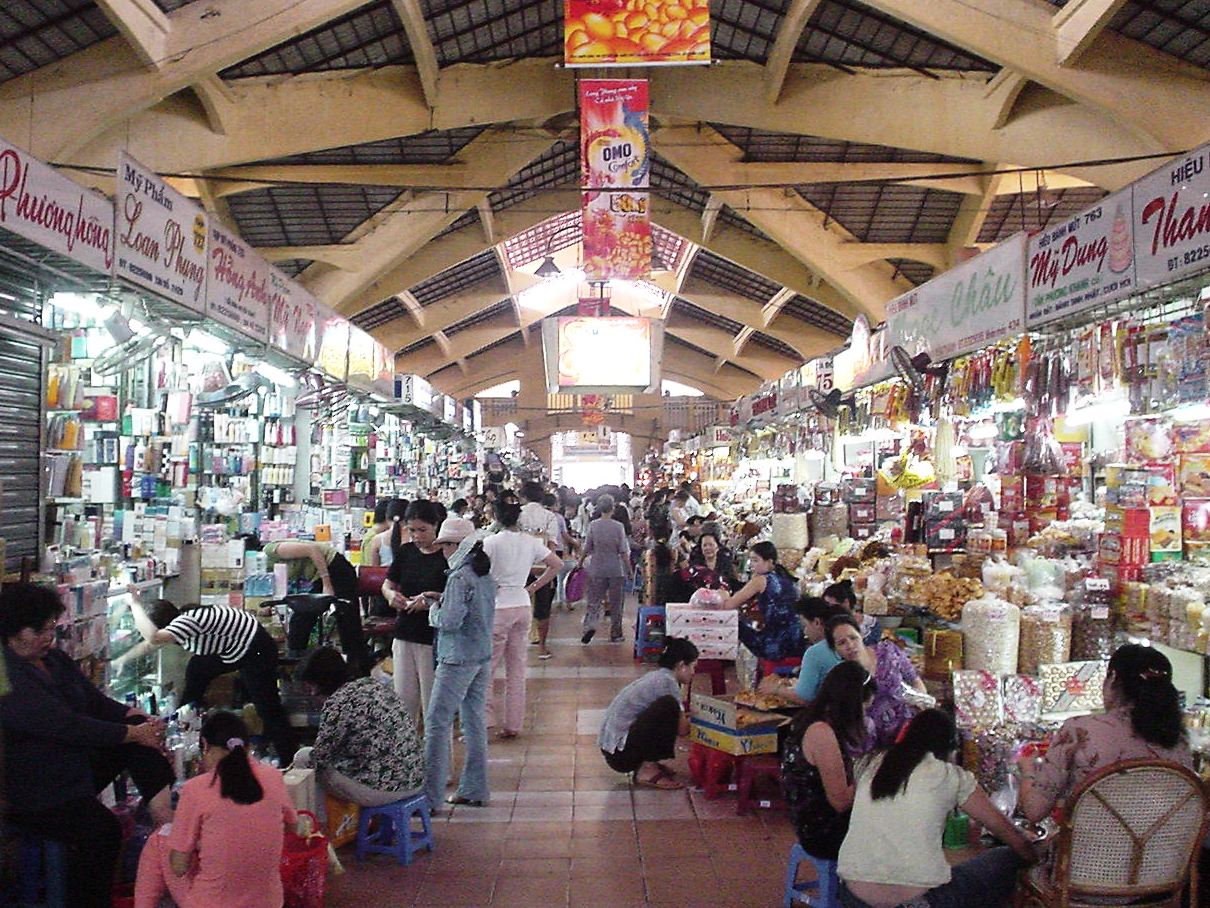
Vietnamese arts and crafts, or mass-produced resin knock-offs thereof, are sold by dozens of shops around the central tourist district. The best, most expensive items can be mostly found on Dong Khoi or the immediate side streets. The goods tend to get progressively simpler and cheaper as you move west toward Ben Thanh Market (though the best wood-carving shop is a stall on the back side of Ben Thanh). A few shops have authentic woven silk textiles from Sapa and the north. Lacquered paintings, plates, bowls, etc., are quite striking and unique to Vietnam. Vietnamese propaganda posters can be very impressive and offer a taste of history. There are two good guide books for shoppers in Ho Chi Minh City: the Luxe City Guide and the MySherpa Guide which also includes a map with shops cross-referenced.
Artworks
Galerie Quynh, 65 De Tham St, District 1 (between Co Bac and Co Giang), ☏ +84 8 3836801. Tu-Sa 10:00-18:00. A serious contemporary art gallery in District 1. Unlike the galleries that focus on more decorative works, this gallery represents innovative local and international artists including Tiffany Chung, Do Hoang Tuong, Hoang Duong Cam and Sandrine Llouquet. (updated Dec 2023) Oil-Paintings, Bui Vien St (near the backpackers area in De Tham and Pham Ngu Lao). There are several shops along this street selling oil paintings. If you want a portrait of a Vietnamese painting or even have your own photograph oil-painted, shop around here. You can get a portrait within a day or two. 450,000-5,000,000 dong.
Eat

You're spoiled for choice in Saigon, which offers the country's largest variety of Vietnamese and international food. Bargains are getting harder to find, however, and restaurant prices have been rising at up to 30% per year due to a combination of higher food prices, rising wages, and soaring real estate costs. Land in the city centre now sells for around US$16,000/m2, so even a modest-sized restaurant sits on real estate worth more than US$1 million. Authentic local food at bargain prices is one of the glories of Vietnam, but it's getting harder to find in Saigon as the city becomes ever more upscale and cosmopolitan. The local food shows influences from French colonial times. Bakeries have fresh and excellent baguettes, which they will fill with cheese (typically of the "La Vache Qui Rit" or "Laughing Cow" brand), potted meat, ham, and onions, or any combination thereof, cheaply. Beef is used in various dishes - whether in any of the many variations of pho, or in a regional specialty such as "bun bo hue" or Hue beef soup. Be sure to try, aside from pho, dishes such as the above-mentioned Hue beef soup, or "banh xeo". Vietnamese savory crepes, consisting of a delicious filling of your choice (various options included bamboo shoots and enoki mushrooms, along with meat, prawns, or both) in a crispy outer crepe-like casing. The Chinese community has also left their mark in Ho Chi Minh City, and the neighbourhood of Cholon continues to have a large number of ethnic Chinese residents, making it a natural place to go to for some Chinese food, though much of it has been adapted to suit Vietnamese palates. That being said, Chinese food is fairly popular among many upper class Vietnamese, so there are also many upscale Chinese restaurants throughout the city. For halal food, seek out the alleyways off Duong Ba Trac street in District 8 around the Jamiul Anwar Mosque, where there are a large number of Muslim Cham residents, and numerous food stalls selling halal versions of popular Vietnamese street dishes to cater to that community. A more centrally-located area would be Nguyen An Ninh Street near Benh Thanh Market, where there are numerous halal Malaysian and Indonesian restaurants catering to expatriates from those countries. Local food at bargain prices is very easy to find in Saigon. Banh mi thit (pork sandwiches) can cost as little as 10,000-15,000 dong. Com tam, a plate of rice with grilled pork (or with different meats) and a bit of vegetables for 18,000 dong.
Street food
1 Ben Thanh Market, Lê Lợi. It's a rather touristy market where you still can enjoy the most authentic Vietnamese pho. (updated Aug 2022) 2 Bánh Mì 37, 185 6-8, Phường Phạm Ngũ Lão. Absolutely delicious even though a bit different than the traditional. Popular among locals, there might be a queue. (updated Aug 2022)
Budget
Food stalls are scattered all over the city, but there's a fair collection in the Ben Thanh market (see Buy). For local fast food, try the ubiquitous Pho 24 chain (though it can be more the twice the price of local fare). The setback of eating street food or food prepared in holes-in-the-wall in any town or city in Vietnam is dodgy hygiene. Street hawkers are not only cooks but they are also cashiers. They touch money and often flip over the notes with their fingers moistened with their saliva. If a bun or baguette is dropped in the pavement, it is picked up to be mixed with the rest. A hawker may cough or sneeze and while preparing food, cover their mouth with their bare hands then resume what they were just doing. Food may have unwanted items such as hairs. Utensils may be washed from the same portable ice-cream container washing basin, without detergent. Debris on spoons are just wiped off from the water on that small dish. Drinking glasses may just be dunked two or three times and ready for the next user. At holes-in-the-wall, if there is shortage of counter space, contained food is placed on the floor. Floors are mostly wet and muddy. Utensils are washed on the floor itself. Waiters tossed used chopsticks and other dishes like bowls and if they don't get in the tub, they fall to the floor to be picked up later. Vegetables and meat parts are also cut in the floor and if they fell off, they are picked up again. Big quantities of vegetables are placed in plastic buckets and cleaned in the toilet tap. The plastic buckets may have been used as bathing or toilet flushing pail. And when they are not used, they may be stacked together and stored in the toilet. However, street food and holes-in-the-wall food are flavourful, fascinating, exotic, ingeniously contrived, and cheap with all the elements of the nutrition pyramid and all the flavours: sweet; sour; salty & hot are well represented. Despite the vastly lower prices, street food is often tastier and more flavourful than the same dishes when served in the posh hotels or tourist restaurants.
Drink

Coffee
Vietnam is the world's second largest exporter of coffee after Brazil, and cà phê is very popular among the Vietnamese. It's a paradise for coffee-loving visitors. The local style is strong and sweet; key words to remember are: sữa (sweetened condensed milk), đá (ice), and nóng (hot, pronounced "nowm"). Cà phê đá is strong, sweet iced coffee; and cà phê sữa đá is the same with condensed milk. Cà phê (sữa) nóng is brewed fresh on your table brewed in a little metal apparatus placed over a cup; just lift it off when it has cooled enough to touch (and hence drink). Prices range from 10,000 to 20,000 dong for coffee in the local style. Since ice might or might not be made with purified water, strictly cautious visitors should avoid it, though long-term residents consume ice from reputable cafes and restaurants all the time. Espresso, cappuccino, and American-style filter coffee are now also widely available in the tourist district, usually at 2-8 times the price of the local style. You will be able to differentiate the better places if they use UHT milk as opposed to condensed milk.
Bobby Brewery Coffee, Bui Vien St. Nice place with good beverages. Used to show movies on 2nd and 3rd floor. Now reopened as La Cantina. Cafe 5 Sao, Pham Ngoc Thach (Near the Turtle Pond). Plays loud techno music. Attractive, but pretentious crowd. Cafe Napoly, Pham Ngoc Thach (Near the Turtle Pond). The decor is Roman ruins-lite (they meant "Napoli"), but the menu is typical for an upscale Vietnamese cafe: coffee, fruit drinks, ice cream, and a simple menu including eggs and rice dishes. Piped music is nice, not too loud by day (though louder at night), prices are decent. Outdoor terrace in the front, air-con section on the ground floor, and evening lounge-bar on the upper floor. Next door to the louder, more trendy and possibly pretentious Cafe Nam Sao. Cafe Saigon, 57 Nguyen Du St (Opposite to Immaculate Conception Cathedral Basilica), ☏ +84 9378 66066. Italian coffee, foods, free Wi-Fi, relaxing & modern music. Chao Ba Ca Phe (Granny's Coffee), TK49/5 Nguyen Canh Chan, Q1 (Walk down Nguyen Canh Chan from the junction with Tran Hung Dao and take a left down the alleyway where the fruit salad restaurant is). This place has a really authentic and wonderful cafe sua da served by the famous "grandma" for about 8,000 dong. A little tricky to find. Chot Nho Café, 189 Nguyen Van Troi, Phu Nhuan District (10 min by taxi from city centre). Reasonable prices, good menu. Free Wi-Fi. Fresco Coffee, 121 Le Loi St, ☏ +84 838 211 009. Free Wi-Fi, play hill song music. Givral Café, Dong Khoi (Opposite Continental Hotel). In the French tradition, with fresh pastries, collared waiters and elaborate portions of ice cream. Well-located, but over 20,000 dong for the simplest cup. Hideaway Café, 41/1 Pham Ngoc Thach, Q.3. As its name implies, this place is hidden away and a good place to read, or have a quiet conversation or meal. Decent Western menu, although slightly pricey. Highlands Coffee. Highlands Coffee is a Vietnamese chain that is ubiquitous in Ho Chi Minh City. They offer a variety of coffee drinks reasonably priced (25,000-60,000 dong, depending on your order) with consistent quality. M-Comic, 99B Vo Thi Sau A. A rather hard to find coffee shop. Upstairs is like a bedroom with a couple of beds. Arrive early if you want to occupy one. It has a large selection of magazine and comic books to choose from. Only serves Vietnamese drinks, and the staff only speak a little English. Free Wi-Fi. 11,000-30,000 dong. Old Saigon Coffee, 2nd floor, 63 Dong Du St, District 1 (Opposite the Sheraton). Reminiscent of HCMC in the past. It has a great view of Dong Khoi St. All the drinks and foods are typical Saigon. The staff are quite decent. Regina Coffee, 84 Nguyen Du St, District 1. Vietnamese coffee or cappuccini. They have a skilled Japanese espresso master who knows how to brew coffee. French mixed with Asian design with brick walls. It is marketed towards tourists and all proceeds go to the church around the corner. Trung Nguyen (Two convenient outlets are on the east side of Nguyen Hue right before the People's Committee Hall, and the corner of Thu Khoa Huan and Ly Tu Trong). The Vietnamese version of Starbucks, but with much better coffee. They have locations all over the city, but are not well represented in the heart of the tourist district. Prices start around 40,000 dong for a basic cuppa, although there are plenty of variations including the infamous weasel coffee (cà phê chồn), made from coffee beans collected from civet excrement; however, a quick Google search about the conditions in which the civets are kept may further dissuade some from sampling.
Alcohol
Saigon has plenty of places to drink, although to a certain degree Vietnamese and foreigners tend to frequent different spots — something that is slowly changing. Places with live music usually have no cover charge but somewhat elevated drink prices (typically 55,000–85,000 dong for beer, spirits, and cocktails). Many places close around midnight or 01:00. Some places remain open later: Go2 Bar in Pham Ngu Lao is popular with backpackers; Apocalypse Now on Thi Sach St draws a mixed crowd and stays open late; ZanZBar on Dong Du St appeals to the regular bar crowd with a closing time that varies depending on the night. There are other late-night clubs catering almost exclusively to young Vietnamese. Vietnamese bottled beer spots can be found throughout the city and typically stay open until 03:00–04:00, and several bars in Phu My Hung stay open until 02:00–03:00. Not to be missed are the pavement bars which get very busy with locals and travellers alike, about halfway down Biu Vien. They sell bottles of Saigon beer for 10,000 dong. Sit on the tiny plastic chairs and enjoy the friendly atmosphere. These are perhaps the best places to drink as a backpacker, as they are very cheap and also great places to meet people, and not just other tourists.
Sleep

Most hotels do not allow you to bring back a local female companion to stay overnight. However it's best to confirm guest policy as plenty of non-international chain hotels allow guests.
Budget
The main backpacker hangout is Pham Ngu Lao in District 1, just a short walk (10-15 min) from Ben Thanh Market. The lanes and alleys in the area between Pham Ngu Lao and Bui Vien are jammed with 5-10 room mini-hotels offering prices around US$15 per room (air-con with hot shower and cable TV). There is no difference in price between single or double occupancy so if you are traveling alone you might want to try finding a dorm bed for around US$6 (but there are not many of them around.) Keep heading southwest away from the backpacker hustle closer Ng Thai Hoc, you'll likely find that as the alleys get smaller the rooms get quieter and owners more friendly. The area swarms with touts and other nuisances. The area is not the safest, and it'd be wise not to run around carrying something like an expensive DSLR camera, thereby making yourself a target for thieves.
An Phuong 2, 295 Pham Ngu Lao, District 1 (across from where buses drop tourists), ☏ +84 8 920 5509, +84 8 836 9248, anhphuong2@yahoo.com. A friendly family-run guesthouse, very clean and homely. Free Internet, cheap laundry and all rooms have double glazing. USD15. Blue River Hotel, 283/2C Pham Ngu Lao, District 1, ☏ +84 8 3837 6483, +84 903 679994 (mobile), blueriver1126@yahoo.com. Amazing small hotel in an alley off Pham Ngu Lao. They can arrange an airport pickup for USD15, although an official taxi from the airport counter will cost USD8. Some staff members speak English and the service is good. USD25 for a room without a view. USD30 for a room with a view that may or may not have a balcony. Dai Huy Hoang Hotel, 283/22 Pham Ngu Lao, District 1 (in a small quiet alley that links Pham Ngu Lao and Do Quang Dau. Coming from Pham Ngu Lao the alley is next to the Canadian Hotel), ☏ +84 8 3837 0677, daihuyhoang06@yahoo.com. Comfortable rooms with air-con, fan, free Internet and breakfast. Friendly staff. USD13-20. Diep Anh, 241/31 Pham Ngu Lao St, District 1, ☏ +84 8 38 367920, guesthouse.diepanh@gmail.com. Very friendly owners. Rooms with air-con, refrigerator, cable TV, en suite bath, and Wi-Fi. Very reasonably priced minibar. USD10-30. Duna Hotel, 167 Pham Ngu Lao, District 1, ☏ +84 8 8373-699. All rooms have air-con, satellite TV, a fridge, elevator. Pleasant staff. The front door is locked around 23:00-24:00. From USD12 for a single room with no window to USD30 for a triple with a window facing the street.. Hanh Hoa Hotel, 237 Pham Ngu Lao, District 1, ☏ +84 8 38372361. Vietnamese styling, with bamboo interiors, rattan beds and wooden floors. Hotel Bi Saigon, 185/26 Pham Ngu Lao, District 1 (in alley #185), ☏ +84 8 836 0678. Clean, comfortable, and terrific staff. In-room Internet access for USD3/day. The lobby houses the La Table de Saigon restaurant. Double USD27. Ly, 84/24B Bui Vien, District 1 (A small alley off Pham Ngu Lao St), ☏ +84 8 3836 4794, hanhbtx@yahoo.com. Family-run guest house with friendly staff who speak English. Air-con, hot water, cable TV with international channels, baggage storage, laundry service, big beds. with balconies. USD10-15. Ly Loan, 241/11/2 Pham Ngu Lao, District 1 (grom airport take a taxi to Pham Ngu Lao St (7 km) and enter Alley 241 (between Liberty 4 Hotel and ABC Bakery), 15 m into the alley, turn left), ☏ +84 8 837 0067, phphuong90@yahoo.com. Family-run guest house in a small, safe, quiet alley. Some English is spoken. Rooms are spacious and nicely furnished. With air-con, hot water, big beds and some with balconies. Free Internet and Wi-Fi. USD16. 1 Mai Guest House, Hem 104 Bui Viên or 241 /41 Phạm Ngũ Lão, District 1, ☏ +84 8 5559 3898. Friendly family. Tucked in a side alley from Pham Ngu Lao or Bui Viên next to My Home Guest Home. Small balcony. Clean apartments with aircon and Wi-Fi. 15,000 or 30,000 dong per kg for 24 hr or express laundry. Doubles USD12, doubles with balcony USD15. My Home Guest House, 241/43 Pham Ngu Lao, District 1, ☏ +84 8 5559 3898, myhome.roomforrent@gmail.com. Friendly staff and clean. The buses from up north drop you right near this hostel. Air-con, hot water, comfortable beds, free Wi-Fi. Free bananas at all times and they do laundry. Tourist bars and clubs are a couple hundred metres away. Singles USD12, doubles USD18, triples available. Nam Chau, 171/2 Co Bac St (Near Co Giant St), ☏ +84 8 3837 0294. Nice and very clean. USD10-15. Galaxy Boutique Hotel, 269/19 De Tham Street, Pham Ngu Lao Ward, District 1, ☏ +848 38386995. Ngoc Minh Hotel, 283/9 Pham Ngu Lao, District 1. Clean hotel with friendly staff, free Internet and Wi-Fi. Elevator. 5 storeys, garden on top floor and free breakfast. From USD20. 2 Nguyen Khang Hotel, 283/25 Pham Ngu Lao, District 1 (in a small quiet alley that links Pham Ngu Lao and Do Quang Dau; coming from Pham Ngu Lao the alley is next to the Canadian Hotel), ☏ +84 8 837 3566, nguyenkhanghotel@yahoo.com.vn. Check-out: 12:00. Good staff, free Internet with PC in lobby and Wi-Fi in rooms. Free breakfast served on the ground floor from 07:00-10:00. Clean, tastefully simple in decoration, rooms are rather small but have air-con, fan, TV, fridge, and those at the front have large windows. Visa and Mastercard accepted. USD10-20. PP Backpackers, 283/41 Pham Ngu Lao (in an alley off PNL along with various other guest houses and hotels), ☏ +84 1262501823, duncan11poolton@hotmail.com. Run by a friendly Englishman, offers clean dorms and rooms, can book tours and offers a big breakfast for USD1. Dorm USD6. Rainbow Hotel, 283/5 Pham Ngu Lao, District 1, ☏ +84 8 836 0039. Large, bright albeit somewhat worn rooms, and those at the front have a nice view. From USD15. Tam Anh Guesthouse, 241/21 Pham Ngu Lao, District 1, ☏ +84 8 3837 0756, tamanhhotel@gmail.com. A clean and secure family-run guesthouse. Good air-con, free Wi-Fi. USD15. Tan Dat My Hotel, 81-83 Ong ich Khiem, District 11 (about a 15-min taxi ride to District 1), ☏ +84 8 3963 4424. Large rooms with a view, air-con, Wi-Fi, fridge, cable TV and a free rooftop breakfast next to the Dam Sen Park. French bakery 30 m away. American-style supermarket 10 min walk on the same street. USD17. Thanh Guest House, 84/9 Bui Vien, Pham Ngu Lao, District 1, ☏ +84 9 318 8588, nicolassang02@gmail.com. Warm and friendly guesthouse. Lobby inside the house with comfy sofa, cable TV and Internet. Free Wi-Fi throughout. Trips and tours can be booked at reception. USD12-18. Thien Hong Hotel, 241/34 Pham Ngu Lao, District 1 (in one of the small alleys running between Pham Ngu Lao and Bui Vien), ☏ +84 8 3920 6078. Helpful and friendly owners, free Wi-Fi, TV in rooms with many channels including international. Air-con room with no window, USD15. Ty Mon, 693 Nguyen Thi Dinh St, Dist. 2, ☏ +84 86 2870526. Friendly owners, very good basic rooms with air-con, TV, decent furniture and fridge. Very cheap price, mostly used by Vietnamese people. A bit far out from centre. USD8-12. Xuan Spring Hotel, 185/34 Pham Ngu Lao St, District 1, ☏ +84 8 837 2115, manager@springhotel.net. Air-con, refrigerator, cable TV and private bath with hot shower and free Internet. Online bookings. Good service. USD14-17. Mi Linh Hotel, B38A Bach Dang Street Ward 02 Tan Binh District. (5 min walk from HCM Airport), ☏ +84-8-35474139. Check-in: any time, check-out: 12:00. a/c standard double room with own bathroom and cable tv. Free Wifi. a good clean place to stay near the HCM Airport. USD12. (updated Dec 2016) Lee Hostel Home For Backpackers, 40/5 Bui Vien Street (near Fine Arts Museum), ☏ +84-9--3880150. Check-in: From 07:00, check-out: 12:00. 20 bed dorm with air.con and hot water free wifi. free breakfast. Some complaints that they will insist on holding your passport hostage even after you've paid, various other scammy practices. From USD3.50 per person. (updated Feb 2017) Bich Hong Guest House, 171/32 Co Bac District 1, ☏ +84 8 38374260. Fan and a/c double rooms with own bathroom. Fan USD10, a/c USD12. (updated Mar 2017) Kim Loan Guest House, 171/1 Co Bac District 1, ☏ +84 8 38368351. Fan double with own bathroom. USD10. (updated Mar 2017) 4 Guest House Thanh, 171/1E Co Bac District 1, ☏ +84 8 38368469. Fan double room with own bathroom. USD10. (updated Mar 2017)
Stay safe
In general, Ho Chi Minh City is a safe city, with violent crimes such as armed robbery being relatively rare. The most common crimes faced by tourists are pickpocketing and snatch theft from motorbikes. Scam artists operate on the streets of Ho Chi Minh City. A person will strike up a friendly conversation claiming they've either seen you at the airport or some other tourist place where they work. Usually they'll be with other family members who will join the conversation very naturally and once they find out where you're from they'll mention that another family member is moving to a city in your country. You will be invited over for food at their house to help console a worried grandmother or to give advice to their family member. Once you arrive at the house however the family member is not there, or the grandmother has suddenly fallen ill and had to go to the hospital. You'll be presented with various business opportunities, legal or not, or asked for financial support for the suddenly sick grandmother. Hotel scams are very common, even in the mid-range price level US$20-70. The hotel will remind you that you should place your valuables in the room safe or the hotel safe. Lock up everything that is more or less valuable. Don't hold up expensive things near the street or leave them out on the table while you're having a meal, especially in District 1, especially around the backpacker area. Petty theft is a big problem, and a lot of times it's done by people on motorbikes. It's easy to prevent by not giving thieves the opportunity. Don't buy SIM card before the immigration at the airport, they will charge you US$10 for a SIM card. After immigration and baggage area, you can find sim card booth. They sell SIM card for $6 only. Don't buy coconut more than ~USD2, real-price is ~USD0.5. If you are forced, call police: ☏ +84 8 3829 7643, +84 8 38299835. A favorite trick is for the vendors to strike up a conversation with you, let you hold the carrying-stick, take a picture, and while you're distracted open a coconut for you that you really didn't ask for. Be aware of a common scam where someone approaches you under the pretence of offering sexual services, with the actual aim of pickpocketing. Keep your valuables secure and be wary of strangers getting unexpectedly close.
Medical services
Public hospitals are generally poorly equipped and overcrowded, and staff tend to speak little to no English. As such, foreigners are highly advised to rely on private hospitals instead. The French-run FV Hospital is Vietnam's best-regarded private hospital with treatment standards that are on par with the West, and also staffed by doctors and nurses who are able to speak French and English. Other hospitals that are popular among expatriates include City International Hospital, American International Hospital, Prima Saigon Medical Center, Nam Sai Gon International General Hospital and Vinmec Central Park International Hospital.
Go next
When going to the airport, specify clearly which terminal you want to go to. International flights leave from the newer international terminal (go straight). Domestic flights (to Da Nang, Hanoi, Nha Trang, and so on) are from the domestic terminal (turn left). If you get dropped off at the wrong terminal, you'll have to dash to the correct terminal via a pedestrian walkway link 600 m away. This is not recommended, especially if you're already late for boarding. When entering the airport, taxi drivers will add an airport entry fee of 5,000 dong to your total metered fare. This is not to be confused with the airport departure tax, which should have been included in the price of your airline ticket. If you're booking a bus around the Pham Ngu Lao area, you probably want to consider buying the tickets right at the bus company instead of one of the booking agencies. The FUTA bus line has an office at the corner Pham Ngu Lao / De Tham (orange-green building) and you get the tickets for around two-thirds the price compared to booking in an agency. Avoid booking trips through your hotel as you'll pay a significant surcharge to join the same trips which can be booked at the plethora of travel agents throughout the city.
Can Gio — the virgin mangrove forest 30 km south of the city. Entrance to the park is near Ca Cam Bridge. Can Tho — the biggest city of the Mekong Delta and famous for its floating market, delicious food, and fresh fruits. The name comes from "cầm thi giang", river of poems. The city is also referred to as "Tay Do" meaning "Western capital". Can Tho is 169 km (3 hr) from Ho Chi Minh City. You can get tickets at Le Hong Phong in district 3 and take a free shuttle bus to Ben Xe Mien Tay, where the air conditioned buses leave. Tickets to Can Tho cost around 100,000 dong. Free shuttle buses in Can Tho will take you directly to your hotel. Cu Chi Tunnel — day-trips are tirelessly flogged by travel agencies around Pham Ngu Lao, and can be done as a half-day trip, or as a full-day with a stop at Tay Ninh to see the Holy See of the Cao Dai religion. Tours, including admission, should cost 70,000-110,000 dong, and are available every day of the week. Cu Chi tunnels are about a 1.5-hr drive out of HCMC centre. It's worth taking the trips to see these amazing structures so cleverly carved underground and used for survival during wartime. One way to get to the tunnels is by speedboat. Dalat — popular hill station built by the French, offering a temperate mountainside "European" escape. Consider going via Cat Tien National Park to see wildlife (including primates, rare birds, and crocodiles) and spectacular jungle scenery. Mekong Delta — boat tours are available with an almost infinite mix of itineraries. They can be short overnight trips, leisurely meanders over several nights. A two- or three-day Mekong tour is worthwhile; expect to be shuffled between tour companies along the way. 2-day, 1-night organized trips to the Mekong Delta can cost as little as $US25, including transportation, tour guides, lodging and several meals. Mui Ne — popular beach resort about 4-6 hr away by bus Nha Trang — beach destination reachable by overnight train Tay Ninh — Cao Dai Holy See and Ba Den mountain. Vung Tau — city with good beaches, about 2 hr away by bus, or less by boat along the Saigon River. The boat journey costs 250,000 dong. Phnom Penh — a 6-hr bus journey to the capital of Cambodia ranges from US$10–12 (210,000-252,000 dong). When you pass into Cambodia and the bus stops for 15 min. Do not buy anything from the roadside cafe. Instead, cross the road to purchase drinks or food from the roadside shops, because prices can be up to 50% cheaper than the bus stop cafe. Alternatively you could book a tour with boat and bus, which will have you spending a night in a cheap hotel in Chau Doc before making the trip over the border (cross-border package prices may include visa support, which should cost 360,000-530,000 dong). Bangkok — Thailand's capital and largest city, the main economic hub of continental Southeast Asia, and another foodie's paradise. Some distance away, but often the final destination for overland trips that include stops in Phnom Penh and Siem Reap (near the famed Angkor Wat in Cambodia); see Bangkok to Ho Chi Minh City overland Da Nang — Da Nang is a coastal city in central Vietnam. It is the largest city in the region and is a popular tourist destination. Da Nang is known for its beautiful beaches, stunning scenery, and vibrant culture. Da Nang Spa are a popular way to relax and rejuvenate. There are many different types of spas to choose from, ranging from traditional Vietnamese spas to international spas.
More pictures of Ho Chi Minh City


From this destination's category on Wikimedia Commons. Each photograph is credited to its own author under its own licence.
The guide text on this page is from the Wikivoyage article Ho Chi Minh City, written by Wikivoyage contributors and published under CC BY-SA 4.0. The authors are listed in the article’s edit history. It has been shortened and re-laid-out for this page; that adapted text is available under the same licence. Nothing else on this page is.
Wikivoyage is written by travellers, not by us. Opening hours, prices and whether a place still exists are exactly the details that go out of date, so check anything you are relying on.
“3,208 readers a month” and the ranking are ours, counted from Wikimedia’s published pageviews (CC0) — the median of twelve complete months. They count people reading about a place, which is not the same as people going there.