
Angkor Archaeological Park
Angkor Archaeological Park, near Siem Reap in northern Cambodia, is one of the most important archaeological sites in Southeast Asia. It's also known for celebrating the engineering of the world's first hydraulic city and was the largest pre-industrial city on Earth, covering roughly 3,000 square kilometers.
Most read about in January, least in March. That is when people look it up, which tends to run a month or two ahead of when they go.
Before you book
The Foreign, Commonwealth & Development Office publishes the UK’s official travel advice. It changes without notice and travelling against it usually invalidates your insurance, so read it at the source rather than anywhere else — including here.
FCDO travel adviceUnderstand

Stretching over 400 km2, including forested area, Angkor Archaeological Park contains the magnificent remains of several capitals of the Khmer Empire of the 9th to the 15th centuries, including the largest pre-industrial city in the world. The most famous are the Temple of Angkor Wat and, at Angkor Thom, the Bayon Temple with its countless sculptural decorations. Angkor Archaeological Park was declared a UNESCO World Heritage site in 1992. At the same time, it was also placed on the List of World Heritage in Danger due to looting, a declining water table, and unsustainable tourism. UNESCO has now set up a wide-ranging programme to safeguard this symbolic site and its surroundings. Angkor has no accommodations and few facilities; the nearby town of Siem Reap, 6 km south, is the tourist hub for the area. You will likely be refused entry to certain sites, such as the highest tier of Angkor Wat, if you are deemed not to be dressed appropriately. This means your shoulders and knees should be covered: a scarf over your shoulders may not be accepted.
Symbolism
The temples of Angkor are highly symbolic structures. The foremost Hindu concept is the temple-mountain, where the temple is built as a representation of the mythical Mount Meru: this is why so many temples, including Angkor Wat, are surrounded by moats, built in a mountain-like pyramidal shape and topped by precisely five towers, representing the five peaks of Mount Meru. The linga (phallus), representing the god Shiva, was also critical and while the lingas themselves have largely gone, linga stands (carved, table-like blocks of stone) can be found in many if not most rooms in the temples. There was also a political element to it all: most kings wanted to build their own state temples to symbolize their kingdom and their rule. While early Angkor temples were built as Hindu temples, Jayavarman VII converted to Mahayana Buddhism c. 1200 and embarked on a prodigious building spree, building the new capital city of Angkor Thom including Bayon, Ta Prohm, Preah Khan and many more as Buddhist structures. However, his successor Jayavarman VIII returned to Hinduism and embarked on an equally massive spree of destruction, systematically defacing Buddhist images and even crudely altering some to be Hindu again. Hinduism eventually lost out to Buddhism again, but the (few) Buddha images in the temples today are later Theraveda additions. One element that continues to mystify archaeologists is the baray, or water reservoir, built in a grand scale around Angkor: for example, the West Baray is a mind-boggling 8 km by 2.3 km in size. While it has long been assumed that they were used for irrigation, some historians argue that their primary function was political or religious. Not a single outlet has been found, either by eye or by NASA imaging. The moat around Angkor and the West Baray still contains water, but the rest have dried up.
Motifs
As you tour the temples, you will see certain mythical figures and other motifs cropping up repeatedly.
Getting there

Angkor is about 20 minutes to the north, by car or motorbike, from central Siem Reap. See the Siem Reap article for details on getting to the town. See "Get around" below for details on getting from the town to the Angkor.
Getting around
Generally speaking, two half-day tour options are offered, sun-rise (ends at the hottest time of day) and late morning (which includes sunset). Both last 4-6 hr depending on your tour. Tour buses feature guided, air-conditioned comfort but also are subject to large crowds and lack of options. Be sure you know which temples are being visited as some of the larger buses only go to the 2 or 3 main tourist attractions, and leave out important "secondary" sights. The cost is US$25–70/day including driver and guide. Cars with drivers can be hired for single or more days. While all drivers are familiar with the area and happy to suggest good routes, most speak little English and are not actual tour guides. For an actual licensed tour guide, the charge varies from US$45–50/day for a driver and English-speaking guide. It is customary for the drivers to ask for US$5–10 extra for trips to further temples such as those of the Big Circuit, Banteay Srey and more for remote sites like Beng Mealea. Motorbikes (with drivers) can be arranged through any guesthouse for about US$6–8/day. Again, drivers might ask for more to visit remote ruins. Some drivers can speak a bit of English, and can give you information about Angkor and Cambodian life. Drivers are required to be licensed and must wear their gray numbered vest while travelling within the confines of the Angkor park. The rental of motorbikes without a driver to foreigners in Siem Reap is discouraged and if stopped by a police officer, they will inform you that renting a motorbike is prohibited; this is not completely true. Motorbike rental places do exist in the city and their numbers are increasing. The rate varies depending on the engine size. The cheapest motorbike rental is around US$6 per day for an electric-powered. Gas-powered motorbikes start at around US$8. Always use a helmet because it is required by law and riding without it will give a police officer a reason to flag you down. Not all locals use helmets, but they do avoid being visible to police officers on duty. Tuk-tuks can be arranged through guesthouses, offering space for 1-4 travellers. Figure on ~US$15 for the main Angkor temples, and US$20–30 for outlying temples. Like the motorbike drivers, they must be licensed, may speak some English and must wear grey numbered vests while travelling within the park. Some drivers will add a US$3 extra fee if you would like to see sunrise at Angkor Wat (start the tour at 05:00 instead of 08:00). Bicycles are a very convenient option to visit Angkor Wat and Angkor Thom, the little circuit or even the big circuit - depending on time you have and how big fan of Khmer temples you are. Renting a bike in Siem Reap is easy and cheap (US$3-4 per day, in most of places you aren't even asked to leave your passport, locks for bikes are provided, check the bike before and ask for some amendments if needed, e.g. pumping air, oiling the chain). Most bike rental shops seem to open at 07:00, so if you want to get a really early start, rent a bike the day before, or arrange it with your hotel or hostel. It is about 6 km from the city to Angkor Wat (if you go first time, make sure you go by the Visitors Centre which is the only place where you can buy passes, and isn't on the main road to the temples). In the little circuit most places are at most 15 minutes away from each other by bike, so it is actually not a problem for a regular tourist (without much biking experience) to visit Angkor Wat, Angkor Thom and spots on the little circuit in one day. If you are willing to get up early and start your trip at 06:00 it won't be a problem to visit all above plus the big circuit (where spots are 30 minutes away each other by bike) in one day. Take into account your shape and visiting preferences. If you bike a lot at home - you can easily get around much quicker. If you enjoy Khmer architecture more than the typical Angkor visitor, it is recommended you reserve at least 3 days for the trip (it doesn't matter if you go by tuk-tuk or by bike). It gets hot, so be prepared to sweat buckets! It is a good idea to take a lot of water with you, rent a bike with a basket, but not a big problem if you run out of it during your trip. Around every temple in Angkor park you can buy some food and drinks (it's just more expensive than in the city, about US$2 per big bottle of water in the park). Cycling in Angkor Park is safe (traffic is low), pleasant (nice views and shady trees) and, last but not least, it saves you a lot of hassle of dealing with tuk-tuk drivers. You can't bring the bike onto the island of Angkor Wat, so expect to still be doing a fair amount of walking. Electric cars will take you to certain areas for a round-trip price of only US$2. They can be found in front of Angkor Wat and the Terrace of the Elephants. Helicopter flights are another way of seeing Angkor Archaeological Park. You can also visit outlying temples like Banteay Chhmar, Boeng Mealea, Koh Ker, Rolous Group, Phnom Bok & Tonle Sap floating village. Helistar Cambodia have prices starting from US$90 per person for the basic Bangkeng Mountain, Angkor Wat. Sras Srang, Pre Rup, Eastern Mebon and Ta Som 14-minute tour. Flights depart daily from the Military Apron, Siem Reap International Airport. Bookings essential and can be made through hotels or travel/tour agents or direct on ☏ +855 12 449 555.
See
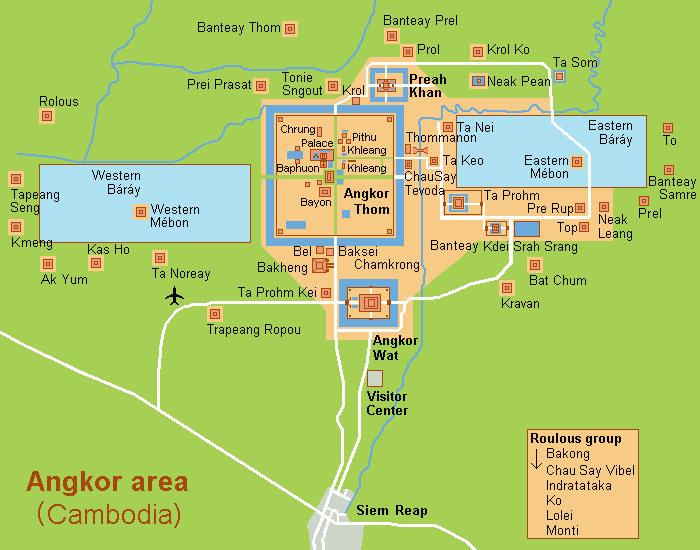
Guides can be hired for about US$20 a day and are available for most major languages. Hiring a guide for at least the first day can help you get orientated to the temples and are particularly useful for finding and explaining the bas-reliefs, which can otherwise be rather overwhelming and/or difficult to understand. Guide books are also useful. Ancient Angkor, a guidebook that is hawked at every temple, is surprisingly good. Particularly if you are interested in the carvings on the walls and towers, the book will keep you occupied for hours. If you don't want to pay money to hear a local tell you about the temples in broken English this is a good option. Authored by Michael Freeman and Claude Jacques, the cover price is US$27.95 at bookstores. Brand new copies are sold by vendors for US$14 but you can easily haggle to US$6 or US$7, and the price amazingly drops to US$1 by the end of the day, even in peak season. The 1 Angkor Panorama Museum, beside the ticket office, is closed (Feb 2020) because of international sanctions against North Korea, which built and operated the museum. Be sure to get to the temples early. You can enter the park beginning at 05:00; the temples open at sunrise. There are fewer visitors early in the morning, and the sun isn't at full force. Arriving at the temples at 08:00 instead of 09:00 can make all the difference in staying one step ahead of the crowds. The temples can broadly be categorized into four groups:
Angkor Wat and Angkor Thom, Angkor Wat is the grandest temple and north of it lies the royal complex of Angkor Thom, which includes Bayon, Bauphon, Terrace of the Elephants and Terrace of the Leper King Little Circuit (Le Petit Circuit), this includes both Angkor Wat and Angkor Thom complex, along with the temples east of Angkor Thom (Ta Kao, Ta Phorm, Banteay Kdei, Sras Srang and Prasat Kravan) Big Circuit (Le Grand Circuit), This includes the major sites north and further east of the Angkor Thom complex and includes Preah Khan, Neak Pean, Ta Som, East Mebon, Pre Rup Roluos group, 15 km east of Siem Reap along National Hwy 6. It includes Bakong, Lolei, Pareah Ko and several other temples Outlying temples, consists of several temples located at a radius of 80 Angkor Wat North: Banteay Srey and Kbal Spean (37 and 45 km respectively from Siem Reap), this can be clubbed with a visit to the Peam So Hoh Waterfall East: Banteay Samre (just east of Angkor complex) and Beng Mealea (80 km from Siem Reap). Beng Mealea can be clubbed with a trip to Koh Ker South: Phnom Krom (12 km from Siem Reap) can be clubbed with can be clubbed with Tonle Sap Lake You can, of course, mix and match freely, but as distances are fairly long, it makes sense to plan ahead and pick sites connected by road. Most car, tuk-tuk or moto drivers will have an itinerary ready if you don't have one in mind, and their expertise may come in handy for arriving at sites a step ahead of the big tour groups.
Angkor Wat
2 Angkor Wat. (updated Jan 2026)
Shopping
Souvenirs are also sold in front of all temples. Bargain, but not too hard: many souvenir sellers live within the park and, being banned from farming on their own land, have to resort to this to make a living. Please do not encourage children who pester tourists in the temples themselves to give money or buy postcards. Spread your tourism dollars around—most temples have the same offerings, so buy your souvenirs and gifts for friends back home from several shops, from several temples if possible, especially the less-visited ones. Ancient Angkor, a guidebook that is hawked at every temple, authored by Michael Freeman and Claude Jacques; the cover price is US$27.95 at bookstores. Brand new copies are sold by vendors for US$14 but can be sold for as little as US$1 in the afternoon without haggling. Alternatively, the book is available for rental online for free through the Internet Archive. The guidebook is detailed, and remains the best introduction to the temples that you can find. There are several decent souvenir shops around the old market. One of the shops called "Black Garuda" has some original key holders and mobile straps and they donate some of your purchase to land mine victims.
Eat
Despite a ban on development and commercial activity, dozens of small noodle and snack shops have sprung up near the major attractions of Angkor Wat and Angkor Thom. The listed prices are high (US$4–7 for mediocre food), but shopkeepers may be willing to bargain. During summer low season, you can bring the price of a good lunch down to as low as US$1 for a dish and US$0.50 for a drink. Their flocks of five year old emissaries aren't likely to hold price-cutting authority. However, avoid hard or aggressive bargaining, either because the odd dollar is nothing to you but can be significant to a local, and also it is unwise to offend or upset anybody before they prepare your meal! You'll also find some local people selling fresh pineapples and mangoes (beautifully cut) and bunches of little bananas for about US$1 a piece. Also try the seasonal toddy palm fruit, a hollow sack as soft as jelly at 4 pieces for US$1 sold at the roadside to Bantay Samre and at temple refreshment stalls. If a tuk-tuk driver brings you to a restaurant, he gets a commission – which means you'll be paying more for the meal and it won't be easy to bargain. Try to find a restaurant yourself and it'll be much easier to get an inexpensive meal.
The modern Angkor Cafe lies just outside Angkor Wat's main entrance, and also doubles as a crafts shop, with fine works from the Artisans d'Angkor shop, where they train locals in the arts. Their prices are on the high side for Cambodia, but very reasonable for Western pockets (mainly US$3–5) with excellent food, nice decor and air conditioning.
Drink
Soft drinks are hawked by stalls in front of practically every temple. As you might expect, prices are inflated: US$1 for a can of soft drink look to beer, or two cold 500-ml bottles of water is more or less standard; $2 is not uncommon (Feb 2020). In warm weather, the temples are extremely hot and it may be worth buying and carrying large bottles of water.
Sleep
There are no accommodations within the park, and camping is not permitted. Like most tourists you will find yourself staying in Siem Reap, with a multitude of options ranging from grubby little guest houses to upmarket hotels and villas. See Siem Reap for more details on accommodation options.
Local customs
Some of Angkor's sites were built as Hindu temples, while some were built as Buddhist temples, and yet others were converted over the years. Today, most of Angkor's major temples house at least a few Buddha statues (nearly all added later) and draw a steady stream of monks and worshippers. You may be approached for donations, but these are likely to be scammers, as genuine Theravada Buddhist monks are not allowed to touch money or solicit donations. Because these are still holy spaces for Cambodians, you are asked to follow the dress code that the Cambodians follow when visiting any temple or holy space, meaning "long trousers or skirt, and covered shoulders." As of May 2019, a ban on exposed shoulders is being strictly enforced for the uppermost level of Angkor Wat, and possibly in some other spots too. Covering your shoulders with a scarf is not accepted, but you are of course welcome to buy a T-shirt from vendors just outside the temple. In other locations very near to active shrines of worship, you may be politely asked to leave if you don't conform to the dress code, but in most areas of the park, no one will say anything.
Stay safe
By local regulation, motorcycle and tuk-tuk drivers must at all times wear a numbered vest when on the job, which goes a long way towards preventing hassles and scams. However, a disturbing number of rapes continue to happen, especially after dark and in the more secluded temples, so it's advised that women not travel alone. Visiting the temples, beware of off-duty police officers, in uniform, who start walking beside you and start showing you around the temples. At this point either say that you would like to see the temples yourself, or agree on a price at the start. Several people have been charged a fee of over US$10 at the end of the temple tour and you are not going to argue with a member of the police force. The official wage for a police officer is very low, so they can easily double their salary by being tourist guides. Beware of anyone offering you incense. They will hand you the incense and then "teach" you a blessing. They will then ask for a donation (generally about US$10) for the monks and the upkeep of the temple. None of the funds will make it to either of these causes, so it's best just to say a quick "No thank you" when they try to give you the incense in the first place. Tourists mulling over whether to rent a tour bike: have no fear. Parking is never a problem and not in the warden's wildest dream that a bike parked besides an attraction will get lost or stolen, locked or not. In small temples it surely is easy to park and leave. Bikes are parked across the west entrance and vendors will even compete for your attention to babysit your bike. During biking trip be aware of children standing by the roads in Angkor Park and raising their hands to give you high fives. Stay on the safe side and just wave your hand, as sometimes they try to take a ring off your fingers when you give them a high five. Be prepared for vast numbers of peddlers who linger around temples. It may feel difficult or rude to ignore the constant come-ons to buy souvenirs, photocopied guidebooks, T-shirts, and assorted junk, but it can be necessary in order to enjoy your visit in semi-peace.
Touring the temples is a hot and sweaty job, so bring sunblock and keep yourself well hydrated. Some of the temples, notably the uppermost level of Angkor Wat, require climbs up very steep staircases and are best avoided if you suffer from vertigo or are not fully confident of being able to keep your footing. Malaria is not endemic around the temple complex; however, it is recommended to seek medical advice before you travel as conditions may change. Don't feed or approach the monkeys who lurk around some sites: many are ill-tempered and will bite at the slightest provocation, and will often attempt to steal anything they can get their hands on. If a monkey jumps on you, stay calm, and do not make any sudden movements until it climbs off you, as moving rapidly is a great way to get bitten.
More pictures of Angkor Archaeological Park


From this destination's category on Wikimedia Commons. Each photograph is credited to its own author under its own licence.
The guide text on this page is from the Wikivoyage article Angkor Archaeological Park, written by Wikivoyage contributors and published under CC BY-SA 4.0. The authors are listed in the article’s edit history. It has been shortened and re-laid-out for this page; that adapted text is available under the same licence. Nothing else on this page is.
Wikivoyage is written by travellers, not by us. Opening hours, prices and whether a place still exists are exactly the details that go out of date, so check anything you are relying on.
“630 readers a month” and the ranking are ours, counted from Wikimedia’s published pageviews (CC0) — the median of twelve complete months. They count people reading about a place, which is not the same as people going there.